

Table of Contents
- 1. The 50/30/20 Budgeting Rule
- 2. Automated Savings and Pay-Yourself-First Strategy
- 3. The Zero-Based Budget Method
- 4. High-Yield Savings Accounts and CD Laddering
- 5. The Envelope/Sinking Fund Method
- 6. Utilizing Technology and Apps to Automate Savings
- 7. Debt Payoff Strategies (Snowball vs. Avalanche)
- 8. Tracking Expenses and Cost-Cutting Audits
- 9. Building and Maintaining an Emergency Fund
- 10. Strategic Negotiation and Shopping Around for Services
- Top 10 Money-Saving Strategies Comparison
- Turning Tips into Lasting Financial Habits
This blog post may contain affiliate links. As an Amazon Associate I earn from qualifying purchases.
Navigating your financial journey can feel overwhelming, but achieving stability and freedom is more accessible than you might think. It begins with adopting smart, sustainable habits that transform your relationship with money. This comprehensive guide moves beyond generic advice, offering a curated roundup of the best money saving tips to help you build wealth, eliminate debt, and gain control over your finances. We have compiled the most effective, actionable strategies designed for real-world application.
The aim of our blog is to provide valuable insights and practical tips to help readers manage their money more effectively. However, the information shared here is for general guidance and educational purposes only. It should not be regarded as professional financial advice. Any actions taken based on our content are entirely the responsibility of the reader, and we accept no liability for the outcomes of those actions. If you require financial advice tailored to your personal circumstances, we strongly recommend seeking assistance from a qualified financial adviser.
This is not a collection of vague platitudes; it's a blueprint for tangible results. Each strategy is broken down into a clear, easy-to-follow format, complete with practical implementation steps, concrete examples, and common pitfalls to avoid. You will learn how to automate your savings, choose the right budgeting method for your lifestyle, and make your money work harder for you through tools like high-yield savings accounts. Whether you're just starting to manage your finances or looking to optimize an existing plan, these proven tips offer a direct path toward a more secure and prosperous future. We will explore powerful techniques like the 50/30/20 rule, the zero-based budget, and strategic debt repayment plans to help you escape financial worries and achieve your long-term goals.
1. The 50/30/20 Budgeting Rule
One of the most effective and best money saving tips for creating financial stability is to adopt a clear, simple framework for your money. The 50/30/20 rule is a foundational budgeting method that divides your after-tax income into just three categories, making it easy to manage without getting lost in complex spreadsheets. This approach, popularized by figures like Elizabeth Warren, provides a balanced structure that ensures you cover essentials, enjoy life, and consistently build your wealth.
How It Works
The rule simplifies your budget by allocating your income proportionally:
- 50% for Needs: This category covers your absolute essentials. Think of things like rent or mortgage payments, utilities, groceries, transportation to work, and insurance premiums.
- 30% for Wants: This is for your lifestyle choices and non-essential spending. It includes dining out, entertainment, hobbies, streaming subscriptions, and vacations.
- 20% for Savings and Debt Repayment: This crucial portion is dedicated to your financial goals. It covers contributions to an emergency fund, retirement accounts (like a 401(k) or IRA), investments, and paying down high-interest debt beyond minimum payments.
For instance, if your monthly take-home pay is $4,000, you would aim to allocate $2,000 to needs, $1,200 to wants, and $800 toward savings and debt repayment. This structured approach helps prevent overspending on "wants" while guaranteeing progress toward financial freedom.
Quick Implementation Steps
To get started, track your spending for one month to see where your money currently goes. Use a budgeting app like Mint or YNAB to automatically categorize transactions and visualize your spending habits against the 50/30/20 targets. Remember to review and adjust your budget quarterly or whenever your income or major expenses change. Improving your money management skills is key to making this rule work for you. For more insights, you can explore detailed guides on this subject. Learn more about the 50/30/20 Budgeting Rule on collapsedwallet.com.
2. Automated Savings and Pay-Yourself-First Strategy
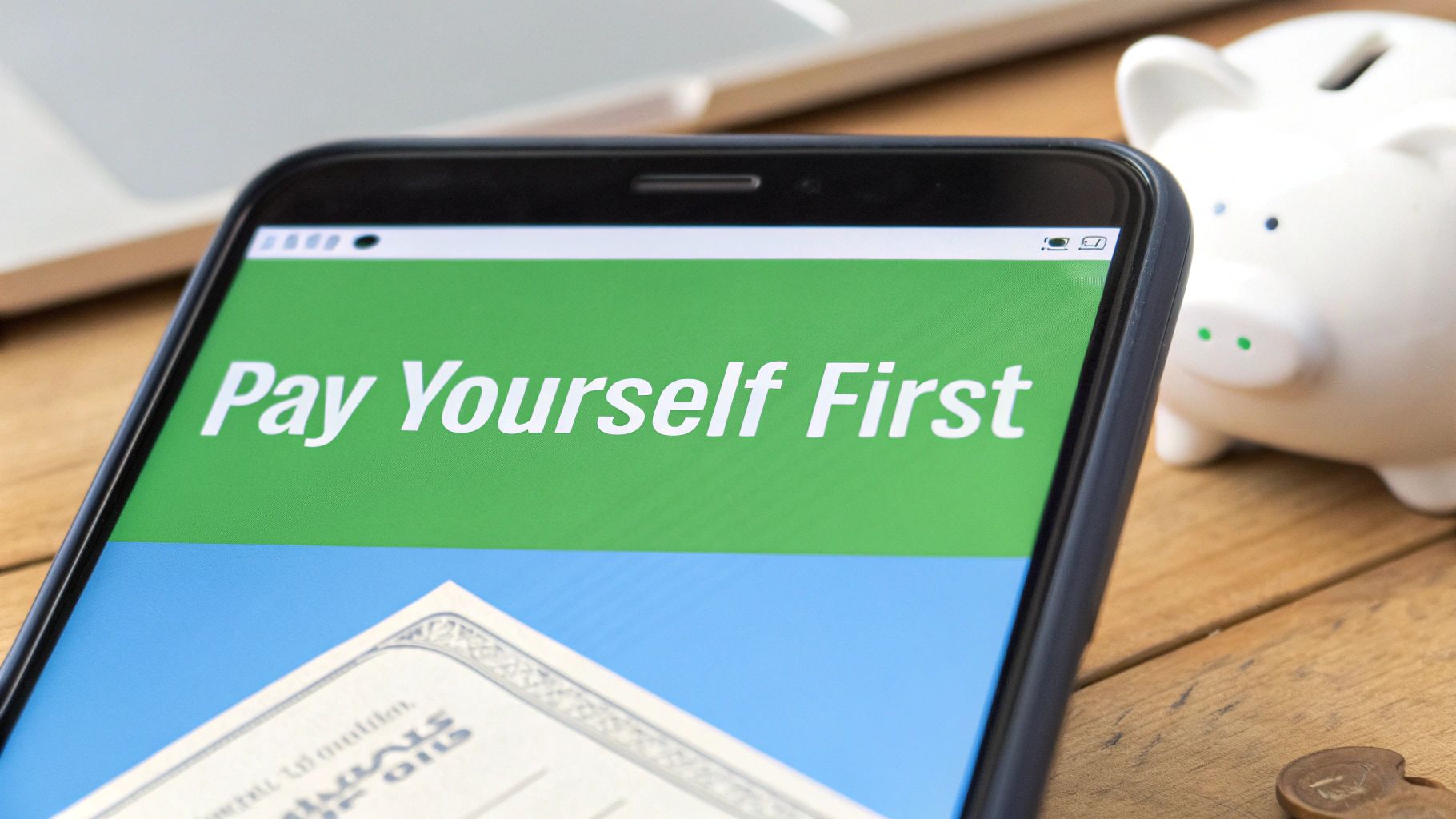
One of the most powerful and best money saving tips is to remove the element of willpower from the equation. The "pay yourself first" strategy does exactly that by automating your savings. This principle, advocated by financial experts like Suze Orman and Robert Kiyosaki, involves treating your savings as a non-negotiable bill. A predetermined amount is automatically transferred from your checking account to your savings or investment accounts as soon as you get paid, before you have a chance to spend it on anything else.
How It Works
This method leverages behavioral finance by making saving the default option, ensuring consistent progress toward your financial goals without daily discipline. It works through simple, scheduled transfers.
- Set It and Forget It: You instruct your bank or payroll provider to automatically move a specific amount or percentage of your income to a designated account.
- Builds Wealth Passively: This system turns saving into a habit that works in the background, whether you're building an emergency fund, saving for a down payment, or investing for retirement.
- Reduces Temptation: By moving the money out of your primary spending account, you are less likely to impulsively spend it.
For instance, an automatic transfer of $500 per month into a high-yield savings account will accumulate $6,000 in just one year, plus interest. Similarly, direct 401(k) contributions from your paycheck reduce your taxable income while building a nest egg for the future, making it a highly efficient savings tool.
Quick Implementation Steps
Getting started is straightforward and can often be done online in minutes. First, decide on a realistic savings amount, even if it's small to begin with. Then, log into your online banking portal or contact your HR department to set up recurring transfers or split your direct deposit. Schedule the transfers to occur the day you get paid to ensure the money is saved before it's spent. Consider opening a separate savings account at a different bank to make accessing the funds less convenient. For a deep dive into building financial security, you can explore guides on this subject. Learn more about the pay yourself first method on thebalance.com.
3. The Zero-Based Budget Method
For those who want complete control over their finances, the zero-based budget method is one of the best money saving tips available. This hands-on approach requires you to assign a job to every single dollar you earn, ensuring that your income minus your expenses equals zero. Popularized by financial experts like Dave Ramsey, this method forces intentionality, turning mindless spending into conscious financial decisions and ensuring no money is wasted or unaccounted for.
How It Works
The core principle of a zero-based budget is simple: every dollar has a purpose before the month begins. You start with your total monthly income and subtract all your planned expenses until the remaining balance is zero. This includes everything from fixed bills to variable spending and financial goals.
- Fixed Expenses: Rent/mortgage, loan payments, insurance.
- Variable Expenses: Groceries, utilities, transportation, entertainment.
- Financial Goals: Savings contributions, extra debt payments, investments.
For example, with a $4,000 monthly income, your budget might look like this: $1,200 for rent, $500 for groceries, $300 for transportation, $400 for utilities, $600 toward savings, and $1,000 for all other categories. The goal is to account for the full $4,000, leaving no "leftover" money to be spent without a plan. This meticulous planning is key to achieving financial freedom.
Quick Implementation Steps
To begin, track your spending for a few months to understand your financial habits. Use this data to create your first zero-based budget, allocating funds based on past spending and future goals. Budgeting apps like YNAB (You Need A Budget) or EveryDollar are designed specifically for this method and can simplify the process. It's crucial to review your budget at the end of each month, compare your planned spending to your actual spending, and make adjustments for the next month. You can find more details about this approach and other budgeting strategies online. Learn more about the Zero-Based Budget Method on everydollar.com.
4. High-Yield Savings Accounts and CD Laddering
Letting your savings sit in a traditional bank account is one of the most common missed opportunities for growing wealth. A powerful and surprisingly simple money-saving tip is to move your funds into a High-Yield Savings Account (HYSA) or build a Certificate of Deposit (CD) ladder. These strategies make your money work for you, earning significant interest with minimal risk and effort, accelerating your journey toward financial freedom.
How It Works
This two-pronged approach focuses on maximizing the return on your cash reserves, especially your emergency fund or money earmarked for future goals.
- High-Yield Savings Accounts (HYSAs): Offered primarily by online banks, HYSAs provide annual percentage yields (APYs) that are often 20 to 25 times higher than those of standard savings accounts. Your money remains liquid and accessible while earning a competitive interest rate.
- CD Laddering: This involves dividing a sum of money into several CDs with staggered maturity dates (e.g., one, two, and three years). As each CD matures, you can either use the cash or reinvest it into a new, longer-term CD, capturing higher interest rates while ensuring a portion of your funds becomes available each year.
For example, a $10,000 emergency fund in an HYSA earning 4.5% APY would generate $450 in interest annually, compared to just a few dollars in a traditional account. A CD ladder with $15,000 could be split into three $5,000 CDs maturing in one, two, and three years, balancing access with higher returns.
Quick Implementation Steps
Getting started is straightforward. First, research and compare current HYSA rates on financial comparison sites like Bankrate or NerdWallet, focusing on reputable online banks like Ally, Marcus, or American Express. Once you choose an account, set up automatic monthly transfers from your checking account to build your savings consistently. For CD laddering, decide on your total investment amount and divide it by the number of "rungs" you want on your ladder. For instance, divide $12,000 into four $3,000 CDs with 1, 2, 3, and 4-year terms.
5. The Envelope/Sinking Fund Method
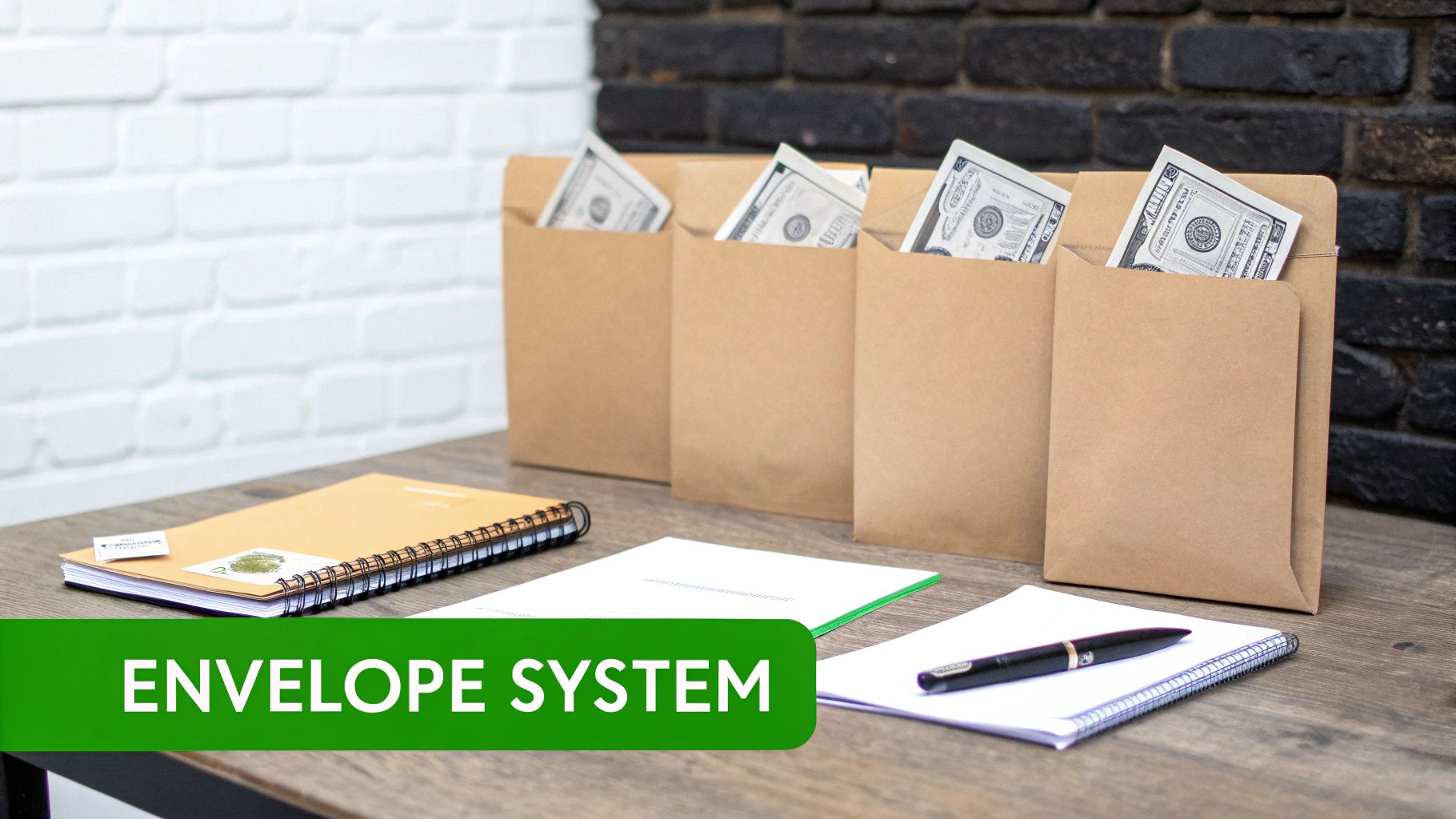
For those who find digital budgeting tools too abstract, the Envelope/Sinking Fund Method offers a tangible, hands-on approach to controlling spending. This is one of the best money saving tips for visual learners as it forces you to physically allocate cash for specific expense categories. By assigning a set amount of money to labeled envelopes, you create a hard stop when the funds run out, eliminating the risk of accidental overspending on discretionary items.
How It Works
The system is straightforward: at the beginning of each pay period, you withdraw cash and divide it into envelopes designated for your variable spending categories. Common categories include:
- Groceries: A fixed budget for your weekly or monthly food shopping.
- Dining Out: Money specifically for restaurants, cafes, and takeaways.
- Entertainment: Funds for movies, concerts, or other leisure activities.
- Gas/Transportation: Cash set aside for fuel or public transport fares.
- Sinking Funds: Envelopes for saving toward specific, future expenses like holiday gifts, car repairs, or an annual vacation.
When you need to make a purchase, you take cash only from the corresponding envelope. If the "Dining Out" envelope is empty, you can't go out to eat until the next pay period. This tangible limit creates powerful spending accountability. One family successfully reduced their discretionary spending by over 30% in just two months by sticking to physical envelopes.
Quick Implementation Steps
To get started, analyze your past spending to set realistic budgets for 4-6 key variable expense categories. Label your envelopes clearly with the category and the allocated amount. Refill them on the same day each month, and schedule a quick weekly review to track your progress. For a modern twist, digital envelope apps like Qapital or EveryDollar mimic this system without the need for physical cash, offering convenience while maintaining the core principles of the method.
6. Utilizing Technology and Apps to Automate Savings
In the digital age, one of the best money saving tips is leveraging technology to build wealth effortlessly. Modern financial apps go beyond simple budgeting; they use AI and clever algorithms to identify savings opportunities, round up your purchases to the nearest dollar and invest the difference, and even negotiate your bills for you. This "set it and forget it" approach helps you save consistently without constant manual effort, making it ideal for achieving financial freedom in a busy world.
How It Works
These tech-driven tools integrate with your bank accounts to analyze your spending habits and automate your savings goals. They work in the background to grow your money, turning small, everyday actions into significant long-term gains.
- Round-Up Apps: Tools like Acorns and Chime automatically round up your debit card purchases to the nearest dollar and transfer the spare change into a savings or investment account. A daily $3.50 coffee becomes a $0.50 micro-investment.
- AI-Powered Savings: Apps like Digit analyze your income and spending patterns to determine how much you can afford to save, then automatically transfer small amounts to a separate savings account.
- Bill Negotiation Services: Services like Trim and Truebill scan your recurring bills (like cable, internet, and phone) and negotiate lower rates on your behalf, capturing savings without you lifting a finger.
This strategy leverages the power of micro-savings and automation, making the process of building wealth almost invisible and highly effective. For example, rounding up daily purchases can easily generate an extra $400-$600 per year for savings or investing.
Quick Implementation Steps
Start by researching and selecting one or two financial apps that align with your goals. Link your primary checking and credit card accounts to the app to allow it to analyze your spending. Set a specific savings goal within the app, such as building an emergency fund or saving for a vacation. Finally, enable automated features like round-ups or smart transfers and let the technology do the work. Review your progress monthly to ensure the app is helping you move toward your objectives.
7. Debt Payoff Strategies (Snowball vs. Avalanche)
Tackling high-interest debt is one of the most powerful and best money saving tips for achieving financial freedom. Choosing a clear strategy, such as the Snowball or Avalanche method, transforms debt repayment from a daunting task into a manageable process. These structured approaches prioritize how you allocate extra payments, helping you eliminate debt faster, reduce total interest paid, and free up significant cash flow for your future goals.
How It Works
Both methods require you to make minimum payments on all your debts, but they differ in how you apply any extra money you can put toward them:
- The Snowball Method: Popularized by Dave Ramsey, this method focuses on behavior and motivation. You list your debts from the smallest balance to the largest, regardless of interest rates. You attack the smallest debt with all your extra cash while paying minimums on the rest. Once the smallest debt is gone, you roll that payment amount into the next smallest debt, creating a "snowball" of momentum.
- The Avalanche Method: This method is mathematically optimal for saving money on interest. You list your debts from the highest interest rate to the lowest. You focus all extra payments on the debt with the highest interest rate first. Once that's paid off, you apply its payment to the next-highest interest rate debt.
For example, with the Avalanche method, you would pay off an 18% APR credit card before a 7% student loan, saving you the most money over time. With the Snowball method, you might pay off a small $500 medical bill first to get a quick psychological win, even if its interest rate is low.
Quick Implementation Steps
Start by listing every debt you have, including the total balance and the interest rate for each. Choose the method that best aligns with your personality: the Snowball for motivational wins or the Avalanche for maximum interest savings. Critically, you must stop accumulating new debt for either strategy to be effective. Use a debt payoff calculator to visualize your progress and celebrate each time you eliminate a debt to stay motivated.
8. Tracking Expenses and Cost-Cutting Audits
One of the most powerful and best money saving tips is to gain a crystal-clear understanding of where your money is going. A systematic cost-cutting audit involves meticulously tracking your expenses to identify and eliminate "spending leaks" like forgotten subscriptions, unnecessary services, and recurring charges you no longer need. This detailed review often reveals significant savings opportunities, allowing you to redirect funds toward your financial goals.
How It Works
This method is about becoming a financial detective for your own accounts. You’ll examine every outgoing transaction to categorize spending, question its value, and take action to reduce or eliminate it. This isn't about extreme deprivation; it’s about mindful spending and ensuring your money aligns with your priorities.
- Identify Spending Leaks: The average person has multiple forgotten subscriptions. For example, cancelling an unused $15 gym membership, a $20 streaming service, and a $12 app subscription saves $528 per year.
- Negotiate Better Rates: Armed with knowledge of your spending, you can contact service providers for utilities, insurance, phone, and internet. Simply asking for a loyalty discount or mentioning a competitor's price can often save $50 to $100 per month.
- Optimize Recurring Costs: By auditing your expenses, you can identify areas to consolidate services or switch to more cost-effective providers, creating consistent monthly savings.
A thorough audit can uncover 10-30% in potential savings from your discretionary budget, freeing up hundreds or even thousands of dollars annually without drastically changing your lifestyle.
Quick Implementation Steps
Start by exporting three to six months of your bank and credit card statements into a spreadsheet. Use this data to categorize every expense and highlight all recurring charges for review. Automate this process with apps like Trim or Truebill, which specialize in finding and cancelling unwanted subscriptions. Set a reminder to perform this audit quarterly to stay on top of your spending. For more ideas on how to align your finances with your lifestyle, explore other resources on our site. Learn more about health, lifestyle, and well-being on a budget on collapsedwallet.com.
9. Building and Maintaining an Emergency Fund
One of the most critical and best money saving tips for long-term financial security is establishing a robust emergency fund. This is a dedicated savings account containing 3-6 months' worth of essential living expenses, designed to act as a financial buffer against unexpected events. Having this safety net prevents you from derailing your financial goals or accumulating high-interest debt when emergencies like a job loss, medical bill, or major car repair strike.
How It Works
An emergency fund is your personal insurance policy against life's uncertainties. Instead of relying on credit cards or loans, you use your own saved cash to cover unforeseen costs, preserving your financial stability and peace of mind. The goal is to isolate this money from your everyday spending and investment accounts so it is liquid and accessible only when truly needed.
- Calculate Your Target: First, determine your essential monthly expenses: rent/mortgage, utilities, groceries, and insurance. If these total $3,000, your emergency fund target should be between $9,000 (3 months) and $18,000 (6 months).
- Fund the Account: Automate contributions to build the fund systematically. Even small, regular deposits make a significant difference over time.
- Use and Replenish: When an emergency occurs, use the fund to cover the expense. Afterward, your top priority should be to replenish the amount you withdrew to restore your safety net.
For example, a person with a $15,000 emergency fund can handle a sudden $5,000 car repair without taking on credit card debt. In a job loss scenario, this fund could cover six months of essential bills, providing crucial time to find a new position without panic.
Quick Implementation Steps
Start by opening a separate high-yield savings account (HYSA) specifically for this purpose, labeling it "Emergency Fund Only" to reinforce its purpose. Automate a recurring transfer of $100-$300 from your checking account each month. Keep this fund completely separate from your daily transaction accounts to resist the temptation of dipping into it for non-emergencies. Remember, this money is for stability, not aggressive growth, so avoid investing it in volatile assets.
10. Strategic Negotiation and Shopping Around for Services
One of the most overlooked yet best money saving tips is to stop passively accepting the rates for your recurring services. Actively negotiating with providers and shopping for better deals on essentials like insurance, internet, and phone plans can unlock significant savings. Many companies rely on customer inertia, but a little effort to compare rates and leverage competitor offers can reduce your monthly bills by 15-30% or more, freeing up substantial cash for your financial goals.
How It Works
This strategy involves regularly researching what competitors are offering and using that information to negotiate a lower rate with your current provider. Companies often have dedicated retention departments authorized to offer better deals to prevent you from switching. This applies to a wide range of services, from your car insurance to your cable bill.
- Car Insurance: If you're paying $200/month, a few calls to competitors might reveal a similar policy for $140. Presenting this quote to your current insurer could lead them to match it, saving you $720 annually.
- Internet/Cable: An $80/month internet plan could often be reduced to $50/month, especially if a new provider offers an introductory rate in your area. This simple switch saves $360 per year.
- Mobile Phone Plans: Switching from a major carrier’s $120/month plan to an MVNO (Mobile Virtual Network Operator) like Mint Mobile or Visible can often cut your bill in half, saving another $720 annually.
Quick Implementation Steps
Set a calendar reminder to review your major service contracts once a year, particularly a month before they are set to auto-renew. Before calling your provider, gather at least three competitive quotes from other companies. When you call, state that you have a better offer and ask if they can match it to keep your business. If the initial agent can't help, politely ask to speak with the retention or loyalty department, as they have more authority to negotiate. Mentioning your loyalty as a long-term customer can also be a powerful negotiation tool.
Top 10 Money-Saving Strategies Comparison
| Method | Implementation Complexity 🔄 | Resources & Effort ⚡ | Expected Outcomes 📊 | Ideal Use Cases 💡 | Key Advantages ⭐ |
|---|---|---|---|---|---|
| The 50/30/20 Budgeting Rule | Low — simple proportional framework 🔄 | Low — basic tracking, occasional adjustments ⚡ | Balanced savings & lifestyle; steady progress 📊 | Beginners, steady incomes, quick setup 💡 | Easy to follow; flexible; clear targets ⭐ |
| Automated Savings / Pay-Yourself-First | Low — one-time setup, automated thereafter 🔄 | Low — requires bank/payroll setup; minimal maintenance ⚡ | High consistency in saving; accelerates balance growth 📊 | Anyone with regular income; retirement savers 💡 | Removes willpower barrier; leverages compounding ⭐ |
| Zero-Based Budget Method | High — detailed monthly planning and review 🔄 | High — time-intensive tracking, frequent adjustments ⚡ | Maximizes cash efficiency; aligns spending to goals 📊 | Households seeking tight control; freelancers 💡 | Eliminates waste; forces intentional allocation ⭐ |
| High-Yield Savings Accounts & CD Laddering | Low — initial setup and periodic monitoring 🔄 | Moderate — requires cash to allocate; account comparisons ⚡ | Improved passive interest income; capital preservation 📊 | Emergency funds, conservative savers, ladder builders 💡 | FDIC-insured higher yields; low effort passive returns ⭐ |
| Envelope / Sinking Fund Method | Moderate — regular replenishment and category management 🔄 | Moderate — cash handling or multiple sub-accounts ⚡ | Strong category control; reduces discretionary overspend 📊 | Cash-preference households; families teaching budgeting 💡 | Tangible accountability; prevents overspending ⭐ |
| Tech & App Automation | Moderate — initial setup and account linking 🔄 | Low–Moderate — requires app selection and goal setting ⚡ | Consistent micro-savings; automated bill reduction 📊 | Tech-savvy savers; anyone needing passive help 💡 | High ROI on time; automates complex financial tasks ⭐ |
| Debt Payoff (Snowball vs Avalanche) | Low–Moderate — requires payment prioritization and discipline 🔄 | Moderate — requires extra payment capacity ⚡ | Faster debt elimination; interest savings (Avalanche) 📊 | Borrowers with multiple debts; motivated payers 💡 | Frees cash flow; improves credit; psychological wins ⭐ |
| Tracking Expenses & Cost-Cutting Audits | Moderate–High — thorough initial audit, recurring reviews 🔄 | Moderate — time, spreadsheets/tools or apps ⚡ | Reveals 10–30% savings opportunities; eliminates leaks 📊 | Anyone with recurring charges/subscriptions 💡 | Identifies forgotten costs; enables negotiation and consolidation ⭐ |
| Building & Maintaining an Emergency Fund | Low–Moderate — steady saving plan and discipline 🔄 | High — requires consistent savings over time ⚡ | High financial resilience; avoids crisis debt 📊 | All adults; those with income volatility or dependents 💡 | Prevents high-interest borrowing; reduces stress ⭐ |
| Strategic Negotiation & Shopping Around | Moderate — research and negotiation calls/emails 🔄 | Moderate — time to compare quotes and switch services ⚡ | Immediate recurring savings (often 15–30%) 📊 | Households with multiple service providers 📡 💡 | Quick, high-ROI reductions in recurring bills ⭐ |
Turning Tips into Lasting Financial Habits
Navigating the path to financial stability can feel overwhelming, but as we've explored, it's a journey built on a series of small, intentional actions. You have just absorbed a comprehensive toolkit of some of the best money saving tips available, moving far beyond generic advice to provide actionable frameworks. We didn't just tell you to "save more"; we showed you how with structured methods like the 50/30/20 rule, the precision of zero-based budgeting, and the discipline of paying yourself first through automation.
The true power of these strategies lies not in isolation but in their synergy. Imagine combining the clarity of a cost-cutting audit with the targeted force of the debt avalanche method. Picture pairing the security of a fully funded emergency fund, nestled in a high-yield savings account, with the forward-planning prowess of sinking funds for major purchases. Each tip is a building block, and when you start stacking them, you construct a fortress of financial resilience. The goal is to transform these individual tips from one-time actions into ingrained, effortless habits that work for you day in and day out.
From Knowledge to Action: Your Next Steps
Information is only potential power; its true value is unlocked through application. The secret to success isn't trying to implement all ten strategies overnight. Instead, the most effective approach is to build momentum gradually. This prevents burnout and ensures that each new habit has the space to take root and become a permanent part of your financial routine.
Here is a simple, three-step plan to get started right now:
- Choose Your "Quick Win": Look back at the list and identify the one tip that feels most achievable and impactful for your current situation. Is it setting up an automated transfer to savings? That takes less than 15 minutes. Is it downloading a tracking app and categorizing your last week of spending? This single action can provide immediate, eye-opening insights.
- Commit to 30 Days: Focus solely on that one chosen habit for the next month. If you chose to automate savings, commit to that one action. If you chose to shop around for a better insurance rate, dedicate one afternoon this month to making those calls. This focused effort helps solidify the behavior.
- Layer and Expand: Once your first habit feels second nature, it's time to add another. Perhaps you started with automating savings and now you're ready to tackle a full zero-based budget for the upcoming month. By layering strategies one by one, you create a robust financial system without overwhelming yourself.
The Bigger Picture: Beyond Saving to Financial Freedom
Mastering these concepts is about so much more than just having a larger number in your bank account. It's about reclaiming control, reducing stress, and creating opportunities. Every dollar you strategically save is a dollar that can be put to work building your future, whether that means investing for retirement, funding a business idea, or simply having the freedom to make life choices based on your passions rather than your financial limitations.
These best money saving tips are your blueprint for escaping the cycle of living paycheck to paycheck and moving toward a future defined by security and choice. The consistency you build today is the foundation for the wealth and peace of mind you will enjoy for years to come. Your journey to financial empowerment begins not tomorrow, but with the very next decision you make. Start small, stay consistent, and watch as these powerful habits transform your financial life.
Ready to take the guesswork out of managing your money? The Collapsed Wallet app is designed to help you implement these strategies seamlessly, from tracking your spending to building a budget that works. Take the first step towards financial clarity and control by visiting Collapsed Wallet to learn more.
Article created using Outrank

6 thoughts on “10 Best Money Saving Tips for Financial Freedom in 2025”