
Table of Contents
This blog post may contain affiliate links. As an Amazon Associate I earn from qualifying purchases.
Before you can even think about paying off debt quickly, you have to know exactly what you're up against. This means getting brutally honest with yourself and digging into the numbers. It’s time to move from that vague, nagging feeling of "I owe a lot" to a crystal-clear picture of your financial reality.
The aim of our blog is to provide valuable insights and practical tips to help readers manage their money more effectively. However, the information shared here is for general guidance and educational purposes only. It should not be regarded as professional financial advice. Any actions taken based on our content are entirely the responsibility of the reader, and we accept no liability for the outcomes of those actions. If you require financial advice tailored to your personal circumstances, we strongly recommend seeking assistance from a qualified financial adviser.
This first step is non-negotiable. It's about gathering all your statements—credit cards, personal loans, car finance, student loans, everything—and laying all your cards on the table. Only then can you build a smart, effective plan to achieve financial freedom.
Confronting Your Debt Head-On
Alright, let's get down to it. The journey to becoming debt-free starts with facing the music. It’s easy to avoid looking at the total amount you owe because, frankly, it can be scary. But you can't fight an enemy you can't see.
Your first mission is to gather every single piece of information. Don't leave anything out. Pull up your latest statements online or find the paper copies for every single debt. Ignoring that one store card or a small personal loan will only sabotage your efforts later.
Creating Your Debt Inventory
Now, we’re going to turn that messy pile of statements into an organized, actionable roadmap. You need to know exactly who you owe, how much, and what it's costing you. A simple spreadsheet or even a notebook will work perfectly for this.
For each and every debt, write down these four critical details:
- Creditor Name: Who did you borrow from? (e.g., Barclays, Amigo Loans, Student Loans Company).
- Total Balance: What's the exact, up-to-the-penny amount you owe right now?
- Interest Rate (APR): This is the most important number on the list. It’s the "cost" of your debt and will be the deciding factor in which payoff strategy you choose.
- Minimum Payment: What's the absolute smallest amount you have to pay each month to keep the account in good standing?
I know this part can feel like a punch to the gut. Seeing that total figure in black and white might be a shock. But trust me, this is also the moment you reclaim control. It's the point where you stop letting debt happen to you and start telling your money where to go.
Facing your debt total isn't about shame; it's about strategy. You cannot defeat an enemy you don't understand. This detailed inventory is your intelligence report, giving you the upper hand for the first time.
Your Personal Debt Inventory Worksheet
Use this template to organize your debts in one place. This snapshot is crucial for choosing the right payoff strategy and tracking your progress.
| Creditor Name | Type of Debt | Total Balance | Interest Rate (APR) | Minimum Payment |
|---|---|---|---|---|
| Example Barclaycard | Credit Card | £3,500 | 21.9% | £105 |
| Example Car Finance | Car Loan | £8,200 | 6.5% | £250 |
| Example Student Loan | Government Loan | £22,000 | 7.8% | £120 |
Once you've filled this out, take a moment. You now have a complete picture of your financial battlefield. You can see which debts are bleeding you dry with high interest rates and which ones have the smallest balances. This is the foundation for everything that comes next. Now, we can start building your plan of attack.
Choosing Your Debt Payoff Strategy
Alright, you’ve laid all your cards on the table. Staring at a complete list of what you owe might feel intimidating, but what you’ve actually done is move from a place of uncertainty to one of power. Now, it’s time to pick your plan of attack. Getting out of debt isn’t about some magic formula; it’s about choosing a deliberate strategy and seeing it through.
The aim of our blog is to provide valuable insights and practical tips to help readers manage their money more effectively. However, the information shared here is for general guidance and educational purposes only. It should not be regarded as professional financial advice. Any actions taken based on our content are entirely the responsibility of the reader, and we accept no liability for the outcomes of those actions. If you require financial advice tailored to your personal circumstances, we strongly recommend seeking assistance from a qualified financial adviser.
The two most popular—and effective—debt repayment plans are the Debt Snowball and the Debt Avalanche. Both will get you to the debt-free finish line, but they appeal to very different personalities. Your choice really boils down to what motivates you more: quick, psychological wins or cold, hard math.
This infographic breaks down the key pieces of the puzzle you’ll be working with for either strategy—balance, interest, and payments.
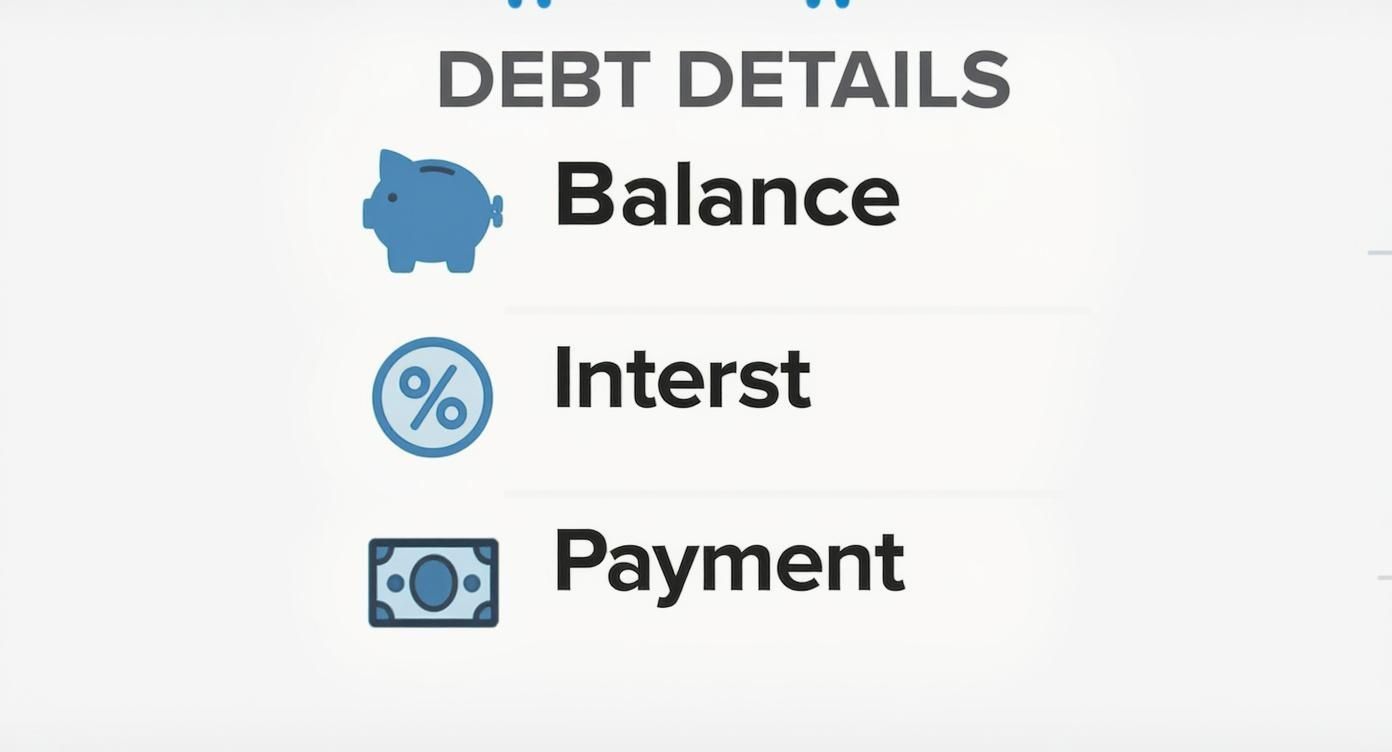
As you can see, each debt has its own unique character. Understanding these differences is the key to picking the right method to knock them out, one by one.
Debt Snowball vs Debt Avalanche A Quick Comparison
Deciding between these two powerful methods can be tough. One focuses on behaviour and momentum, while the other prioritizes mathematical efficiency. This table breaks down the core differences to help you figure out which approach fits your personality and financial situation best.
| Feature | Debt Snowball Method | Debt Avalanche Method |
|---|---|---|
| Primary Focus | Smallest debt balance first, regardless of interest rate. | Highest interest rate (APR) debt first, regardless of balance. |
| Key Advantage | Psychological. Quick wins build momentum and keep you motivated. | Mathematical. Saves the most money on interest over the long run. |
| Best For | People who need to see progress quickly to stay on track. | People who are disciplined and motivated by numbers and long-term savings. |
| Potential Drawback | You may pay more in interest over time by leaving high-interest debts for later. | It might take a long time to pay off the first debt, which can be discouraging. |
| The "Win" Factor | You get the satisfaction of clearing entire accounts off your list faster. | The win is knowing you're paying less to the banks and getting out of debt sooner. |
Ultimately, there's no "wrong" answer here. The best strategy is the one you will actually stick with until you're debt-free.
The Debt Snowball Method: Psychology Over Math
The Debt Snowball is all about building momentum. The game plan is simple: you make the minimum payments on all your debts, but you throw every spare pound you can find at the one with the smallest balance. It doesn't matter what the interest rate is.
Once that smallest debt is gone, you take the entire amount you were paying on it (the minimum plus all the extra cash) and "roll" it onto the next-smallest debt. This creates a bigger and bigger "snowball" of money that plows through your debts one after the other.
- The Power of Quick Wins: The real magic here is psychological. Paying off an entire account, even a tiny one, feels fantastic and gives you a huge motivational boost.
- Building Positive Habits: Those early victories help you stay in the fight for the long haul, which is crucial when you get to the bigger debts down the line.
Think back to your debt list. If you had a £500 store card, a £3,000 credit card, and a £15,000 personal loan, the Snowball method tells you to attack that £500 store card with everything you’ve got. Seeing that first "Paid in Full" notice is incredibly empowering.
The Debt Avalanche Method: Math Over Psychology
On the flip side, the Debt Avalanche is the most efficient way to pay off debt, period. If saving the maximum amount of money is your goal, this is your strategy. You still cover the minimums on everything, but all your extra money goes directly to the debt with the highest interest rate (APR).
High-interest debt, like the kind on credit cards and payday loans, grows sickeningly fast. By hitting it first, you stop that aggressive interest from piling up, meaning more of your hard-earned money chips away at the actual debt. This can shave a serious amount of time off your repayment journey.
The Avalanche method is perfect for people who are driven by the numbers. It might take longer to score your first "win," but you are guaranteed to pay less in interest. That's a massive win in its own right.
This approach definitely requires more discipline. You might be chipping away at a large, high-interest loan for months (or even years) before you get the satisfaction of clearing an account. But the long-term savings are undeniable. For anyone looking to build the discipline this requires, sharpening your money management skills is the perfect place to start.
Real World Scenario: £15,000 Debt Portfolio
Let’s make this real. Imagine this is your debt situation:
- Credit Card: £2,500 at 22.9% APR
- Personal Loan: £10,000 at 8% APR
- Car Finance: £2,500 at 5% APR
With the Debt Snowball: You'd ignore those interest rates and go after one of the £2,500 debts. Let's say you pick the car finance. You'd clear it, then roll that payment onto the credit card, and finally tackle the personal loan. You get those quick wins, but that nasty 22.9% credit card is just sitting there, racking up expensive interest the whole time.
With the Debt Avalanche: The target is crystal clear: the 22.9% APR credit card. Every extra penny goes there until it’s wiped out. Next up would be the 8% loan, and last, the 5% car finance. It will take longer to kill that first credit card, but you'll save hundreds—maybe even thousands—in interest by the end.
The choice is yours: quick wins to fuel your motivation, or maximum savings to fuel your bank account.
Building a Budget That Fights Debt
Picking a debt payoff strategy is a huge step, but it’s only half the battle. The other half is actually finding the money to make it happen. A standard budget where you just track what you’ve already spent won't get you out of debt quickly. You need an aggressive, forward-looking financial plan—a budget built specifically to attack your debt.
The aim of our blog is to provide valuable insights and practical tips to help readers manage their money more effectively. However, the information shared here is for general guidance and educational purposes only. It should not be regarded as professional financial advice. Any actions taken based on our content are entirely the responsibility of the reader, and we accept no liability for the outcomes of those actions. If you require financial advice tailored to your personal circumstances, we strongly recommend seeking assistance from a qualified financial adviser.
Think of it as a short-term sprint, not a lifelong marathon of deprivation. You’re making deliberate, temporary sacrifices now to secure the permanent prize of financial freedom way ahead of schedule.
Adopt a Zero-Based Budget
The single most effective tool for this is the zero-based budget. It's a simple concept with a powerful punch: give every single pound a job. You start with your monthly income, and you don't stop allocating until every penny is assigned to an expense, a savings goal, or a debt payment, leaving you with zero.
This approach forces you to be incredibly intentional. There’s no slush fund or vague "spending money" category. Every pound is accounted for, which is critical when you're trying to funnel cash toward debt.
Let's say you take home £2,500 a month. A zero-based plan would look something like this:
- Rent/Mortgage: £900
- Utilities: £150
- Groceries: £300
- Transport: £120
- Minimum Debt Payments: £280
- Extra Debt Payment: £750
- Total: £2,500
See? Nothing is left to chance. This level of detail shines a spotlight on where your money truly goes and makes sure every spare bit is thrown at your debt.
Get Brutally Honest About Needs vs. Wants
To make a zero-based budget work, you have to ruthlessly separate your essential 'needs' from your negotiable 'wants'. This is where you'll find the hidden cash to supercharge your debt payoff.
Needs are non-negotiable for living and working:
- Housing costs
- Core utilities (gas, electricity, water)
- Basic food
- Transport to get to your job
- Your minimum debt payments
Wants are literally everything else:
- That morning latte or lunch out
- Streaming services like Netflix and Spotify
- The gym membership you rarely use
- Nights out, takeaways, and entertainment
- Upgrading to the latest phone
You have to be completely honest with yourself here. A daily £3 coffee habit costs you over £700 a year. That’s enough to completely wipe out a small credit card balance or take a huge chunk out of a bigger loan.
The point isn't to make your life miserable. It's to temporarily hit pause on non-essential spending. Every 'want' you cut becomes a direct investment in your future, debt-free self.
Trim the Fat, Find the Cash
With your spending categorised, it’s time to get trimming. Go through your last couple of bank statements, line by line, and challenge every 'want'. You’ll probably find subscriptions you totally forgot about—cancel them. Your grocery bill is one of the easiest places to find quick savings; learning how to save money on groceries can free up a surprising amount of cash to redirect to your financial goals.
This isn’t about finding one massive £100 saving. It’s about finding ten places to save £10. Those small cuts quickly add up and can be redirected straight to your priority debt, which can shave months, or even years, off your timeline.
Let Technology Keep You on Track
Let’s be real: tracking every pound by hand is a drag. This is where technology becomes your secret weapon. Modern budgeting apps can automate most of the heavy lifting, making it much easier to stick with your aggressive plan.
A couple of great options to check out:
- YNAB (You Need A Budget): This app is designed specifically for the zero-based method. It’s perfect for forcing you to be proactive with your money.
- Emma: A great UK-based app that syncs with your accounts, categorises spending automatically, and even flags wasteful subscriptions you might have missed.
Using an app keeps you honest. It gives you instant feedback, alerts you when you’re about to overspend in a category, and shows you charts of your progress. Seeing those debt balances shrink is a powerful motivator to keep going.
Put Your Income into Overdrive to Pay Debt Down Faster

Trimming your expenses is an essential first step, but let's be honest—it has a ceiling. You can only cut back so much. On the flip side, boosting your income has practically unlimited potential. This is where you can truly light a fire under your debt repayment plan.
The aim of our blog is to provide valuable insights and practical tips to help readers manage their money more effectively. However, the information shared here is for general guidance and educational purposes only. It should not be regarded as professional financial advice. Any actions taken based on our content are entirely the responsibility of the reader, and we accept no liability for the outcomes of those actions. If you require financial advice tailored to your personal circumstances, we strongly recommend seeking assistance from a qualified financial adviser.
By earning more, you're creating a powerful new stream of cash aimed squarely at your debts. It’s not about working yourself into the ground forever. It's about a focused, temporary sprint to achieve a permanent, life-changing goal of financial freedom.
Cash in on Your Existing Skills
The fastest way to start bringing in extra money is often to do more of what you already know. If you're a writer, designer, web developer, or have solid admin skills from your 9-to-5, there are people out there who will pay for your expertise on a project basis.
Websites like Upwork, Fiverr, and PeoplePerHour are buzzing with opportunities. You don’t have to dive in headfirst. Start by picking up a few hours of work in the evenings or on a weekend. It might not seem like a fortune at first, but when every penny goes directly toward a high-interest credit card, you'll see the impact immediately.
Get on Board with the Gig Economy
Maybe your day job skills don't translate neatly into freelance gigs. No problem. The gig economy is packed with accessible, flexible roles that you can fit around your main schedule.
- Delivery Services: Companies like Deliveroo, Uber Eats, and Just Eat are constantly looking for riders and drivers. You work when you want, making it a perfect fit for earning extra during peak evening and weekend times.
- Task-Based Apps: Check out apps like Airtasker or TaskRabbit. You can get paid for helping people with everyday jobs—anything from assembling flat-pack furniture to helping with a house move.
- Ride-Sharing: If you have a decent car and don't mind driving, signing up for Uber or Bolt can provide a steady stream of extra cash, especially if you live in or near a city.
My Takeaway: The gig economy is your ticket to immediate, flexible earnings. Even an extra £200-£300 a month can make a huge dent, potentially shaving a year or more off your repayment timeline.
Ring-Fence Your Extra Earnings
This is the most important part of the strategy, so don't skip it. Every single pound you earn from your side hustle is sacred. It's not for your regular budget, and it's definitely not for a takeaway coffee.
I highly recommend opening a separate, fee-free bank account. Call it your "Debt Demolition Fund" or something similar. As soon as you're paid from your extra work, transfer 100% of it into this account. At the end of the month, you take that entire balance and throw it at your target debt as an extra payment.
This simple habit achieves two crucial things:
- It stops that extra cash from just getting absorbed into your day-to-day spending.
- It gives you a crystal-clear, highly motivating view of how much your hard work is paying off. Seeing that fund grow is an incredible feeling.
Turn a Hobby into a Paycheck
What do you love to do in your spare time? Chances are, it could be a source of income. Many people have turned their passions into profitable side hustles with very little upfront cost.
Think about it:
- Crafts & Art: If you're great at knitting, painting, or making jewellery, you could set up a shop on a platform like Etsy.
- Skills-based services: A passion for personal finance can easily become a side business. You could offer financial coaching or budgeting workshops to help others on their journey.
- Tutoring: Are you a whiz at maths, fluent in another language, or a talented musician? Offer your services to students locally or online.
When you're earning money from something you genuinely enjoy, it doesn't feel like work. That makes it a much more sustainable way to keep your income—and your debt payments—supercharged for the long haul.
Using Financial Tools to Cut Your Interest Costs
https://www.youtube.com/embed/5jVbrOgim9U
High-interest debt feels like trying to swim against a strong current. You're putting in the effort, but that constant drag of interest keeps pulling you back, making real progress feel almost impossible. The steps we’ve already talked about—making a budget, picking a payoff plan, and boosting your income—are all about swimming harder.
Now, let's talk about weakening that current.
By being smart with a few financial tools, you can slash the interest rates you’re paying. This is a huge deal. It means more of your money attacks the actual debt balance instead of just getting eaten up by interest. This one move can save you a fortune and get you to the finish line much, much faster.
The Power of a Balance Transfer Card
For high-interest credit card debt, a 0% APR balance transfer card can be your secret weapon. The concept is simple: you open a new credit card that offers a special introductory deal, usually for 12 to 21 months, where you pay zero interest on balances you move over from your old cards.
Think of it as a temporary ceasefire in your war against interest. You get a breathing room—an interest-free window—to throw everything you can at the principal.
Let’s say you have a £3,000 balance on a card charging a nasty 22.9% APR. If you move that to a card with a 15-month 0% APR offer, every single pound you pay for those 15 months chips away directly at that £3,000. That simple maneuver could easily save you hundreds of pounds.
Of course, there are a few things to watch out for:
- The Transfer Fee: Nearly every card will charge you a fee to move the balance, typically 3-5% of the total amount. Do the maths first to make sure this fee is still far less than the interest you'd pay otherwise. (It almost always is).
- The Deadline: Mark the exact date the 0% period ends on your calendar. Any balance left over will start getting hit with the card's standard interest rate, which is often quite high.
- Your Credit Score: To get the best deals, you'll need a good credit score. It pays to know where you stand before you start applying.
A 0% balance transfer card isn't a free pass to relax. It's a strategic opportunity. Your mission is to completely wipe out the transferred balance before that promotional clock runs out. Use it to get ahead, not to take a break.
Simplify Your Life with a Debt Consolidation Loan
Are you juggling a bunch of different high-interest debts? Maybe a few credit cards, a store card, and a personal loan, all with different due dates and rates? A debt consolidation loan can bring some much-needed calm to that chaos.
Here’s how it works: you take out one new loan and use that money to pay off all your other smaller debts. From then on, you only have one single payment to manage.
The real win, however, is getting a lower, fixed interest rate than the average you were paying across all those other debts. This not only makes your finances easier to handle but can dramatically cut the total amount of interest you pay over time.
For instance, if you bundled £10,000 of credit card debt averaging 20% APR into a personal loan at 9% APR, you’ve just sliced your interest costs in half overnight.
So, when is consolidation a smart move?
- When the rate is right: The whole point is to secure a significantly lower interest rate. If you can't, it's probably not worth it.
- When you crave structure: These loans come with a fixed repayment term, like 3 or 5 years. You get a clear, predictable payment and an exact date when you'll be debt-free.
- When you can trust yourself: Here's the biggest pitfall. Once those old credit cards are paid off, the temptation to use them again is real. You have to be disciplined and commit to not racking up new debt.
Applying for a loan or a new card will involve a credit check, so it's a good idea to know your credit score before you begin. When used wisely, these tools can be game-changers, turning that exhausting upstream swim against interest into a much smoother float toward financial freedom.
Got Questions About Paying Off Debt? We've Got Answers
The road to becoming debt-free isn't always a smooth one. Let's be honest, life happens. The car decides to give up, your motivation disappears, and you're left wondering what to do next. It’s completely normal to hit a few bumps along the way.
This is where having a plan for the "what-ifs" makes all the difference. Think of it as building a little resilience into your financial game plan. Here’s how to handle some of the most common hurdles people face.
What If an Unexpected Expense Pops Up?
It's never a matter of if an emergency will happen, but when. The boiler will inevitably break down on the coldest day of the year, or you’ll need an urgent trip to the dentist. The trick is not letting it completely torpedo your progress.
This is exactly why that small emergency fund of £500 to £1,000 is so crucial, even when you're laser-focused on debt. It's your buffer. It stops a minor crisis from becoming a new credit card balance.
Here’s the game plan:
- When an emergency hits, pause your extra debt payments for just that month.
- Keep making all your minimum payments—don't skip those.
- Use your emergency fund to cover the cost.
If you haven't built that fund yet, no panic. Just take the extra cash you were planning to throw at your debt this month and use it for the emergency instead. The most important thing is to deal with the problem, adjust for a month, and then jump right back into your plan without any guilt.
How Do I Stay Motivated When My Debt Feels Huge?
Staring down a five-figure debt total can feel like trying to climb a mountain in flip-flops. It’s easy to feel defeated before you even start. When that overwhelming feeling kicks in, you have to stop looking at the summit and focus on the very next step in front of you.
The real secret here is celebrating the small wins. Seriously. Did you finally clear that nagging little store card? That's a massive victory. Acknowledge it! Create a visual tracker, like a chart you can colour in or a paper chain where every link is £100 of debt you've killed. Seeing your progress in a tangible way is a powerful antidote to feeling stuck.
Find your 'why.' Why are you putting in all this work? Is it to finally have the freedom to quit a job you hate? To travel without financial stress? Or just to feel that incredible peace of mind that comes from owing no one? Keep that reason front and centre. It's your best motivator.
Should I Pay Off Debt or Invest My Extra Cash?
Ah, the classic question. On paper, it can seem tempting to invest, especially if you think you can earn a higher return than the interest rate on your loans. But paying off high-interest debt gives you something an investment can't: a guaranteed, risk-free return.
Think about it this way: when you pay off a credit card with a 21% APR, you've essentially "earned" a 21% return on your money. No stock market investment can promise you that. For most people, the priority should be crystal clear:
- First, build that small emergency fund.
- Next, attack high-interest debt with everything you've got. I'm talking about anything with an interest rate over 7-8%, which usually means credit cards and personal loans.
- Then, once the expensive debt is gone, you can invest for the long term.
By wiping out your high-interest debt first, you free up an enormous amount of your income. That's money you can then channel directly into building real wealth, putting you in a far more powerful financial position for whatever comes next.
At Collapsed Wallet, we're dedicated to providing the clear, practical guidance you need to take control of your finances. From building your first budget to making your final debt payment, we're here to support you with actionable advice every step of the way. Explore more of our resources at https://collapsedwallet.com.

7 thoughts on “How to Pay Off Debt Fast A Practical Guide”