

Table of Contents
This blog post may contain affiliate links. As an Amazon Associate I earn from qualifying purchases.
Wondering how to negotiate salary increase? Well it comes down to three core moves: digging into market benchmarks, building a data-driven case, and picking the right moment to ask. Nail those, and you’ll often align your pay with your performance and potentially adding thousands to your annual income.
The aim of our blog is to provide valuable insights and practical tips to help readers manage their money more effectively. However, the information shared here is for general guidance and educational purposes only. It should not be regarded as professional financial advice. Any actions taken based on our content are entirely the responsibility of the reader, and we accept no liability for the outcomes of those actions. If you require financial advice tailored to your personal circumstances, we strongly recommend seeking assistance from a qualified financial adviser.
Before we dive into detailed scripts and checklists, here’s a quick overview of each phase and the results you can expect.
Comparison Of Key Negotiation Steps
Below is a side-by-side look at what to do in each phase and why it matters.
| Phase | Action | Expected Outcome |
|---|---|---|
| Research | Gather salary benchmarks from Glassdoor, Payscale, LinkedIn Salary | Define a realistic compensation range |
| Value Case | Document contributions with clear metrics (e.g., 25% sales boost) | Build evidence that supports your worth |
| Timing | Ask right after a performance review or major project win | Increase the likelihood of a positive response |
Use this table as your roadmap before you craft detailed talking points and follow-ups.
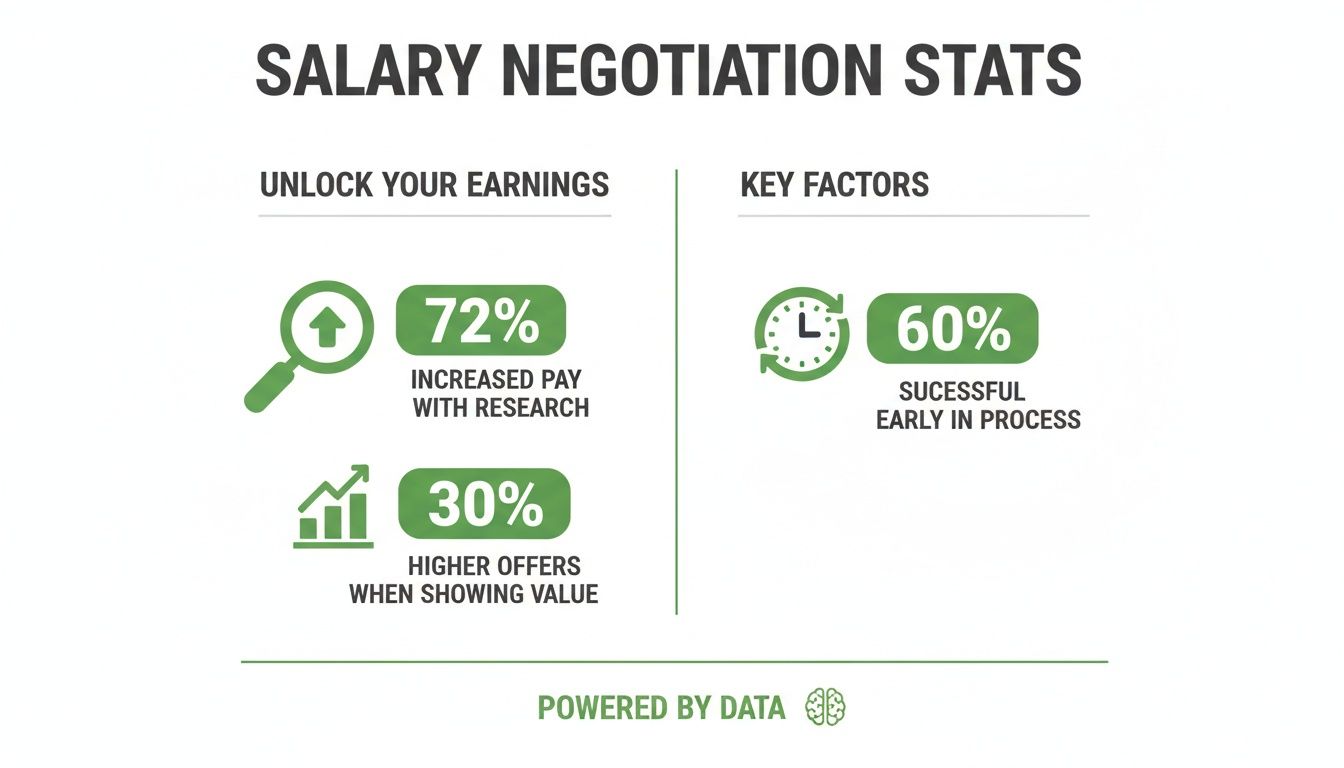
A well-timed ask backed by concrete data can boost your raise success rate by over 60%.
Preparing Your Case With Market Research
Confidence comes from hard facts, not guesswork. Before you decide on a number, you need a clear snapshot of what the market pays for your role.
This Glassdoor chart plots salary ranges for positions like yours and shows that mid-level pros typically earn between $65k and $80k, depending on where they live.
Gather Salary Data From Key Sites
When you’re hunting for pay benchmarks, visit sites like Glassdoor, LinkedIn Salary and Payscale.
Filter by title, years on the job and zip code to get numbers that really match your situation.
Keep an eye on variables such as:
- Company size (startup vs. enterprise)
- Local cost of living (big city vs. small town)
- Tenure and past promotions
- Specialized certifications or technical expertise
Well-chosen benchmarks give you leverage during negotiations.
Analyze Regional Cost Differences
Pay scales swing up and down by an average of 15% between urban centers and rural areas. Pull in a cost-of-living index for your city to fine-tune your ask.
- Large metros often pay 10–20% above national norms
- Smaller locales may run 5–10% below the average
Localizing your data makes your proposal feel fair and reasonable.
Translate Achievements Into Monetary Impact
Numbers resonate. Tie your accomplishments back to real dollars whenever you can.
A 25% surge in sales added about $150k to the bottom line. Cutting costs by 15% saved roughly $30k a year.
List each win with dates and project names for extra credibility. Include a note on how you performed versus team averages to drive the point home.
Set Realistic Salary Ranges
Based on your research, choose a range between the 25th and 75th percentiles. This shows you know your stuff but aren’t unreasonable.
Anchor your upper target near the 75th percentile and reference those dollar-impact stories. Then include a fallback figure about 5% below your ideal to signal flexibility.
Industry data says 67% of procurement pros who negotiate see a bump (Procurement Tactics Salary Stats). On average, negotiators walk away with an 18.83% increase.
If you haven’t yet tracked your own spending patterns, sharpen your analysis with our expense tracker guide: How to Track Your Expenses.
Prepare Your Research Report
Condense all your findings into a clear, one-pager. Include:
- A compact table of market benchmarks
- Bullet points of your top three achievements and their dollar value
- Your proposed salary band with percentile context
- A quick overview of local market factors
- Space for recent company wins or industry news
A tidy report shows professionalism and respect for everyone’s time.
Rehearse your key points aloud or mock-negotiate with a mentor. The more you practice, the more natural your delivery will feel.
Review Industry Surveys
Don’t stop at public websites. Consult annual reports from groups like WorldatWork and role-specific associations.
- WorldatWork projects a 4.5% average global raise in 2025
- Sector studies break down expectations for fields such as finance or tech
Quoting respected surveys adds extra weight to your case.
Armed with these insights, finalize your document and move forward confidently.
Plan Follow-Up Steps
Two weeks after your discussion, send a concise follow-up email. Restate your main points and any fresh data you’ve gathered.
This proactive touch keeps momentum and shows you’re invested in a positive outcome.
Timing Your Request And Choosing Your Format
Nailing both the “when” and the “how” can turn a routine raise conversation into a real win. Think of timing as setting the stage—pick a moment when budgets are fresh and your recent successes are still top of mind.
Recognize Prime Windows
Your best shot comes right after a tangible win or a strong review. At that point, you’re not just another face in the org chart—you’re the person who delivered results.
Take advantage of business rhythms and personal highlights:
- After corporate earnings beats or quarterly reports
- During midyear check-ins
- Within days of wrapping up a high-profile project
Data speaks volumes. Employees who negotiate see an average bump of 18.83%, compared with the usual 4.5%. Globally, companies budget for 5.4% salary growth, with the US at 3.7%, India 9.3%, and Brazil 5.3%. Learn more about the global salary outlook.
57% of Americans regret not negotiating; seizing the moment is crucial.
Weigh In-Person Versus Email
There’s no one-size-fits-all. In-person chats let you read body language, while emails give you the space to lay out numbers and talking points clearly.
| Format | Pros | Cons |
|---|---|---|
| In-Person | Immediate feedback and rapport building | Harder to schedule discreetly |
| Provides a written record and clarity | Lacks instant interaction |
If you’re mostly remote or you need to gather your thoughts, go email. When subtle cues matter, aim for face time.
Schedule Without Surprise
You don’t want your manager scrambling in defense mode. A simple, honest invite sets the right tone.
- Subject Line: “Quick Chat on Role Progress”
- First Line: “I’d welcome your feedback on my recent projects.”
- Timing Note: “Would Tuesday at 10:00 work for you?”
When they suggest another slot, lock it in fast. That keeps momentum on your side.
As you talk, watch for these signals:
- Hesitation or budget-related comments
- Mentions of upcoming performance reviews
- Questions digging into your achievements
Spotting these cues helps you know when to pivot or press on.
Craft Sample Email Template
Here’s a no-frills example that merges timing and clarity:
Subject: Discussion on My Recent Contributions and Compensation
Hi [Manager Name],
I hope you’re doing well. After leading the [Project Name] to a 15% cost reduction, I’d like to review my compensation to reflect this impact. Could we meet next week to discuss?
Thanks for your time,
[Your Name]
Attach a one-page summary of your wins and relevant market data. Swap in your own metrics to make it unmistakably yours.
Actionable Timing Checklist
- Pinpoint a major win from the past quarter
- Mark upcoming budget-planning or review meetings
- Decide whether email or face-to-face fits your situation
- Draft your talking points or concise email
With this plan, you’ll strike while the iron is hot—and make your case impossible to dismiss.
Crafting A Persuasive Salary Pitch

Bringing together solid data and a conversational tone makes your salary request stand out. You’ll learn how to kick off the talk, spotlight your wins, and propose a range rooted in real market numbers.
Examples of actual dialogue will help you practice confident phrasing—without ever resorting to ultimatums. Plus, we’ll cover how to pivot when hesitation creeps in.
Opening The Discussion Confidently
Start by tying your request to shared goals.
Mention a recent win to frame the conversation.
- Reference the project name and its impact
- Thank your manager for their guidance
- Invite feedback before diving into figures
Highlighting Quantifiable Achievements
Hard numbers win attention.
Choose two or three successes that come with clear metrics.
- Showcase dollars saved or revenue generated
- Emphasize improvements in efficiency or customer satisfaction
“I led the Q2 launch that generated $120k in additional revenue over three months.”
Proposing A Data Backed Range
Once you’ve laid out your impact, introduce your salary band.
Base it on reputable market data between the 50th and 75th percentile.
- The upper end shows ambition backed by research
- The lower end signals flexibility and invites dialogue
Scripts That Show Confidence Without Ultimatums
Rehearse these lines to refine tone. Steer clear of “I need” or “take it or leave it.” Instead, try:
- “I’d like to explore an adjustment to align with my contributions.”
- “With our recent wins, I’m keen to discuss a salary in the $75k–$82k range.”
- “I value our momentum and want compensation that reflects our results.”
Pivoting When You Face Hesitation
Pushback often masks timing or budget issues. When that happens:
- Ask which priorities are top of mind
- Suggest a phased raise tied to deliverables
- Propose a three-month check-in to review progress
Reinforcing Collaboration And Future Focus
Ending on a team-oriented note keeps things positive.
Try: “How can we track my progress against these objectives together?”
Dos And Don’ts
| Do | Don’t |
|---|---|
| Use data examples | Demand without context |
| Keep tone collaborative | Compare with colleagues |
| Propose ranges | Say “I deserve” |
Key Takeaways to Negotiate Salary Increase
- Combine market research with specific results
- Practice scripts to nail your tone
- Pivot calmly when objections arise
- Finish by mapping out next steps
Successful negotiators prepare both data and dialogue.
Avoid Ineffective Phrases
- “I just want to be valued” feels vague
- “What’s the best you can do?” sounds uncertain
Personal Tip From A Negotiator
I once stated my range and then paused for five seconds. That silence gave my manager room to agree rather than counter.
- Silence builds credibility
Framing Future Contributions
Connect your raise to upcoming goals to show continued value:
- Tie the increase to concrete deliverables
- Highlight efficiency gains or new responsibilities
Template For Your Pitch
Subject: Meeting On Compensation Review
Hi [Manager Name],
Thanks for your support on [Project]. With a X% improvement and $Y saved, I’d like to discuss aligning my salary to $A–$B to reflect these outcomes.
Could we find a time next week to explore this?
Best,
[Your Name]
Checklist Before You Meet
- Update your market data sources.
- Rehearse your opening and strategic pauses.
- Prepare fallback options like a bonus or review timeline.
- Print a one-pager outlining your key points.
Practice With A Peer
Role-play with a colleague or mentor to gather feedback:
- Record the session and review tone
- Identify spots to strengthen data or clarity
Using Technology To Refine Your Pitch
Tools like Otter.ai can transcribe your practice runs. A simple voice recorder helps you:
- Spot filler words
- Maintain a steady pace around 120 wpm
Case Study Example
Alex followed this playbook after leading a cost-saving effort. She documented a 15% efficiency gain worth $30k annually. Her manager approved an 18% raise and set a three-month review.
“Backing my ask with real numbers made it impossible to say no,” Alex recalls.
Final Best Practices
- Stay concise and focused on outcomes
- Keep the door open for future reviews
- Document every agreement in writing
- Thank your manager sincerely
In Person Pitch Example
Maintain open body language and strong eye contact. Begin with, “I appreciate our recent success on [Project],” then pause before sharing your range.
- Mirror positive cues like nodding
Measuring Results Post Negotiation
Track your new salary against ongoing market benchmarks. A simple spreadsheet or app can help you see where you stand each year.
Next Action Steps
- Schedule your negotiation meeting
- Share your draft script with a peer for review
With this playbook, negotiating a raise feels not just possible—but within reach.
Handling Counteroffers And Objections

As soon as you lay out your research and ask for fair compensation, your manager may push back on budget or timing. I’ve seen this dozens of times—it’s a pivotal moment in any salary discussion. How you handle objections here can make the difference between a flat “no” and a new path forward.
Before we dive in, a quick note: these guidelines are for general inspiration and learning. They don’t replace personalized financial counsel. If you need advice shaped around your unique situation, please reach out to a qualified professional. We can’t accept liability for decisions you make based on this material.
Staying Calm Under Pressure
Negotiations often bring a flurry of objections. Staying composed—rather than defensive—keeps the conversation grounded.
Here are some real-world reframes:
- “Our budget is set for the year” → “What if we explore a bonus tied to my next project’s success?”
- “You’ve exceeded headcount” → “Could we phase in a salary increase after I hit key milestones?”
- “We’ll review next quarter” → “Can we lock in a checkpoint now to align on goals?”
- “I need to consult finance” → “What additional data would strengthen this proposal?”
Each response takes you from a stalled “no” to a constructive dialogue.
Turning Objections Into Opportunities
When a manager hesitates, treat it as an opening for creativity. A concise script can set the tone:
Manager: “We can’t increase your base salary right now.”
You: “I hear you. If a 5% bonus tied to my annual sales target is on the table, I’m ready to commit fully.”
That simple shift turns a dead end into a measurable yes. You’re trading immediate flexibility for long-term impact.
Practical counteroffer ideas:
- A bonus structure linked to clear KPIs
- A six-month performance review with an agreed salary range
- Non-cash perks, such as professional development funds
- Equity or stock options, if available
Securing Commitments In Writing
Nothing beats having the details on paper. A follow-up email or memo prevents mixed messages and cements progress.
Use this checklist:
- Summarize agreed bonus percentages or review dates
- Ask for written confirmation, whether on letterhead or via email
- Note any conditions, like project goals or performance targets
Key Takeaway: Book it in writing so expectations are shared and tracked.
Sharing the summary with HR and stakeholders ties everyone to the same timeline and deliverables.
For additional negotiation frameworks, see our Debt Negotiation Techniques guide—this method works in any money conversation.
Comparing Counteroffer Options
When budget or timing stalls a raise, mixing compensation types can find common ground. The table below lays out when each choice makes sense:
| Option | Benefit | When To Use |
|---|---|---|
| Immediate Raise | Direct pay increase | If budget allows and fiscal timing aligns |
| Performance Bonus | Goal-linked payout | When base salary is frozen but targets are clear |
| Future Review | Scheduled salary check | If money’s tight now but you want a commitment later |
| Flexible Benefits | Extra vacation or training | When non-cash perks have more wiggle room |
Use this comparison to tailor your proposal and stay flexible.
Negotiating Additional Perks And Future Checkpoints
Money isn’t the only lever you can pull. Perks can add value without a heavy budget impact.
Consider asking for:
- Extra paid time off tied to project milestones
- A professional development stipend for courses or conferences
- Flexible work arrangements, like remote days or compressed weeks
I once couldn’t secure a raise, so I negotiated two extra remote days per month. It cost the company almost nothing—and my productivity shot up.
Best Practices Summary:
- Focus on what matters most and be ready to make trade-offs
- Frame perks as mutual wins, not ultimatums
- Keep discussions collaborative and data-driven
Mastering counteroffers means expecting pushback, offering creative alternatives, and documenting every agreement. With these tactics, you’ll turn objections into opportunities and secure fair compensation along with a clear growth plan.
Following Up And Planning Next Steps
Right after your salary chat, send a short thank-you message—ideally within 24 hours. Confirm the main takeaways, like any agreed pay bump, new title, or bonus targets. That small gesture locks in clarity and shows you mean business.
For instance, recap the raise percentage you discussed and attach a one-page summary of your biggest wins alongside current market rates. In my experience, a clear follow-up helped me get written confirmation in under 48 hours.
Writing A Clear Follow-Up Email
Start by thanking your manager and mentioning the meeting date. Then, bullet out each agreed item so nothing slips through the cracks. Finish with a polite request for written confirmation to cement the agreement.
- Subject line example: “Thanks and Next Steps”
- Lead with gratitude: “Thank you for meeting on March 15.”
- Bullet your agreements:
- New salary of $75,000
- Updated title to Senior Analyst
- Quarterly bonus targets
- Close by asking: “Could you please confirm these details by Friday?”
Quick, precise follow-ups can boost implementation rates by 80%, according to HR specialists.
If your manager needs more time, pencil in a “Progress Review” two to three weeks out. Use that check-in to share fresh results, iron out any concerns, and tweak timelines.
When base salary negotiations stall, explore alternative perks:
| Option | Benefit | Ideal When |
|---|---|---|
| Project Bonus | Direct reward for project wins | Salary budget is locked |
| Equity Discussions | Long-term ownership potential | You believe in the company’s growth |
| Professional Training | Skill upgrade for future roles | Promotion funds aren’t available |
Keep a simple spreadsheet to track your milestones—think cost savings, revenue boosts, or completed deliverables. Reviewing these numbers before each meeting keeps your case fresh.
Planning Your Career Path
Draft a 3–6 month roadmap that ties your goals to company priorities. Break it into tangible milestones so every win is measurable. Bring this plan along to show you’re thinking ahead.
If you need extra income while you wait, check out our guide on side hustle ideas for students for creative ways to boost earnings. It’s packed with practical options that work around a full-time job.
Finish strong with this quick checklist:
- Send thank-you email within 24 hours
- Confirm details and request written agreement
- Schedule a Progress Review meeting
- Update performance metrics in your tracker
- Explore bonus or equity pathways
- Share your 3–6 month impact roadmap
Consistent follow-ups aren’t just polite—they keep momentum rolling and underline your dedication.
A simple timeline chart makes everything crystal clear:
| Month | Action |
|---|---|
| Month 1 | Send follow-up email and gather feedback |
| Month 2 | Present performance report and discuss bonus criteria |
| Month 3 | Midpoint check-in to validate progress |
| Month 6 | Full review meeting to finalize salary adjustment |
Keeping this timeline handy ensures both you and your manager stay aligned—and accountable—for every step.
Salary Negotiation FAQ
It’s normal to hit a few roadblocks when you’re gearing up to ask for a raise. This FAQ zeroes in on the trickiest parts, with real examples and quick tips you can use today.
If you want reliable pay data but don’t want to tip off your manager, free tools such as Glassdoor, Payscale, and LinkedIn Salary let you dial in on market rates for your role, experience level, and location.
Think a “no” means game over? A brief, courteous follow-up can turn that initial rejection into a roadmap for success.
Common Benchmark Sources
- Glassdoor: Region-specific salaries from real employees.
- Payscale: Role comparisons plus career trend analysis.
- LinkedIn Salary: Compensation filtered by industry, location, and seniority.
“If you hear ‘not right now,’ treat it as an opportunity to set clear milestones and schedule the next check-in.”
Timing Your Ask
| Scenario | Recommended Next Step |
|---|---|
| Budget Still In Flux | Propose a performance-linked bonus |
| Discussion Deferred To Next Cycle | Lock in a review date (for example, three months out) |
| Manager Prefers Written Updates | Send a concise email with your data attached |
On a recent project, my lead postponed my raise talk until Q2. I replied with a calendar invite and a one-page summary of my wins. When Q2 rolled around, the conversation was already halfway won.
Follow-Up Strategies
- Send a thank-you email within 24 hours, recapping the main points.
- List any agreed next steps in bullet form—no details left behind.
- Share a calendar invite for your follow-up meeting.
- Highlight peer feedback or key metrics to reinforce your case.
For more on scripting your request or handling counteroffers, flip back to those sections above.
Ready to level up your personal finance game? Check out Collapsed Wallet!

2 thoughts on “How to Negotiate Salary Increase Confidently”