
 collapsed.wallet.admin.usr
Yes, you can absolutely earn a real income from blogging. It’s not a myth. It happens when you stop just writing and start building a business around valuable content, using smart monetization methods like affiliate marketing, ads, and selling your own products. This isn’t about getting lucky; it’s about turning your expertise into a resource that helps people solve their problems and move towards financial freedom.
The aim of our blog is to provide valuable insights and practical tips to help readers manage their money more effectively. However, the information shared here is for general guidance and educational purposes only. It should not be regarded as professional financial advice. Any actions taken based on our content are entirely the responsibility of the reader, and we accept no liability for the outcomes of those actions. If you require financial advice tailored to your personal circumstances, we strongly recommend seeking assistance from a qualified financial adviser.
Building the Foundation for a Profitable Blog
So, you’re thinking about starting a blog that actually generates income? Good. The key is to treat it like a business from the very beginning, even if it’s just a side project for now. This mindset is what separates bloggers who earn a real income from those who just have a hobby, helping you escape financial worries.
Forget the idea that this is some abstract, mysterious way to make money online. It’s a tangible process built on a solid foundation. You need a strategic plan, realistic goals, and a clear-eyed view of what it takes to build a path to financial independence.
Starting With a Minimal Investment
One of the biggest myths about blogging is that you need a lot of cash to get started. You don’t. Your most important resource is your time and your willingness to learn. The actual startup costs are surprisingly low, making it an accessible route to building an asset.
You really only need two things to get off the ground:
- A Domain Name: This is your blog’s address, like
yourblogname.com. You can grab one for about $15 per year. - Web Hosting: This is where your website lives on the internet. You can find introductory plans from services like Bluehost or SiteGround for just a few dollars a month.
Everything else can be done for free, at least at first. WordPress.org is the free software we’ll build on, and it has thousands of free themes and plugins for design, security, and SEO. Success comes from your strategy, not from how much money you throw at it initially.
Your most critical investment isn’t money—it’s the time you put into understanding your audience and creating content that genuinely solves their problems. That is the real engine of a profitable blog.
Finding Your Profitable Niche
This is probably the most important decision you’ll make. Your niche is the specific topic you’ll focus on. It’s tempting to write about all your interests, but that’s a fast track to getting lost in the noise. A tight focus is what allows you to build a loyal audience and, eventually, earn an income.
The perfect niche is a blend of something you’re passionate about, something you know a good deal about, and something people are actively searching for solutions to. Think specific. Instead of a generic “personal finance” blog, drill down.
- Broad Niche: Personal Finance
- Focused Niche: Debt reduction strategies for young families
- Another Focused Niche: Beginner-friendly ETF investing for millennials
When you get this specific, you’re no longer competing with giant news outlets. You’re becoming the go-to expert for a smaller, more dedicated group of people who are looking for exactly what you have to offer. That’s how you build trust and create a blog that supports your journey to financial freedom.
This whole foundational process—from picking a niche to getting your blog online—is a clear sequence of steps.
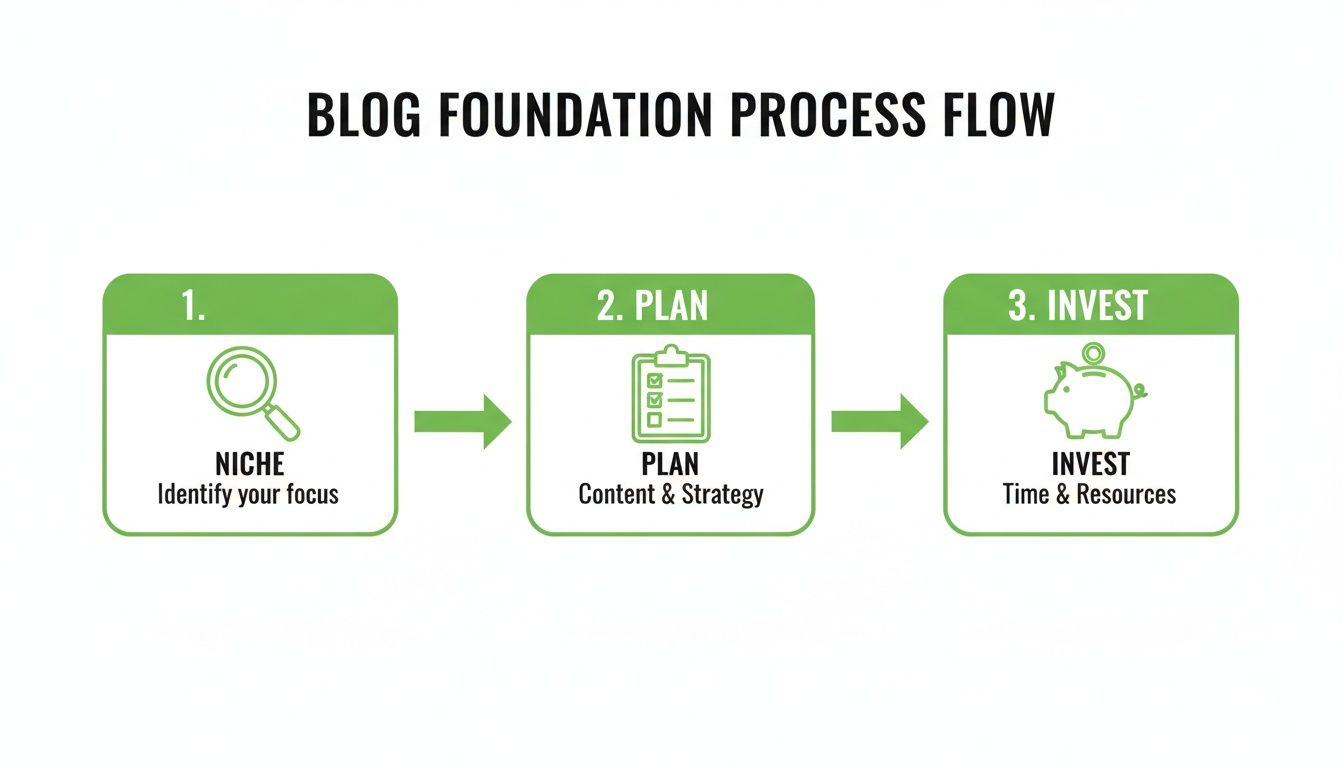
As you can see, it all starts with a well-defined niche. From there, you create a content plan and make a few smart, minimal investments to bring your blog to life. Get this foundation right, and you’re setting yourself up for success.
Launching Your Blog for Less Than a Cup of Coffee
Let’s clear up a common misconception: you don’t need a huge budget to start a blog that looks and feels professional. In fact, you can get the whole thing up and running for a surprisingly small amount. The key is to be smart and strategic with your initial spending, putting your money where it counts toward achieving financial freedom.
The aim of our blog is to provide valuable insights and practical tips to help readers manage their money more effectively. However, the information shared here is for general guidance and educational purposes only. It should not be regarded as professional financial advice. Any actions taken based on our content are entirely the responsibility of the reader, and we accept no liability for the outcomes of those actions. If you require financial advice tailored to your personal circumstances, we strongly recommend seeking assistance from a qualified financial adviser.
With that out of the way, let’s break down how to get your blog online without breaking the bank.
Getting Your Domain and Hosting Sorted
First things first, you need a domain name (your blog’s address, like collapsedwallet.com) and a hosting plan (the service that stores your blog’s files and makes them accessible online). Think of your domain as your street address and hosting as the piece of land your website is built on.
When you’re picking a domain, try to find something memorable that reflects your niche. While a .com is the gold standard, don’t get discouraged if your first choice is taken. Other options like .co or .net work just as well.
For hosting, there’s no need to splurge on a pricey plan right away. Most reputable hosting companies have introductory offers that cost just a few dollars a month. This is more than enough power to handle the traffic you’ll get as a brand-new blog. You can always upgrade later as your audience grows. This lean approach is a smart habit to build—in fact, you can find more tips like this in our guide on how to lower business expenses.
Installing WordPress and Your Basic Toolkit
With your domain and hosting secured, it’s time to install WordPress. This might sound technical, but most hosts offer a one-click WordPress installation that does all the heavy lifting for you. It’s usually just a matter of filling out a quick form, and within minutes, you have a live website.
The real power of WordPress comes from its vast library of themes and plugins.
- Themes: These control the look and feel of your blog. You don’t need to spend a dime here to start. There are thousands of fantastic, professional-looking free themes available right in your WordPress dashboard.
- Plugins: These are like apps for your website, adding new features. You can add a contact form, beef up your security, or make your site faster, all with free plugins.
My advice? Start with a clean, fast-loading free theme and just a handful of essential plugins for security, site speed, and basic SEO. Keeping it simple at the start saves money and ensures your visitors have a great experience.
Starting a blog in a field like personal finance isn’t just a side project; it’s a proven path to a real income. The numbers speak for themselves. According to 2026 blogging statistics, the average blogger in the U.S. earns an impressive $103,446 annually. This shows just how well bloggers in sought-after niches can do, with personal finance being the second most profitable, pulling in a median monthly income of $9,100. You can discover more insights about these blogging statistics to see the full potential.
Creating Content That Attracts Both Readers and Revenue
Now that you’ve got the technical bits sorted, we can dive into the heart of your blog: the content. This is what truly drives income. High-quality, genuinely helpful articles are the engine of any successful blog, building the trust and traffic that make monetization a reality.
The aim of our blog is to provide valuable insights and practical tips to help readers manage their money more effectively. However, the information shared here is for general guidance and educational purposes only. It should not be regarded as professional financial advice. Any actions taken based on our content are entirely the responsibility of the reader, and we accept no liability for the outcomes of those actions. If you require financial advice tailored to your personal circumstances, we strongly recommend seeking assistance from a qualified financial adviser.
Alright, let’s get back to it. Forget just writing what you think people want. The real key is creating content that solves a specific, urgent problem for your audience. That’s how you turn a casual visitor into a loyal follower.
Brainstorming Topics That Solve Problems
Your best ideas won’t come from a vacuum; they’ll come directly from your audience’s biggest headaches. What financial questions keep them up at night? What money challenges are they constantly trying to overcome? Your job is to provide the clearest, most actionable answers you can.
Imagine your ideal reader is a young family trying to finally get out of debt. A generic post on “saving money” won’t cut it. You need to get specific and offer immediate value.
- A Detailed Guide to the Zero-Based Budget: Don’t just explain it. Create a step-by-step tutorial showing exactly how to put this powerful method into practice.
- An Honest Review of a Popular Investment App: Actually use the app and share your real experience. Detail the good, the bad, and the ugly for a true beginner.
- A Simple Breakdown of How ETFs Work: Take a complex financial topic and completely demystify it, making it accessible to someone who’s brand new to investing.
This approach—creating content that is a solution—is everything. It shifts your mindset from “writing an article” to “helping a person,” which is the secret sauce for building a blog that actually earns money.
Structuring Your Posts for Maximum Engagement
How you present your content is just as important as the words themselves. A massive wall of text is a surefire way to send readers bouncing right off your page. You have to make your articles easy to scan and digest, especially on a phone.
You must build your content for scanners. People rarely read every single word online. They scan for headings, bullet points, and bold text to find what they need—fast.
To nail this, stick to a simple but effective framework.
Focus on creating plenty of white space with short paragraphs, aiming for no more than 2-3 sentences each. This makes the page feel less intimidating and much easier to read.
Then, break up your article with clear, descriptive subheadings. These act as signposts, guiding readers to the sections that are most relevant to them.
Finally, use compelling visuals. A well-placed image, screenshot, or simple graphic can do wonders to illustrate a point and break up long stretches of text. Following this structure is a huge part of learning how to earn income from blogging because it keeps people on your site longer, signaling to search engines that you’re providing real value.
Building a Content Calendar for Consistency
Consistency is absolutely non-negotiable if you want your blog to grow. Posting sporadically tells both your readers and the search engines that you’re not taking this seriously. A content calendar is your best friend here.
It doesn’t have to be some fancy, complicated system. A simple spreadsheet is all you need to plan your topics, set deadlines, and maintain a steady flow of fresh content. This consistency is what builds momentum and establishes your blog as a go-to resource.
To keep up the pace without burning out, it helps to learn how to work more efficiently. You can discover how to write blog posts faster with an AI-powered workflow and stay on top of your schedule.
Ultimately, creating content that brings in revenue comes down to one thing: providing immense value. When you put all your focus on genuinely helping your audience, the traffic and the income will follow. While blogging is a fantastic way to build your financial future, if you need cash sooner, consider exploring our list of ways to make extra money from home.
Here’s how you can turn all that great content into actual income. This is the exciting part, where your blog starts working for you.
When you’re writing about personal finance, monetizing isn’t just about slapping ads on your site and hoping for the best. It’s about thoughtfully connecting your readers to tools and resources that will genuinely help them on their financial journey.

The aim of our blog is to provide valuable insights and practical tips to help readers manage their money more effectively. However, the information shared here is for general guidance and educational purposes only. It should not be regarded as professional financial advice. Any actions taken based on our content are entirely the responsibility of the reader, and we accept no liability for the outcomes of those actions. If you require financial advice tailored to your personal circumstances, we strongly recommend seeking assistance from a qualified financial adviser.
Your goal is to build trust that lasts. That means every way you make money should feel like a natural extension of your mission to help people with their finances. Let’s look at the smartest ways to do just that.
Start With Affiliate Marketing
If you’re wondering where to begin, my answer is almost always affiliate marketing. It’s the perfect first step for new personal finance bloggers.
Here’s how it works: You partner with brands you already use and love—maybe a budgeting app, a high-yield savings account, or an investing platform. You then earn a small commission when a reader clicks your unique link and signs up or buys something.
This method just feels right because it’s built on authentic recommendations. When you write a detailed review of a tool that genuinely helped you crush debt, your affiliate link isn’t a sales pitch; it’s a helpful shortcut for readers who want to follow in your footsteps.
The numbers back this up. For bloggers earning between $7,500 and $25,000 a month, affiliate marketing is the heavyweight champion, bringing in 42.2% of their income. It easily beats out display ads (33.3%) and sponsored posts (12.1%). For a blog about achieving financial freedom, it’s a no-brainer.
Layer in Display Ads (at the Right Time)
Display ads are those banners you see in sidebars and sprinkled throughout articles. They’re a classic blog income stream, but timing is absolutely critical.
Putting ads on a brand-new site with hardly any traffic will just annoy your first few readers for what will likely be pennies a day. It’s not worth it.
My advice? Hold off on ads until you have a steady flow of traffic—I’m talking at least 10,000 monthly sessions. Once you hit that number, you can apply to premium ad networks like Mediavine or Raptive (formerly AdThrive) that offer much better payouts than Google AdSense.
When you reach that milestone, ads become a fantastic source of largely what is passive income in our detailed guide. You set them up, and they generate revenue in the background while you focus on creating great content.
Create and Sell Your Own Digital Products
This is where your income potential really starts to explode. When you sell your own products, you’re no longer earning a small commission—you’re keeping the lion’s share of the profit.
For a personal finance blog, the opportunities are huge. Think about what your readers are constantly asking for or struggling with.
You could easily create:
- Budgeting Templates: Well-designed spreadsheets or printable PDFs that make tracking expenses simple.
- Debt Payoff Planners: A step-by-step workbook to help someone get organized and motivated to pay off debt.
- A Mini-Ebook: A short, powerful guide on a specific topic, like “Getting Started with Index Funds” or “How to Build Your First Emergency Fund.”
Of course, you’ll need a way to sell them. Choosing from the best platforms for selling digital products is a key step, as they handle all the backend stuff like payment processing and file delivery, making it seamless for everyone.
Explore Sponsored Posts Authentically
As your blog grows and builds authority, you’ll find that brands start reaching out for sponsored posts. This is when a company pays you to feature their product or service in an article.
The golden rule here is authenticity. Full stop.
Only work with brands you genuinely respect and that make sense for your audience. A sponsored post should never feel like a jarring advertisement; it should read like a valuable piece of content that happens to feature a product you endorse. And always, always disclose that it’s a sponsored post. Your readers’ trust is your most valuable asset—don’t compromise it.
To help you decide which path to start with, here’s a quick comparison of the most popular monetization methods.
Blog Monetization Methods at a Glance
| Monetization Method | Best For | Potential Income | Effort Level |
|---|---|---|---|
| Display Ads | Blogs with 10k+ monthly sessions | Low to Medium | Low (once set up) |
| Affiliate Marketing | New and established blogs | Medium to High | Medium |
| Digital Products | Blogs with a loyal audience | High to Very High | High (upfront) |
| Sponsored Posts | Blogs with established authority | Medium to High | Medium |
Ultimately, the best strategy is a mixed one. Starting with affiliate marketing gives you early wins, while adding ads and your own products later on helps you build a diverse and resilient income stream.
Driving Sustainable Traffic to Your Blog

Writing incredible content is a huge accomplishment, but it’s only half the job. The most insightful article in the world won’t make a dime if no one ever sees it. That’s where a smart traffic strategy comes in—it’s how you get your hard work in front of the people who need it most.
Our goal isn’t just a one-time traffic spike from a viral post. We’re after something much more valuable: a sustainable, steady stream of visitors that grows over time. This means building a community, not just chasing clicks. To do that, you need a solid plan that doesn’t put all your eggs in one basket.
Let’s walk through the essential ways to bring consistent, high-quality traffic to your new blog.
Master the Basics of SEO
SEO, or Search Engine Optimization, can sound intimidating, but the idea behind it is simple. You’re just making it easy for search engines like Google to find your content and show it to the right people.
Here’s a sobering fact: an estimated 90% of web pages get zero organic traffic from Google. Our mission is to land your blog in the 10% that do, and it starts with understanding keywords.
Keywords are simply the phrases your ideal readers are typing into the search bar. Think “how to start a budget” or “best investment apps for beginners.” You can use free tools to discover what people in your niche are searching for. Once you have a target keyword for an article, you need to place it strategically:
- In your post title: This is the most important signal to Google.
- In your subheadings: Use keywords to structure your article logically.
- Within the first paragraph: Mention your main keyword early on to confirm the topic.
- Throughout the body: Weave in your keyword and related phrases naturally. Don’t force it.
SEO is a marathon, not a sprint. It can easily take months before a new blog starts seeing meaningful traffic from search engines. The key is consistency. Keep publishing high-quality, optimized content, and have patience.
Build Your Email List from Day One
Your email list is the single most important asset you will build as a blogger. You don’t own your social media following or your search engine ranking—those can change in an instant. But your email list? That’s a direct line to your audience that you control completely.
From the moment your blog goes live, you need a simple way for people to subscribe. Don’t overthink it. A basic sign-up form in your sidebar or at the end of every post is all you need to get started. To make it more enticing, offer a small “freebie” in exchange for their email, like a downloadable budget tracker or a simple checklist.
This direct access is incredibly powerful. Every time you publish a new article, you can send it straight to your subscribers’ inboxes for an instant burst of traffic and engagement. This is a crucial piece of learning how to earn income from blogging, as it builds a loyal community that trusts you and will be more receptive to your offers later.
Use Social Media Strategically
Social media can be a fantastic source of traffic, but you have to be smart about it. The biggest mistake new bloggers make is trying to be everywhere at once. Spreading yourself thin across five different platforms is a fast track to burnout with very little to show for your efforts.
Instead, pick just one or two platforms where your target audience actually hangs out.
If you’re writing about personal finance for young adults, Instagram or TikTok might be your best bet. If your blog is about career development for professionals, you should probably focus your energy on LinkedIn.
Don’t just drop links to your latest posts and disappear. Use social media to start conversations. Ask questions, share quick tips pulled from your articles, and engage with people in the comments. Think of it as the friendly handshake that invites people back to your blog for the full, in-depth story.
Common Questions About Earning an Income From Blogging
Alright, let’s talk about the big questions that are probably bouncing around in your head. When you’re just starting out, the path to actually making money from a blog can feel a bit murky. It’s totally normal to wonder about timelines, common pitfalls, and what this is really going to cost you.
The aim of our blog is to provide valuable insights and practical tips to help readers manage their money more effectively. However, the information shared here is for general guidance and educational purposes only. It should not be regarded as professional financial advice. Any actions taken based on our content are entirely the responsibility of the reader, and we accept no liability for the outcomes of those actions. If you require financial advice tailored to your personal circumstances, we strongly recommend seeking assistance from a qualified financial adviser.
Now, let’s clear up some of that uncertainty so you can move forward with confidence.
How Long Does It Realistically Take to Start Earning?
This is the big one, isn’t it? While you might hear exciting stories of bloggers making money in a few months, that’s the exception, not the rule. For most of us, a realistic timeline for earning a consistent, meaningful income is somewhere between 12 and 24 months.
Why so long? Because your first year is all about building the foundation. Think of it as constructing an asset.
- You need a content library. A handful of posts won’t cut it; you need a solid base of genuinely helpful articles.
- You have to build authority. This comes from consistently showing up and proving to readers that you know your stuff.
- SEO needs time to work its magic. It takes a while for Google to start trusting your site and sending you that sweet, free traffic.
Patience is your most valuable asset in this game. Many bloggers who now earn a full-time living didn’t see significant revenue for their first one to two years. Your focus should be on consistent effort, not instant results.
What Are the Biggest Rookie Mistakes in Monetization?
The excitement of earning your first dollar can lead new bloggers to make mistakes that actually sabotage their long-term success. I see it all the time.
One of the most frequent errors is plastering ads and affiliate links all over a blog that has barely any traffic. When you only have a few dozen visitors a day, you’ll earn literal pennies, and you risk annoying the very first people who chose to give you their attention.
Another classic mistake is promoting products you don’t actually believe in. Your readers are smart; they can sniff out an inauthentic sales pitch from a mile away. Pushing a product just because it has a high commission is the fastest way to break the trust you worked so hard to build.
But the biggest failure of all? Giving up too soon. Most blogs that fail are simply abandoned within the first 18 months—often right before the compound effect of their efforts was about to kick in.
Can You Really Start a Blog on a Tiny Budget?
Absolutely. The myth that you need to sink a ton of cash into a blog to make it profitable is just that—a myth. You can get a professional-looking site up and running for surprisingly little.
Your essential startup costs are tiny. You really only need two things:
That’s it. You can build out the rest with incredible free tools. The WordPress.org platform is free, and there are thousands of fantastic free themes and plugins to make your site look and feel great. Your biggest investment won’t be money; it will be your time.
Do You Need to Be a Financial Expert?
No, you don’t need to be a Certified Financial Planner to run a successful personal finance blog. What you do need is to be passionate, knowledgeable, and completely committed to providing accurate, well-researched information.
Think about it: many of the best finance bloggers are simply people who became experts in their own financial story. They’re the ones who clawed their way out of massive debt, figured out how to budget for a growing family, or taught themselves how to invest from scratch.
Your personal experience is your superpower. Be authentic, share what you’ve learned, and always focus on empowering your readers to make their own informed choices.
At Collapsed Wallet, we’re all about giving you the practical, no-nonsense guidance you need to take control of your money. If you’re ready to build a more secure financial future, explore our guides and start your journey today at https://collapsedwallet.com.

collapsed.wallet.admin.usr
Writes plain-English money guides for Collapsed Wallet — beginner-first, jargon-free and independent.