

Table of Contents
This blog post may contain affiliate links. As an Amazon Associate I earn from qualifying purchases.
Meal planning isn’t just about figuring out what’s for dinner. When you get serious about it, it becomes one of the most powerful tools you have for taking control of your money. It’s a strategic way to slash your grocery bill, fight back against rising food prices, and put those savings to work building the financial future you want. Here you will find all the tips and tricks for budget friendly meal planning!
The aim of our blog is to provide valuable insights and practical tips to help readers manage their money more effectively. However, the information shared here is for general guidance and educational purposes only. It should not be regarded as professional financial advice. Any actions taken based on our content are entirely the responsibility of the reader, and we accept no liability for the outcomes of those actions. If you require financial advice tailored to your personal circumstances, we strongly recommend seeking assistance from a qualified financial adviser.
How Meal Planning Shapes Your Financial Future
It’s easy to overlook how much our food spending really affects our overall financial picture. Think about it: an unplanned takeaway here, a daily coffee there, a few impulse buys at the supermarket… it all adds up. These little leaks are often the exact reason so many of us struggle to save, invest, or escape financial worries.
When you start planning your meals, you’re not just making a grocery list; you’re taking back control over one of the biggest and most flexible parts of your household budget. This isn’t about depriving yourself—it’s about empowerment. You’re consciously deciding to put your money toward what truly matters, whether that’s building an emergency fund, investing for the long haul, or knocking down your mortgage faster.
The Financial Leaks in an Unplanned Food Budget
Walking into a grocery store without a plan is a recipe for overspending. You’re wide open to clever marketing tricks, you’ll grab things you don’t need, and you’ll inevitably end up wasting food.
Meal planning plugs these common financial drains:
- Impulse Buys: That rack of snacks at the checkout or the BOGO deal on something not on your list? Those can easily add 10-20% to your total bill.
- The Convenience Tax: Pre-chopped veggies, jarred sauces, and ready-made meals come with a hefty price tag. A little planning helps you avoid these for a fraction of the cost.
- The “What’s for Dinner?” Panic: After a long day, it’s tempting to just order takeout. A plan eliminates that last-minute decision and the expensive bill that comes with it.
- Food Waste: Buying produce without a purpose is like throwing cash directly into the compost bin. A meal plan ensures every ingredient has a job.
Seeing the Real Impact on Your Savings
The financial payoff from planning your meals is real and easy to see. With food prices always seeming to creep up, getting a handle on your grocery spending is more important than ever. The USDA’s Economic Research Service confirms that food prices are expected to keep climbing, which makes smart shopping a crucial financial skill.
Research consistently shows that a solid meal plan can cut a household’s grocery bill by 15–20%. If you spend $600 a month on groceries, that’s an extra $90–$120 back in your pocket every single month.
Over a year, this consistent saving can add up to over $1,000. Imagine what that could do for you—it could jumpstart a new investment, wipe out a credit card balance, or build a respectable emergency fund.
To really see how this could work for you, take a look at the numbers.
Your Potential Annual Savings Through Meal Planning
This table illustrates the direct financial impact of reducing grocery spending by 15% through effective meal planning, highlighting your path to financial freedom.
| Current Monthly Grocery Spend | Potential Monthly Savings (15%) | Potential Annual Savings |
|---|---|---|
| $400 | $60 | $720 |
| $600 | $90 | $1,080 |
| $800 | $120 | $1,440 |
| $1,000 | $150 | $1,800 |
| $1,200 | $180 | $2,160 |
Seeing the annual figures makes it clear: small, consistent changes lead to significant financial wins.
This shift in mindset is the first real step. Stop seeing your grocery bill as just another expense. Start seeing it as a powerful lever you can pull to get you closer to your financial goals, one planned meal at a time.
Building Your Financial Meal Plan Framework
Let’s get one thing straight before we dive in. The tips and strategies I’m sharing here come from years of experience helping people get their food budgets under control. This is all for educational and guidance purposes. I’m not a certified financial adviser, so please don’t take this as professional financial advice. If you need help tailored to your specific situation, it’s always best to chat with a qualified professional. My goal is to give you a solid playbook; what you do with it is up to you.
Alright, with that out of the way, let’s talk about turning the idea of saving money into a real, actionable plan. This isn’t about getting bogged down in complicated spreadsheets or starving yourself. It’s a practical framework to get your grocery spending in line with your bigger financial goals. Think of it as creating a blueprint for your household finances—one where every dollar you spend is a deliberate investment.
This visual really sums up the shift from random spending to intentional saving. It’s all about that planning step.
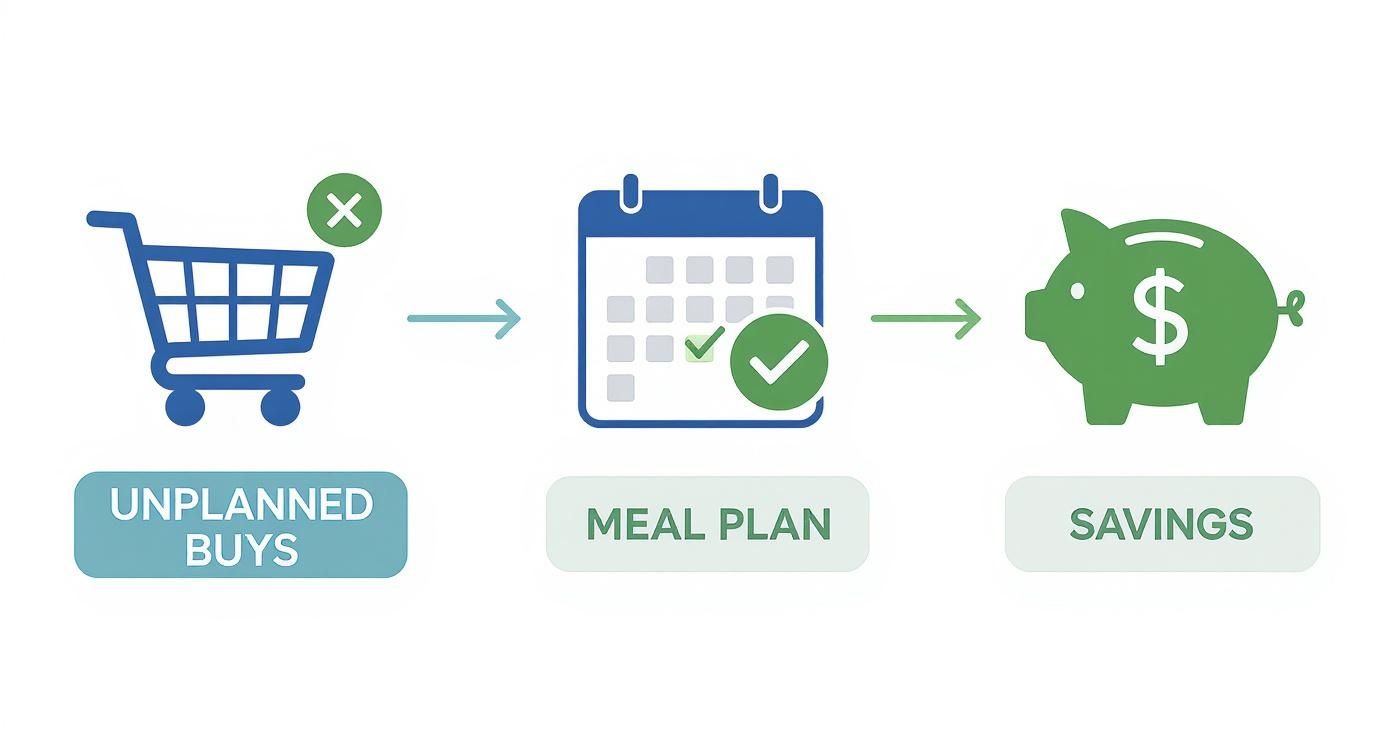
As you can see, slipping that planning phase between your shopping and saving goals is what turns impulse buys into predictable wins for your bank account.
Conduct a Pantry Audit First
Before you even dream of writing a shopping list, your first move is to figure out what you already have. I call this a “pantry audit,” and it’s the absolute cornerstone of any budget-friendly meal planning strategy. The whole point is to stop buying things you don’t need and force yourself to use up the ingredients you’ve already paid for.
Take a few minutes to raid your pantry, fridge, and freezer. Jot down a quick list of what’s in there, paying special attention to anything that’s getting close to its expiration date. You’ll probably be surprised by what you find.
This single step is a direct assault on food waste, which is basically just throwing money in the trash. When you build your first couple of meals around what you already own, you automatically shrink your next grocery bill.
Set a Realistic Food Budget
Once you know your starting inventory, it’s time to draw some financial lines in the sand. Setting a food budget isn’t about depriving yourself; it’s about giving your money a mission. The number needs to be realistic—a percentage of your take-home pay that lets you live well without sabotaging your savings or debt-payoff plans.
A great way to start is by looking at what you spent on groceries and takeout over the last three months. This gives you an honest baseline. From there, see if you can trim it by a manageable amount, like 10-15%.
Your food budget is one of the most powerful levers you can pull in your personal finances. It’s one of the few big expenses you have almost complete daily control over. Get this right, and you’ll free up cash for the things that really matter, whether that’s investing or paying down your mortgage faster.
For instance, if you’ve been averaging $800 a month on food, a 15% cut means your new target is $680. That’s an extra $120 every single month you can redirect toward your financial freedom fund.
Build Your Plan Around Versatile Staples
The real secret to a meal plan that you can actually stick with is to lean heavily on low-cost, versatile ingredients. These are the workhorses of a frugal household. They can show up in multiple recipes throughout the week, which cuts down on waste and squeezes every bit of value from your budget.
Start thinking about your meals from the ground up, using staples like these:
- Legumes: Lentils, pinto beans, and chickpeas are protein powerhouses that cost next to nothing. They’re perfect for various dishes. A bag of dried beans is almost always cheaper than a can.
- Grains: Brown rice, oats, and whole-grain pasta are filling and incredibly cheap. They can form the base for countless different meals.
- Seasonal Produce: This is a big one. Buying fruits and veggies when they’re in season will always save you money. Check your local grocery flyers to see what’s on sale this week.
- Starchy Vegetables: Potatoes, sweet potatoes, and carrots last for a long time, are consistently affordable, and can be used in almost any meal.
When you prioritize these ingredients, you fundamentally drive down your cost-per-meal. Your budget suddenly stretches way further without you having to sacrifice nutrition.
Simplify Decisions with Theme Nights
Honestly, one of the biggest reasons meal plans fail is good old-fashioned decision fatigue. You get home after a long day, and the last thing you want to do is make another choice. That’s when the lure of expensive takeout becomes almost impossible to resist.
This is where theme nights are a game-changer.
By assigning a simple theme to each night of the week, you eliminate most of the guesswork. It creates a structure that’s easy to follow but still leaves room for creativity. You’ll find that planning becomes much faster and requires way less mental energy.
Here are a few simple ideas to get you started:
- Pasta Night: A classic for a reason. Pasta is cheap, and you can switch up the sauce and toppings based on sales or what needs to be used up.
- Taco Tuesday: Use ground turkey, lentils, or beans for the filling. The toppings are easy to customize.
- Soup & Sandwich Saturday: The perfect way to use up leftover veggies, the last few slices of bread, and small bits of protein.
- Leftover Remix Friday: Get creative! Challenge yourself to combine leftovers from the week into a totally new meal, ensuring nothing goes to waste.
This simple system turns meal planning from a daily chore into a predictable, low-stress routine. It’s exactly this kind of habit-building that leads to long-term financial success.
Mastering the Strategic Grocery Shop
Once you’ve got your meal plan sorted, the grocery store stops being a chore and starts feeling more like a mission. This is where all that planning pays off, creating a buffer between your wallet and all those sneaky temptations designed to make you spend more. When you walk in with a plan, you’re the one in control of your food budget, not the other way around.
Heads up: The advice here is based on my experience and is for educational purposes. It’s not professional financial advice. If you need financial guidance tailored to your specific situation, I always recommend chatting with a qualified financial adviser.
Shop Less and Save More
Here’s a simple but powerful trick: go to the grocery store less often. Seriously. Every time you pop in for “just a few things,” you open the door to impulse buys. By planning for a full week—or even two—you slash those opportunities to overspend.
This approach just naturally makes you more intentional. A bi-weekly shop demands a solid plan, making sure you leave with everything you need and nothing you don’t. It’s a discipline that really pays off in the long run.
Decode Unit Pricing for True Value
Don’t let the big, bright price tag fool you; it’s not always the best deal. The secret is to look for the unit price—that tiny number on the shelf tag that breaks down the cost per ounce, per pound, or per item. It’s the only way to do a true apples-to-apples comparison.
A bigger package might have a higher sticker price, but the unit price could be way lower, saving you money over time. Getting into the habit of checking this is a small change that leads to consistent savings. For more ideas on how to slash your bill, you might find our guide on grocery savings tips helpful.
Embrace Store Brands and Bulk Buys Wisely
Switching from name brands to store brands is one of the fastest ways to cut your grocery bill. A lot of the time, these products are made in the exact same factories as their pricier cousins. You’re just paying for the food, not for a massive marketing budget.
Buying in bulk can be another game-changer, but you have to be smart about it.
- Stick to non-perishables: Things like rice, pasta, canned goods, and toilet paper are perfect for bulk buying.
- Always check the unit price: Make sure the bulk option is actually cheaper per unit. Sometimes it isn’t!
- Got space? It’s not a deal if you have to cram it into a closet or it goes bad before you can use it.
Buying in bulk only saves money if you actually use everything before it expires. Wasted food is just wasted money, no matter how great the initial “deal” was.
Use Sales Flyers and Digital Coupons to Your Advantage
Your shopping list shouldn’t be written in a bubble. Before you even decide on meals, pull up the weekly sales flyer. If chicken thighs or seasonal veggies are on sale, build your plan around those. It’s a simple, proactive way to let the store’s promotions work for you.
And don’t forget digital coupons. Most grocery stores have an app where you can “clip” coupons with a tap. Spending just a few minutes doing this before you shop can easily shave 5-10% off your total.
With the cost of living on the rise, it’s no surprise that more people are planning their food. The global meal kit market, valued at around USD 16.2 billion in 2023, is a testament to this. Studies even show these services can cut household food waste by up to 30%, which is a direct saving.
One last tip: organize your shopping list by the store’s layout (produce, dairy, pantry, frozen). This helps you move through the aisles efficiently, prevents backtracking, and gets you out the door faster—before that fancy end-cap display convinces you that you really need something you didn’t plan for. You get in, get what you need, and get out. Mission accomplished.
Using Technology for Smarter Meal Planning
If you’re not using technology to help with your budget friendly meal planning, you’re leaving money on the table. The right tools can turn this weekly chore into a powerful way to hit your financial goals by automating the tedious parts, spotting savings, and keeping you on track.
Streamline Your Strategy with Dedicated Apps
There’s an app for just about everything, and meal planning is no exception. These tools are designed to take the guesswork out of the process, which is a huge win for your food budget.
- Recipe Organizers: Think of an app like Paprika as your personal digital cookbook. You can clip recipes from any website, and the app instantly organizes the ingredients and instructions. The real financial upside? No more buying a second jar of cumin because you forgot you already had one. Your entire recipe collection is in your pocket.
- Automated Meal Planners: This is where things get really efficient. Apps like Mealime can generate an entire week’s worth of meals based on your food preferences and diet. Then, it creates one consolidated shopping list for you. This is the ultimate weapon against impulse buys and those costly last-minute “what’s for dinner?” decisions.
- Savings and Cashback Apps: Tools like Flipp and Ibotta put money directly back into your budget. Flipp lets you browse all the local weekly sales flyers, so you can build your meal plan around what’s on sale. Ibotta gives you cashback on specific items you were already buying. The savings add up fast.
By weaving these apps into your routine, you create a system that saves more than just time. You’re building a solid defense against the small, unplanned purchases that slowly eat away at your budget.
Build a Personalized Financial Dashboard
For anyone who loves seeing the numbers, creating a custom dashboard in a simple spreadsheet is a game-changer. Using Google Sheets or Microsoft Excel, you can track exactly what your food is costing you, right down to the price per meal.
It’s easier than it sounds. Just set up columns for the date, meal, ingredients, total cost, and cost per serving. As you plan and shop each week, you simply fill it in.
This hands-on approach creates a powerful link between your daily meals and your wallet. Seeing that a well-planned meal costs only $1.50 per serving makes it much easier to skip that $15 takeout order. It’s all about perspective.
This kind of detail gives you incredible insight into your spending habits. Over a few months, your dashboard will show you which meals give you the best bang for your buck, helping you refine your budget friendly meal planning for maximum savings. To get a better handle on managing this kind of data, check out our guide on how to track your expenses.
Not sure which tech approach is right for you? This table breaks down the options.
A Comparison of Meal Planning Technologies
A feature-based comparison of different technology types to help you choose the best tool for your financial and planning style.
| Tool Type | Key Financial Benefit | Best For | Example Apps |
|---|---|---|---|
| Recipe Organizers | Prevents duplicate purchases and food waste | Individuals who enjoy finding and saving their own recipes | Paprika, AnyList |
| Automated Planners | Eliminates impulse buys with pre-made shopping lists | Busy individuals or families needing maximum efficiency | Mealime, PlateJoy |
| Savings & Cashback | Reduces the final cost of groceries through deals and rebates | Shoppers willing to browse offers before they shop | Flipp, Ibotta |
| Spreadsheets | Provides detailed cost-per-meal analysis and budget tracking | Data-driven individuals who want granular control over their spending | Google Sheets, Excel |
Ultimately, the best tool is the one you’ll actually use. Whether you prefer the set-it-and-forget-it nature of an app or the fine-tuned control of a spreadsheet, embracing technology is a smart move on your journey to financial freedom—one meal at a time.
Advanced Strategies to Maximize Your Food Budget
Once you’ve got the basics of meal planning down, you can start exploring some next-level strategies. These aren’t just about trimming the fat from your grocery bill; they’re about fundamentally shifting how you see your household finances and the food in it. Think of it as moving from just saving money to actively creating value right in your own home.
Just a quick heads-up: The insights and tips we share on our blog are here to help you get a better handle on your money. This is all for general guidance and educational purposes, so please don’t take it as professional financial advice. Any action you take is your own responsibility. If you need financial advice for your specific situation, we really recommend chatting with a qualified financial adviser.
Embrace Strategic Meal Prep
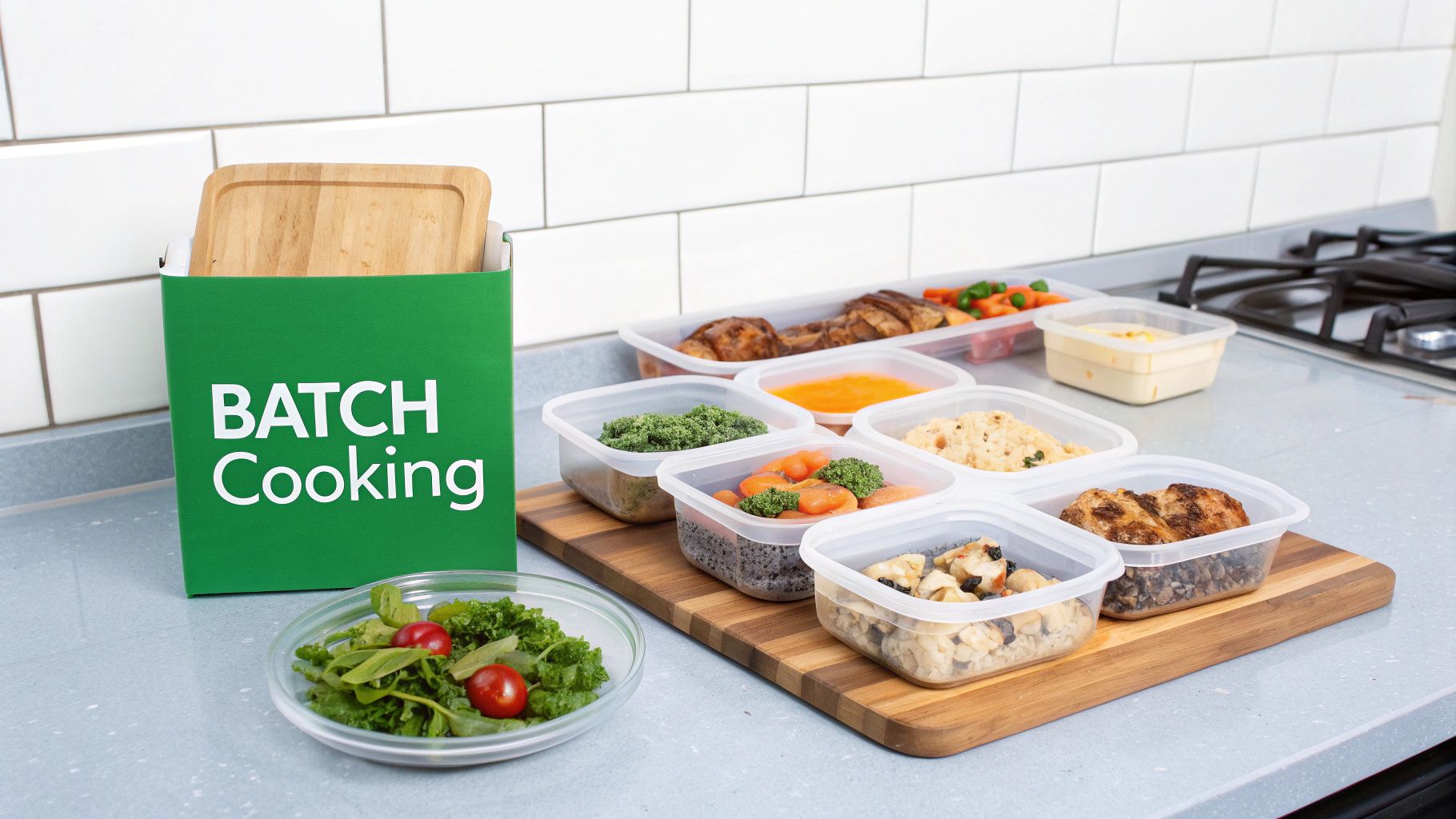
Let’s reframe “meal prep.” It’s not just about having leftovers for lunch. It’s a financial defense system. When you dedicate a couple of hours on a Sunday to prep core ingredients, you’re building a firewall against those expensive, last-minute takeout orders that sabotage your budget during a chaotic week.
This doesn’t mean you have to prepare five entirely different meals at once. The real trick is to focus on versatile building blocks.
- Prepare a big batch of a staple grain like brown rice or quinoa.
- Roast a whole sheet pan of whatever seasonal veggies are on sale.
- Prep a flexible protein, like a few pounds of shredded chicken or a big pot of lentils.
With these components ready to go, you can throw together different meals in minutes. A rice bowl Monday, a loaded salad Tuesday, a quick burrito Wednesday—you get the idea. This simple habit saves you a ton of time, but more importantly, it locks in your food spending for the week.
Adopt a Zero-Waste Kitchen Mindset
Every scrap of food that goes into the trash is money down the drain. Plain and simple. When you start thinking with a zero-waste mindset, you see leftovers and food scraps not as garbage, but as untapped assets. This is a game-changer for truly effective budget friendly meal planning.
Think about it: those vegetable peels, onion skins, and carrot tops can be saved for a rich, flavorful—and completely free—vegetable broth. That slightly stale bread? It can become croutons or breadcrumbs. Leftover roasted veggies can be blended into a creamy soup for tomorrow’s lunch.
By challenging yourself to use everything, you fundamentally change your relationship with your groceries. You stop throwing money away and start maximizing the return on your initial investment, squeezing every last drop of value out of what you buy.
It’s a powerful habit that compounds your savings over time, ensuring your grocery budget is working as hard for you as it possibly can.
Build Meals Around Low-Cost Staples
The single most impactful financial move you can make in your household is to build your meals on a foundation of low-cost, high-value staples. These are your nutritional and financial powerhouses: beans, lentils, potatoes, rice, and oats. Instead of making an expensive cut of meat the star of the show, you relegate it to a supporting role.
This isn’t a new concept. Large-scale food programs have been using this model for years. For instance, in many lower- and middle-income countries where every penny counts, school meal programs center their meals on staples like rice, maize, and lentils. By buying in bulk and using simple recipes, some programs can get the cost per meal as low as USD 0.25–0.50. You can see how they make it work in the GCNF Global Survey Report.
You can apply the exact same logic at home. Make a hearty lentil soup the main event and just add a little sausage for flavor. You’ll find the cost per serving plummets compared to a meat-centric dish. For more ideas on these foundational foods, check out our guide to building an inexpensive healthy grocery list. It’s not about deprivation; it’s about being smart.
When you combine strategic meal prep, a zero-waste philosophy, and a focus on inexpensive staples, you create a powerful system for financial savings. You’re no longer just budgeting—you’re actively engineering a lower cost of living, freeing up cash to build your future and finally get ahead.
Answering Your Top Meal Planning Questions
Getting started with meal planning on a budget always brings up a few questions. Let’s tackle some of the most common roadblocks people run into, so you can feel confident and stick with it for the long haul.
How Do I Stick to Meal Planning When I’m Busy?
This is the big one. Life gets chaotic, and when it does, the meal plan is often the first thing to go out the window. The secret isn’t finding more time; it’s creating a system that works for your busy schedule, not against it. You have to make the smart financial choice the easiest choice.
Here are a few practical ways I’ve learned to stay consistent:
- Keep it simple. Weeknight dinners don’t need to be gourmet. Focus on recipes with just a handful of ingredients and quick prep times.
- Embrace the slow cooker. This appliance is a lifesaver. You can add a few ingredients in the morning and come home to a hot, affordable meal. No last-minute stress.
- Prep components, not whole meals. Spend an hour or two on Sunday prepping the building blocks. Prepare a big batch of quinoa or rice, chop all your veggies for the week, or prepare a pack of chicken breasts to use in salads, wraps, or stir-fries. This tiny time investment pays off big time on a frantic Tuesday night.
What if I Get Bored with My Meals?
Variety is absolutely essential if you want this to become a habit. Nobody, and I mean nobody, wants to eat the same three meals on repeat forever, no matter how much money they’re saving. The trick is to build variety into your plan without blowing your budget or your schedule.
Boredom is the enemy of any sustainable financial plan. If you get tired of your food, you’re far more likely to ditch the plan for expensive takeout just to feel something new.
Here’s how to keep things interesting:
- Create a “greatest hits” list. Write down 10-15 of your family’s favorite, go-to affordable meals. This becomes your core rotation, giving you plenty of options to pull from without having to start from scratch every single week.
- Try one new recipe a week. This is my favorite rule. It satisfies that craving for something different without overwhelming you. If it’s a hit, add it to your master list!
- Become a master of your spice rack. This is the cheapest and fastest way to transform a meal. The same basic dish of chicken and rice can taste completely different with a switch from Italian herbs to a curry powder blend or a smoky BBQ rub.
Is It Really Cheaper Than Processed Foods?
Yes. Over the long term, planning your meals around whole foods is almost always cheaper. A single frozen pizza might look like a deal at the store, but when you break it down, the cost per serving for meals made from staples like beans, rice, seasonal produce, and pasta is significantly lower.
Planning from scratch gives you total control over where your money goes. You’re not paying for packaging, marketing, or convenience—just the food itself. It’s the most direct way to make every dollar in your grocery budget count.
Here at Collapsed Wallet, our goal is to give you clear, actionable financial advice to help you build a more secure future. For more practical strategies, come find more of our guides and articles at Collapsed Wallet.

4 thoughts on “Master Budget Friendly Meal Planning to Secure Your Finances”