

Table of Contents
This blog post may contain affiliate links. As an Amazon Associate I earn from qualifying purchases.
Let's be real—trying to get a handle on your money as a young adult can feel like a total nightmare. You're juggling student loans, rent that seems to go up every year, and this constant pressure to have everything figured out. It’s enough to make anyone stressed. This guide is here to change that. We're going to reframe budgeting from a chore you dread into your secret weapon for taking back control and building a life you actually love. We'll get into real-world strategies that work, without the confusing jargon or judgment.
The aim of our blog is to provide valuable insights and practical tips to help readers manage their money more effectively. However, the information shared here is for general guidance and educational purposes only. It should not be regarded as professional financial advice. Any actions taken based on our content are entirely the responsibility of the reader, and we accept no liability for the outcomes of those actions. If you require financial advice tailored to your personal circumstances, we strongly recommend seeking assistance from a qualified financial adviser.
Why Your Budget Is Your Best Financial Tool
The word "budget" gets a seriously bad rap. For most people, it brings up images of a strict financial diet, forcing you to say "no" to everything fun. But that’s not what it’s about at all.
A good budget is the complete opposite—it’s a plan that gives you permission to spend on the things that actually matter to you. It's the roadmap that takes you from feeling constantly worried about money to feeling financially free.
Without a plan, it's way too easy to let your spending get away from you and then wonder where your entire paycheck went a week after you got it. A budget brings clarity and turns that vague money anxiety into a clear, actionable game plan.
Shift Your Mindset From Restriction to Intention
The secret to successful budgeting for young adults is a simple mindset shift. Stop seeing your budget as a list of things you can't buy. Instead, look at it as a tool for intentional spending.
This is all about consciously pointing your money toward your goals. Maybe that's saving for a down payment on a house, aggressively paying down student loans, or building an investment portfolio for long-term financial freedom.
When you create a budget, you're not limiting yourself; you're empowering yourself. You're taking control of your own financial story and making choices that line up with the life you want to live. It's a proactive approach that helps you sidestep common money traps, like racking up high-interest credit card debt or failing to build up an emergency fund.
A budget tells your money where to go instead of you wondering where it went. This simple shift in control is the first major step toward achieving your long-term financial goals and escaping money-related stress.
The Foundation for Future Wealth
Think of your first budget as the foundation of a house. It’s not the most glamorous part of the building process, but without that solid base, everything built on top is shaky. The habits you start building today will have a huge impact on your ability to hit those big financial milestones down the road.
Getting a handle on your income and expenses now pays off in a few key ways:
- You become financially aware. You'll get a crystal-clear picture of your spending habits and spot places where you can cut back without feeling like you're sacrificing.
- You start hitting your goals. Vague ideas like "I need to save more" turn into concrete actions, like setting aside a specific amount of money each month for investments or debt repayment.
- You feel less stressed. Seriously. Just knowing you have a plan for your bills, savings, and investments can do wonders for your mental health and help you escape financial worries.
Ultimately, a budget is your personal playbook for winning with money. It helps you navigate today with confidence while actively building the future you deserve.
Get an Honest Look at Your Finances
The aim of our blog is to provide valuable insights and practical tips to help readers manage their money more effectively. However, the information shared here is for general guidance and educational purposes only. It should not be regarded as professional financial advice. Any actions taken based on our content are entirely the responsibility of the reader, and we accept no liability for the outcomes of those actions. If you require financial advice tailored to your personal circumstances, we strongly recommend seeking assistance from a qualified financial adviser.
Alright, let's get real. You can't build a budget that actually sticks until you play detective with your own money.
This first step isn't about judging yourself for that daily latte or the concert tickets you splurged on. It’s about one thing: gathering data. We need a clear, unfiltered picture of what’s really happening with your cash.
Think of it like this: you can't get directions to a new city without knowing your starting point. For one month, your only job is to track every single dollar that comes in and every single dollar that goes out. No cheating. Every little purchase counts.
Choosing Your Tracking Method
There's no magic bullet here. The "best" way to track your spending is simply the one you'll actually use consistently. The goal is to make it as painless as possible, so it doesn't feel like a chore you dread.
Here are a few popular ways to do it:
- A Simple Spreadsheet: If you like being hands-on, a basic Google Sheet or Excel file is perfect. Just create columns for the date, what you bought, its category (like "rent" or "transportation"), and the amount.
- A Dedicated Notebook: Old school, but it works. The physical act of writing down what you spend can be a powerful way to become more mindful of your habits.
- Budgeting Apps: Let technology do the heavy lifting. Apps like Mint or YNAB (You Need A Budget) can sync with your bank accounts and credit cards, automatically sorting your transactions for you.
Honestly, the tool doesn't matter as much as the habit. For a deeper dive into finding a system that clicks with your personality, check out our guide on how to track your expenses. It’s all about finding something you can stick with for the long haul.
Identifying Your Income and Expenses
Once you've picked your weapon of choice, it's time to start logging. You're essentially sorting everything into two big buckets: what's coming in and what's going out.
Income: This is any and all money flowing your way.
- Your paycheck from your main job.
- Cash from any side hustles or freelance gigs.
- Money from family or other support.
Expenses: This is everything else. Break it down into categories so you can see the patterns. For most young adults, the big ones are rent, utilities, loan payments, transportation, insurance, subscriptions, and investments.
Be brutally honest here. That streaming service you forgot you even had? Write it down. The late-night food delivery orders? They count, too. This isn't about shame; it's about collecting accurate data for your future self.
Uncovering Common Spending Traps
Being a young adult comes with its own unique financial pressures. A recent study from Bank of America found that 35% of Gen Z spend more than they expect each month after moving out on their own. That number shoots up to 43% for those aged 23-28.
So, what’s eating up their budgets? The main culprits were housing costs (47%), dining out (42%), and general cost of living increases. It's a clear sign of how quickly expenses can catch up with you if you're not paying attention.
This is why your tracking phase is so important—it helps you spot the little "spending leaks" that sink your budget over time. Be on the lookout for these common traps:
- Subscription Creep: How many streaming, software, and subscription box services are you really using?
- The Convenience Tax: Food delivery, ride-sharing apps, and those little impulse buys at the checkout add up faster than you think.
- Social Spending: FOMO is expensive. The pressure to go out for every dinner, concert, and weekend trip can put a serious strain on your wallet.
After a month of this, you'll have a complete financial snapshot. This is the foundation for everything that comes next. It shows you exactly where you are, reveals your habits, and gives you the power to finally tell your money where to go—not the other way around.
Build a Budget That Fits Your Life
The aim of our blog is to provide valuable insights and practical tips to help readers manage their money more effectively. However, the information shared here is for general guidance and educational purposes only. It should not be regarded as professional financial advice. Any actions taken based on our content are entirely the responsibility of the reader, and we accept no liability for the outcomes of those actions. If you require financial advice tailored to your personal circumstances, we strongly recommend seeking assistance from a qualified financial adviser.
Alright, you’ve done the hard work of tracking where your money is going. Now it’s time for the fun part: telling your money where to go next. This is where you move from just observing your finances to actively directing them.
Building a budget isn't about cutting out all the fun. It’s about creating a plan that actually supports the life you want, whether you're juggling classes and a part-time job, navigating your first "real" salary, or managing the ups and downs of freelance work.
The secret? Find a method that clicks with your personality. A budget should feel like a roadmap, not a straitjacket. If it’s too rigid or a pain to manage, you’ll drop it. Let's look at two popular and genuinely effective approaches.
The 50/30/20 Rule: A Simple Framework for Balance
If you're just dipping your toes into budgeting, the 50/30/20 rule is a fantastic place to start. It’s less of a strict budget and more of a common-sense guideline that splits your after-tax income into three buckets. Simple, clear, and flexible.
Here’s how it works:
- 50% for Needs: This chunk covers your non-negotiables. We're talking rent, utilities, essential transportation, insurance, and minimum debt payments—the stuff you absolutely have to pay.
- 30% for Wants: This is your lifestyle fund. It’s for everything that makes life more enjoyable but isn't essential for survival, like your Netflix subscription, concert tickets, or a weekend getaway.
- 20% for Financial Goals: This last piece is all about building your future. It goes toward creating an emergency fund, saving for big goals, investing, and throwing extra cash at high-interest debt.
People love this method because it provides guardrails without forcing you to track every last transaction. It gives you the freedom to enjoy the money you earn while still making sure you’re hitting your financial goals.
The beauty of the 50/30/20 rule is its simplicity. It prevents you from getting bogged down in tiny details and instead focuses your attention on the big picture of your financial health.
It's shocking how many young people miss out on this foundational skill. Research from Santander UK found that a staggering 79% of young adults aged 18-21 have never actually created a budget. It’s not their fault; this stuff often isn't taught in school, leaving a huge gap in practical knowledge. You can read the full research on youth financial education to see just how widespread the issue is.
Zero-Based Budgeting: For Maximum Control
If the 50/30/20 rule feels a bit too loose for your taste, you might be a great candidate for Zero-Based Budgeting. The idea here is dead simple: Income – Expenses = Zero. Every single dollar gets a job.
With this system, nothing is left to chance. Before the month even begins, you decide exactly how much is going toward bills, loan payments, gas, entertainment, savings—everything. This hands-on approach is perfect for people who love details and want to optimize every penny. It’s also a lifesaver for anyone with an irregular income, since it forces you to make a new plan based on the money you actually have each month.
You literally list your income, then list out all your expenses until the two sides balance. If you have money left over, you have to assign it somewhere, like an extra payment on your student loans or a boost to your investment fund.
This flowchart can help you decide if you're ready to take control of your spending.
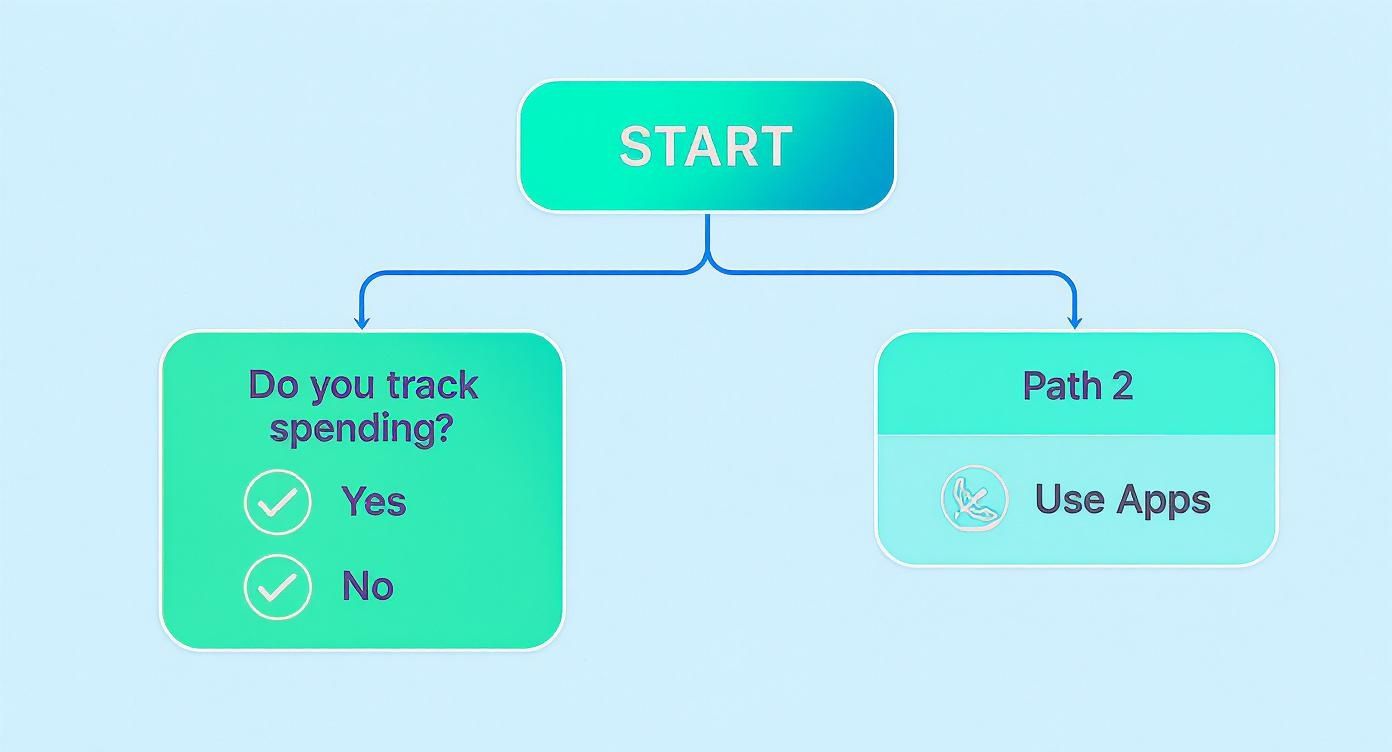
As you can see, it all starts with knowing where your money is going. If you're not there yet, using an app is a great way to get started.
Choosing the Right Method for You
So, which one is better? Honestly, the one you’ll actually stick with. There's no single "best" budget. It’s all about finding what fits your brain and your lifestyle.
To help you decide, here’s a quick comparison of the two approaches.
Popular Budgeting Methods for Young Adults
This table breaks down the 50/30/20 Rule and Zero-Based Budgeting to help you find the approach that best fits your financial style.
| Feature | 50/30/20 Rule | Zero-Based Budgeting |
|---|---|---|
| Effort Level | Low. Simple to set up and maintain. | High. Requires detailed tracking and monthly planning. |
| Flexibility | High. Offers general guidelines, not strict rules. | Low. Every dollar has a specific assignment. |
| Best For | Beginners or those who prefer a hands-off approach. | Detail-oriented individuals or those with variable income. |
| Main Goal | To create a balanced financial life without micromanagement. | To optimize spending and maximize savings with precision. |
Ultimately, whether you go for the laid-back 50/30/20 rule or the laser-focused zero-based budget, you’re taking a huge step. Building a budget is about taking control, making intentional choices, and paving the way to financial freedom. The most important thing is simply to begin.
How to Save Money and Tackle Debt

A solid budget does more than just tell you where your money went last month. It's your game plan for hitting two massive financial milestones: saving for the future and digging out of debt.
Often, saving and paying down debt feel like they’re in a tug-of-war for every spare dollar. The trick is to find a balance that lets you make real progress on both fronts without feeling like you're failing at one to succeed at the other.
Build Your Financial Safety Net First
Before you get aggressive with debt or start dreaming about investments, you need a safety net. This is your emergency fund, and it's non-negotiable.
Think of it as a cash cushion tucked away for when life inevitably goes sideways—a sudden layoff, a busted transmission, or an unexpected medical bill. Without this fund, any one of those emergencies can force you to swipe a credit card and undo all your hard work.
Your first target is a starter emergency fund of $500 to $1,000. It's a manageable goal that can stop a minor inconvenience from becoming a major financial setback. The easiest way to get there? Automate it. Set up a recurring transfer from your checking to a separate high-yield savings account right after every payday.
Once you’ve hit that initial goal, your next mission is to save 3 to 6 months' worth of essential living expenses. Go back to your budget and tally up only the absolute must-pays:
- Rent or mortgage
- Utilities (power, water, internet)
- Essential transportation
- Insurance payments
- Minimum debt payments
So, if your bare-bones monthly expenses are $2,000, your full emergency fund goal is somewhere between $6,000 and $12,000. That number can feel intimidating, but you build it the same way you started: one paycheck at a time.
An emergency fund isn't just about money. It's about buying yourself peace of mind. Knowing you have a buffer to handle whatever comes your way is a huge stress reducer, freeing up mental energy to focus on your bigger goals.
Choose Your Debt Repayment Strategy
While that emergency fund is growing, you can start making a serious dent in your debt. For young adults today, this is a massive hurdle. Student loans and other debts are a much bigger burden than they were for previous generations.
In fact, 2022 data shows that 40% of young adults have student debt, a staggering jump from just 15% in 1989. The amount owed has also exploded, growing nine-fold in that same period. You can discover more insights about young adult debt on treasury.gov for a deeper look at the numbers.
Two battle-tested methods can help you get out of debt for good: the Debt Avalanche and the Debt Snowball. There's no single "best" choice—the right one is whichever one you'll actually stick with.
The Debt Avalanche Method
From a pure math perspective, the Debt Avalanche is the smartest move. The strategy is simple: you attack the debt with the highest interest rate first, no matter the balance. You'll make minimum payments on everything else and throw every extra penny at that one high-interest loan.
- How it works: List your debts from the highest interest rate to the lowest. Focus all your firepower on the one at the top.
- Why it's effective: You save the most money on interest charges over the long haul.
- Best for: Anyone who is driven by numbers and the logic of long-term savings.
Once that first debt is gone, you roll its entire payment (the minimum plus all the extra you were paying) onto the debt with the next-highest interest rate. This creates an even bigger payment and speeds up your progress.
The Debt Snowball Method
The Debt Snowball is all about psychology and momentum. Instead of focusing on interest rates, you list your debts from the smallest balance to the largest. You make minimum payments on everything but throw all your extra cash at the smallest debt until it’s wiped out.
- How it works: You pay off the smallest debt first, scoring a quick and motivating win.
- Why it's effective: The psychological boost from completely eliminating a debt keeps you motivated to continue.
- Best for: Anyone who needs to see fast results to stay in the fight.
After you knock out that first small debt, you take its payment and add it to what you’re paying on the next-smallest one. Your "snowball" of money gets bigger and bigger as you eliminate each debt. You might pay a little more in interest compared to the avalanche, but for many, the motivation from those early victories is absolutely worth it. For more ideas, you can check out our guide on how to pay off debt fast.
Ultimately, balancing savings and debt is a personal call. By building your safety net first and then picking a repayment strategy that fits your personality, you can create a clear path toward financial freedom.
Put Your Finances on Autopilot and Watch Your Money Grow
Look, the best budget is one you don't have to constantly think about. After you've done the hard work of tracking your spending and mapping out a plan, the last thing you want is for it all to unravel just because you got busy and forgot to move some money around. This is where automation becomes your secret weapon.
Putting your finances on autopilot takes willpower and memory out of the equation. It makes saving money and paying bills the default, not an afterthought. It’s the closest you’ll get to a “set it and forget it” system for building real financial stability.
Pay Yourself First—Automatically
This is the single most powerful financial habit you can build. Don't wait until the end of the month to see what’s left for savings. Spoiler alert: it’s usually nothing. Instead, treat your savings goal just like you treat your rent or car payment—as a non-negotiable bill.
The moment your paycheck hits your account (or the very next day), have a transfer automatically scheduled to move a set amount from your checking to your high-yield savings account. When the money is gone before you even see it, you’ll naturally learn to live on the rest. This one simple move guarantees you’re always making progress, whether you're building an emergency fund or saving for a house.
Automate Bill Payments and Kiss Late Fees Goodbye
Late fees are just a tax on being disorganized. Seriously, they are a completely avoidable waste of money. Thankfully, almost every company you owe money to—from your student loan servicer to your electric company—lets you set up automatic payments.
Take one hour, log into all of your accounts, and schedule your payments to be automatically pulled a few days before they’re due. This does more than just save you money on fees; it also protects your credit score from the damage of missed payments. It’s a small investment of your time that pays off big in peace of mind.
By automating your savings and your bills, you’re building a financial foundation that practically runs itself. This frees up your brainpower to focus on bigger things, like increasing your income or optimizing your investments, instead of just juggling due dates.
Let Technology Do the Saving for You
Beyond simple bank transfers, there are some really cool tools out there that can help you save more without even feeling it. Fintech and banking apps have gotten incredibly clever at making saving an invisible, background activity.
Look for apps with features like:
- Round-ups: These tools round up every purchase to the nearest dollar and sweep the change into your savings or investment account. That $3.50 coffee effectively becomes a $4.00 transaction, with $0.50 getting stashed away. It adds up way faster than you’d think.
- Savings Rules: Some apps let you create your own rules. For example, you could set it to transfer $5 to savings every time you hit the gym or visit your favorite coffee shop, turning your habits into a savings engine.
Take the Next Logical Step: Investing
Once your budget is automated and your savings account is growing, you can start thinking about the next level: building long-term wealth through investing. This doesn’t mean you have to become a stock-picking genius overnight.
A fantastic starting point for beginners is learning about Exchange-Traded Funds (ETFs). An ETF is like a basket holding hundreds or even thousands of different stocks or bonds. When you buy a single share of an ETF, you instantly own a tiny piece of all those companies. This diversification helps lower your risk because you aren't just betting on one company to succeed. Instead, you're investing in the broad growth of an entire market, like the S&P 500.
This strategy taps into the power of compound interest, where your earnings start making their own earnings. It’s a snowball effect that can turn small, consistent contributions into a serious nest egg over time. The most important part is just getting started, even with a little bit.
Don't Just Set It and Forget It Forever
Automation is incredibly powerful, but your financial system shouldn't be set in stone. Life happens, and your budget needs to evolve with it. Make a calendar reminder to review your automated setup every six months or so, and definitely check in after any major life event.
- Got a raise? Time to bump up that automatic savings transfer.
- Paid off a car loan? Reroute that old payment amount toward your investment account.
- Subscription costs getting out of hand? Do a quick audit and cancel anything you’re not using.
This regular check-in ensures your autopilot system stays aligned with your current life and future goals, keeping your financial plan sharp and effective as you move forward.
Common Questions About Budgeting
Getting into budgeting for the first time usually kicks up a lot of questions. If you're feeling a little lost as you start building these new money habits, you're not alone. Let's walk through some of the most common hurdles people face and get you some clear answers to keep you moving forward.
How Often Should I Review My Budget?
A budget is not a crockpot—you can't just set it and forget it. Life changes constantly, and your financial plan has to be nimble enough to keep up.
A good rhythm is to do a quick check-in at least once a month. This doesn't need to be a major overhaul. Just set aside 15-20 minutes to see how you did. Did you stick to your spending targets? Do you need to shuffle things around for the month ahead? For instance, if you know a friend's wedding is coming up, you might want to beef up your "gifts" or "entertainment" category temporarily.
Beyond that monthly glance, it’s smart to schedule a deeper review every six months or so. You should also do one after any major life event, like landing a raise, moving to a new apartment, or switching careers. This is your chance to zoom out, look at your big-picture goals, and make sure your budget is still the right tool for the job.
What If I Overspend in a Category?
First things first: don't panic. It happens to literally everyone. Going over your "dining out" budget doesn't mean you've failed at money forever. The real skill is in how you react.
When you overspend in one area, the money has to come from somewhere else. Think of it as a financial game of Tetris—you have a fixed amount of income, and all your expense blocks need to fit. If one block is too big, you have to shrink another one to make it work.
The easiest place to look is your "wants" categories. Can you pull that extra cash from your "shopping" or "hobbies" fund for the rest of the month? It’s like a digital version of the envelope system. Once the money in an envelope is gone, it's gone… unless you consciously decide to borrow from another.
The goal isn't perfection; it's awareness. Overspending is a signal. It tells you that a particular category might have been underfunded or that you need to be more mindful of your spending in that area next month.
How Can I Budget with an Irregular Income?
Budgeting when you’re a freelancer or gig worker feels like trying to hit a moving target, but it's totally doable. The secret is to build your budget around your lowest-earning month from the past year. This creates your "baseline" budget—the bare-bones plan that covers all your non-negotiable expenses.
Then, when you have a killer month and earn more than that baseline, that extra cash gets a specific job. Don't just let it sit there, tempting you. Your first priority is to use it to get one full month ahead on your bills. This creates a powerful financial buffer.
Once you’re a month ahead, any income above your baseline can be put to work:
- Boost your emergency fund: Get to your goal much faster.
- Attack your debt: Make extra payments on high-interest loans or credit cards.
- Save for big, irregular expenses: Start a sinking fund for things like taxes, new equipment, or a well-deserved vacation.
This strategy turns the financial rollercoaster into a much smoother ride, giving you stability even when your income is all over the place. For more ideas on managing your money, explore these additional personal finance tips for young adults that can help solidify your strategy.
Can I Use a Credit Card and Still Stick to My Budget?
Yes, absolutely! In fact, using a credit card responsibly is one of the smartest ways to build a strong credit score, which is a huge deal for future goals like getting a mortgage or a car loan. The key is to treat your credit card like a debit card.
This means you only charge purchases you have the cash in your bank account to cover right now. Never, ever spend more on the card than you can afford to pay off in full the moment the bill arrives.
Your budget is your guide here. If you’ve set aside $300 for a specific expense category, you can swipe your credit card for those purchases, but you stop when you hit that $300 limit. As long as you pay the balance in full every month, you’ll avoid interest, build your credit, and maybe even rack up some nice rewards like cashback or travel points.
At Collapsed Wallet, our mission is to provide you with clear, practical advice to help you master your finances. Explore more of our guides and take the next step on your path to financial freedom.
Find out more at https://collapsedwallet.com.

1 thought on “A Guide to Budgeting for Young Adults”