
Table of Contents
- 1. Build an Emergency Fund Before Investing (use a High-Yield Savings Account)
- 2. Master the <a href="https://www.lloydsbank.com/help-guidance/support-and-wellbeing/managing-your-money/50-30-20.html">50/30/20 Budgeting Rule</a>
- 3. Automate Your Savings to Remove Decision Fatigue
- 4. Prioritize High-Interest Debt Elimination
- 5. Start Retirement Investing Early With Employer 401(k) Match
- 6. Use the 30-Day Rule to Combat Impulse Spending
- 7. Track Expenses Ruthlessly to Find ‘Money Leaks’
- 8. Negotiate Your Salary and Benefits Before Accepting Offers
- 9. Implement the ‘No Spend Challenge’ Monthly to Reset Spending Habits
- 10. Understand and Optimize Your Credit Score for Long-Term Financial Benefits
- Comparison of 10 Financial Tips for Young Adults
- Taking the Next Step on Your Financial Journey
This blog post may contain affiliate links. As an Amazon Associate I earn from qualifying purchases.
Navigating your finances in your 20s and 30s can feel overwhelming, but building a strong foundation now is the single most powerful step you can take towards long-term wealth and security. This isn’t about cutting out lattes or living a life of extreme frugality; it’s about making smart, intentional choices that align with your goals. From creating a budget that actually works to making your first investments, we’ve compiled a definitive list of actionable financial tips for young adults designed to demystify money management and empower you to take control. These strategies will help you build positive habits, avoid common pitfalls, and set a course for a future free from financial anxiety.
The aim of our blog is to provide valuable insights and practical tips to help readers manage their money more effectively. However, the information shared here is for general guidance and educational purposes only. It should not be regarded as professional financial advice. Any actions taken based on our content are entirely the responsibility of the reader, and we accept no liability for the outcomes of those actions. If you require financial advice tailored to your personal circumstances, we strongly recommend seeking assistance from a qualified financial adviser.
This guide moves beyond generic advice to provide a prioritized, step-by-step roadmap. You will learn specific, practical methods to build an emergency fund, master the popular 50/30/20 budget, and automate your savings to eliminate decision fatigue. We will also cover crucial topics like tackling high-interest debt, optimizing your credit score for long-term benefits, and starting your retirement investing journey by capitalizing on employer 401(k) matching programs. Each tip is structured to be immediately implementable, giving you the tools to create meaningful, lasting change in your financial life starting today.
1. Build an Emergency Fund Before Investing (use a High-Yield Savings Account)
An emergency fund is a critical financial safety net, consisting of 3 to 6 months of essential living expenses stashed in a separate, easily accessible account. This fund is your first line of defense against unexpected financial shocks like a job loss, medical emergency, or urgent car repair. Establishing this fund is one of the most vital financial tips for young adults because it prevents you from derailing your long-term goals or accumulating high-interest debt when life throws a curveball.
Why a High-Yield Savings Account (HYSA)?
Keeping this cash in a standard checking or traditional savings account means it’s losing purchasing power to inflation. A High-Yield Savings Account (HYSA) is the ideal home for your emergency savings. These accounts, typically offered by online banks, pay interest rates significantly higher than brick-and-mortar institutions while keeping your money liquid and FDIC-insured.
For example, a $5,000 emergency fund in a HYSA earning 4.5% APY would generate over $225 in interest per year, passively growing your safety net. Popular HYSA providers include Ally Bank, Marcus by Goldman Sachs, and Capital One 360.
How to Build Your Fund
Getting started can feel daunting, but a phased approach makes it manageable.
- Start with a “Baby” Fund: Aim to save your first $1,000 as quickly as possible. This initial buffer can cover many common minor emergencies.
- Automate Your Savings: Set up automatic transfers from your checking account to your HYSA on every payday. Even $50 per paycheck adds up consistently over time.
- Calculate Your Full Goal: Determine your essential monthly expenses (rent/mortgage, utilities, food, transportation) and multiply that by three to six to find your ultimate savings target.
- Rebuild Immediately: If you use a portion of your fund, make it a top priority to replenish it.
Creating this financial cushion provides immense peace of mind and is a foundational step before you begin investing or aggressively paying down low-interest debt.
2. Master the 50/30/20 Budgeting Rule
Budgeting doesn’t have to be a complex chore involving dozens of categories and tedious spreadsheet tracking. The 50/30/20 rule is a simple yet powerful framework that offers clarity and control over your finances. This method simplifies budgeting by dividing your after-tax income into just three categories: 50% for Needs, 30% for Wants, and 20% for Savings and Debt Repayment. It’s one of the most effective financial tips for young adults because it provides a sustainable structure without being overly restrictive.

Why This Rule Works So Well
The 50/30/20 rule provides a clear roadmap for your money. Your “Needs” (50%) are essential expenses like rent, utilities, insurance, and transportation. “Wants” (30%) cover lifestyle choices like dining out, hobbies, and streaming services. The crucial final 20% is dedicated to building wealth and financial security through savings, investments, and paying down debt faster.
For a young adult earning $40,000 per year after taxes ($3,333/month), this breaks down to $1,667 for needs, $1,000 for wants, and $667 for savings and debt. This structure ensures you are consistently working toward your future goals without sacrificing your present enjoyment.
How to Implement the 50/30/20 Rule
Putting this framework into action is straightforward and can be adjusted to your unique circumstances.
- Track Your Spending First: Before creating your budget, track all your expenses for one or two months to see where your money is actually going. This gives you a realistic starting point.
- Leverage Budgeting Apps: Use apps like YNAB, EveryDollar, or Mint to automatically categorize your spending. Most of these platforms have built-in features that align with the 50/30/20 framework.
- Adjust Percentages as Needed: If you live in a high-cost-of-living area, your needs might exceed 50%. You can adjust to a 55/25/20 split or similar, but always protect your 20% savings goal.
- Review and Adapt Quarterly: Your income and expenses will change over time. Schedule a quick review every three months to ensure your budget still aligns with your financial reality and goals.
3. Automate Your Savings to Remove Decision Fatigue
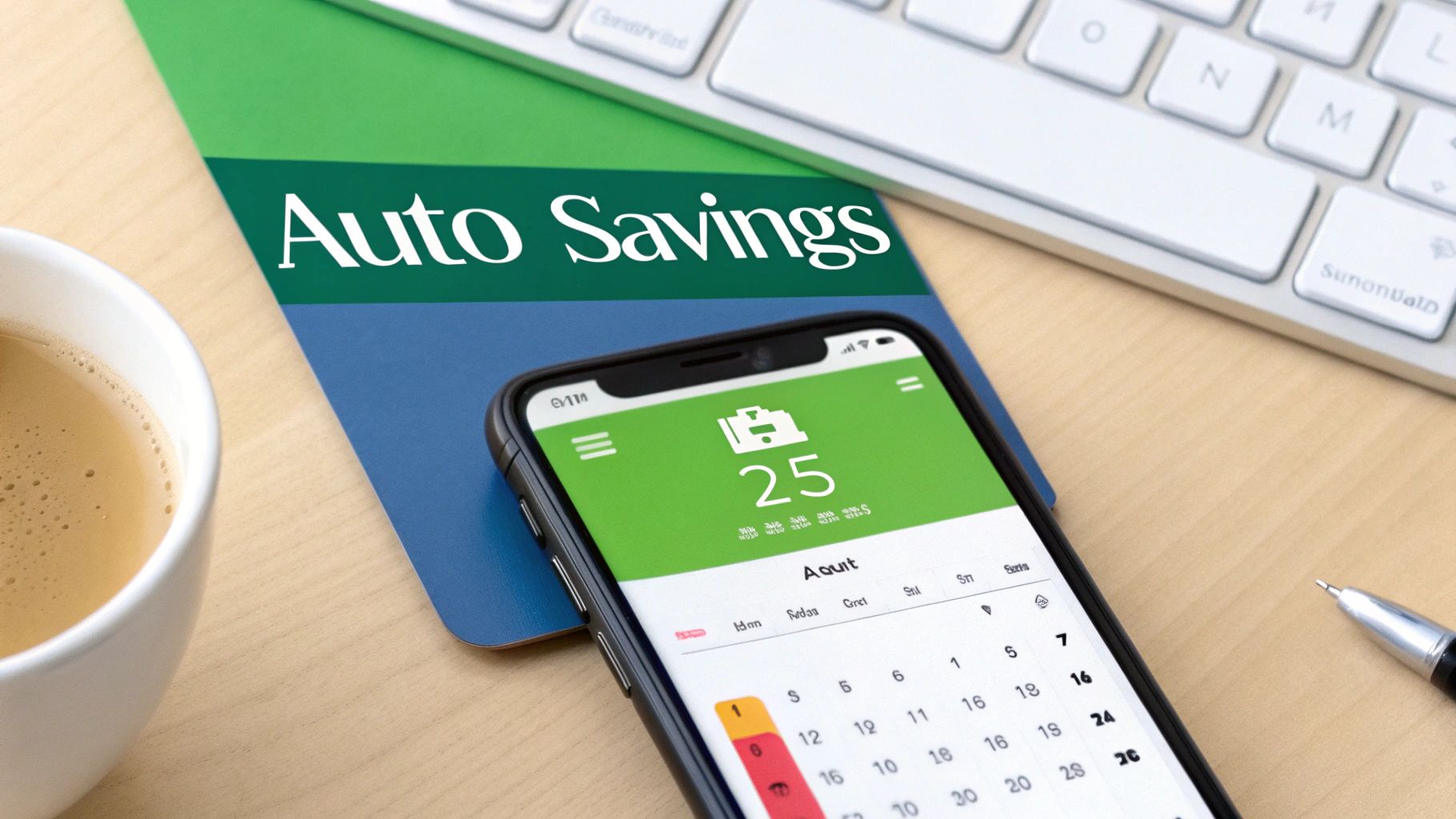
Automation is the financial equivalent of putting your savings on autopilot. This strategy involves setting up recurring, automatic transfers from your checking account to your savings or investment accounts, typically scheduled right after you get paid. By moving the money before you have a chance to spend it, you eliminate the daily temptation and decision-making process of saving, leveraging a powerful behavioral psychology principle known as “paying yourself first.” It’s one of the most effective financial tips for young adults because it builds wealth consistently without relying on willpower.
Why Automation Is a Game-Changer
Willpower is a finite resource. After a long week, it’s easy to rationalize skipping a manual savings transfer in favor of an impulse purchase. Automation removes this friction by making saving the default option, not an active choice. This “out of sight, out of mind” approach ensures your financial goals are being met in the background while you live your life.
For example, a young professional automating $500 per month to a retirement account and $250 per month to a vacation fund will save $9,000 in just one year, all without having to think about it twice. The consistency turns small, manageable amounts into significant sums over time.
How to Implement Savings Automation
Setting this up is simple and can usually be done in minutes through your online banking portal.
- Time Your Transfers: Schedule your automatic transfers for one or two days after your payday. This ensures your direct deposit has cleared and the money is available.
- Start Small and Grow: If your budget is tight, start with a modest amount like $50 per paycheck. The key is to build the habit. You can increase the amount with every pay raise or when a debt is paid off.
- Use Separate Accounts: Create and name different savings accounts for specific goals (e.g., “Emergency Fund,” “Car Down Payment,” “Travel”). This creates a psychological barrier to pulling money for unintended uses.
- Boost with Raises: Commit to automatically saving a portion, like 50%, of every future raise. This helps you avoid lifestyle inflation and accelerates your wealth-building journey.
Automating your savings transforms it from a chore into an effortless, background process, making it a cornerstone habit for achieving financial stability and freedom.
4. Prioritize High-Interest Debt Elimination
High-interest debt, particularly from credit cards with rates often exceeding 20% APR, is a major obstacle to building wealth. It creates a powerful headwind, where the interest you pay to lenders actively works against your savings and investment goals. Prioritizing the elimination of this toxic debt is one of the most impactful financial tips for young adults, as it frees up your cash flow and stops compound interest from working against you. This strategy means aggressively paying down your most expensive debt first.
Why Focus on High-Interest Debt?
The interest on credit cards and personal loans can cost you thousands over time, canceling out any gains you might make from investing. Paying off a credit card with a 19% APR is like getting a guaranteed 19% return on your money; no investment can safely promise that.
For example, a young adult with $8,000 in credit card debt at a 19% APR who only makes minimum payments could take decades to pay it off. By contrast, paying a fixed $300 per month eliminates that debt in about 3 years and saves over $2,500 in interest payments, freeing up that money for wealth-building activities.
How to Tackle Your Debt
A systematic approach is key to successfully eliminating high-interest debt and achieving financial freedom.
- List Your Debts: Create a simple list of every debt you have, noting the current balance and the interest rate (APR). This gives you a clear picture of what you’re up against.
- Choose a Strategy: The Debt Avalanche method involves paying extra toward the debt with the highest interest rate first, which saves you the most money. The Debt Snowball method involves paying off the smallest balance first for a quick psychological win.
- Stop Accumulating: Freeze your credit card spending. You cannot dig your way out of a hole if you keep digging.
- Consider a Balance Transfer: If you have a good credit score, you might qualify for a 0% APR balance transfer credit card. This can give you an interest-free period to pay down the principal balance aggressively.
5. Start Retirement Investing Early With Employer 401(k) Match
Of all the financial tips for young adults, this one offers the closest thing to a guaranteed high return on your money. An employer 401(k) match is essentially free money your company gives you for contributing to your own retirement account. By not contributing enough to receive the full match, you are leaving part of your salary on the table. This is a critical early step in wealth-building, as it leverages free capital and the immense power of compound interest over a long career.
Why This is Your Best First Investment
An employer match is an immediate 50% or 100% return on your contribution, an outcome you cannot find anywhere else in investing. This “free money” then begins to grow and compound over decades, dramatically accelerating your path to a secure retirement. It is the single most effective way to start your investing journey.
For instance, if you earn $50,000 and your employer matches 100% of your contributions up to 6% of your salary, you contribute $3,000, and they give you another $3,000 for free. That initial $6,000, invested annually, could grow to over $1.2 million in 40 years, assuming a 7% average annual return. The free money from the match is responsible for half of that total.
How to Maximize Your 401(k)
Navigating your employer’s plan is straightforward once you know the basics.
- Capture the Full Match: Find out your company’s matching formula and contribute at least enough to get the entire amount. This is your number one priority.
- Understand Your Vesting Schedule: Vesting determines when you own your employer’s contributions. Some plans offer immediate vesting, while others may require you to stay with the company for a few years.
- Choose Appropriate Investments: As a young adult, your time horizon is long. Consider a diversified, low-cost target-date fund or a broad-market index fund (like an S&P 500 ETF) rather than overly conservative options.
- Automate and Escalate: Contributions are automatically deducted from your paycheck. Aim to increase your contribution rate by 1% each year or with every pay raise.
6. Use the 30-Day Rule to Combat Impulse Spending
The 30-Day Rule is a powerful psychological tool designed to curb impulse buying, a common financial drain for many young adults. The concept is simple: when you feel the urge to make a non-essential purchase over a certain amount (say, $100), you wait a full 30 days before buying it. This cooling-off period separates the initial emotional want from a genuine need, allowing for more rational and intentional spending decisions.
Why the 30-Day Rule Works
Impulse spending is driven by instant gratification. By intentionally delaying the purchase, you give your brain time to evaluate its necessity and true value. Many people find that after a few weeks, the intense desire for the item has faded completely, revealing it was an impulse, not a need. A recent graduate who implemented this rule discovered that over 70% of the items they initially wanted were forgotten or deemed unnecessary by the end of the waiting period. This simple habit is one of the most effective financial tips for young adults looking to gain control over their discretionary spending.
How to Implement the 30-Day Rule
Putting this rule into practice is straightforward and can be customized to fit your lifestyle.
- Create a “Wait List”: Start a note on your phone or in a physical notebook. When you want to buy a non-essential item, write it down along with the date.
- Set Your Threshold: Decide on a price point that triggers the rule, such as any non-essential purchase over $50 or $100. This prevents the system from becoming tedious for small purchases.
- Transfer the “Saved” Money: When you add an item to your list, immediately transfer its cost from your checking account to a savings account. This makes the financial impact real and grows your savings.
- Re-evaluate After 30 Days: If you still genuinely want the item after the month is up and it fits your budget, you can make the purchase guilt-free. Often, you may find it on sale, saving even more.
This technique not only saves you money but also helps you build mindfulness around your spending habits, a crucial skill for long-term financial health.
7. Track Expenses Ruthlessly to Find ‘Money Leaks’
Expense tracking is the process of monitoring and categorizing every dollar you spend to understand where your money is actually going. This practice is one of the most powerful financial tips for young adults because it uncovers “money leaks” like forgotten subscriptions, impulse purchases, and excessive convenience spending. By identifying these patterns, you can reclaim hundreds of dollars each month to accelerate your savings and debt repayment goals.

Why Manual Tracking is a Thing of the Past
Gone are the days of tedious spreadsheets and receipt hoarding. Modern budgeting apps automate the entire process by syncing directly and securely with your bank accounts and credit cards. They categorize transactions for you, making it simple to get a clear, visual overview of your spending habits. This technology removes the friction, allowing you to focus on analysis rather than data entry.
For example, a young professional used an app and discovered they were spending $180 per month on unused subscriptions and memberships. After canceling them, they redirected that money straight into their high-yield savings account, adding over $2,100 per year to their emergency fund. Popular apps that simplify tracking include YNAB and Mint.
How to Track Effectively
A strategic approach turns tracking from a chore into a powerful financial tool.
- Use an App: Choose a budgeting app with automatic bank syncing to eliminate manual work and ensure accuracy.
- Track for a Full Month: Before making any drastic changes, track your spending for at least 30 days. This provides an honest baseline of your true financial habits, not just a snapshot.
- Review Weekly: Set aside 15-20 minutes each week to review your categorized spending. This is frequent enough to stay on top of things but not so often that it becomes overwhelming.
- Be Ruthlessly Honest: Don’t hide discretionary spending in vague categories like “Miscellaneous” or “Other.” If it was a coffee, categorize it as such to see the real impact.
- Target Recurring Charges First: Forgotten subscriptions are the lowest-hanging fruit. Scrutinize your bank statements for any recurring debits you no longer use or value.
By diligently tracking your expenses, you arm yourself with the data needed to create a realistic and effective budget, ensuring every dollar you earn is working toward your financial freedom.
8. Negotiate Your Salary and Benefits Before Accepting Offers
One of the most impactful financial moves you can make is to negotiate your compensation package before accepting a new job. Many young adults accept the first salary offer they receive, unknowingly leaving significant lifetime earnings on the table. Negotiating your salary, signing bonus, or benefits like paid time off can dramatically increase your long-term wealth, as even a small percentage increase compounds substantially over a decades-long career. This is one of the most crucial financial tips for young adults to master early.
Why You Should Always Negotiate
Companies expect candidates to negotiate and often build a buffer into their initial offers to accommodate this. By not negotiating, you are essentially accepting less than what they are likely willing to pay for your role. The financial impact is staggering; a graduate who negotiates a starting salary from $55,000 to $58,500 gains an extra $3,500 annually. Over a 40-year career, assuming modest raises, this single negotiation could be worth well over $140,000.
Beyond salary, negotiating can improve your work-life balance. Securing a few extra vacation days, a flexible work schedule, or a budget for professional development contributes directly to your well-being and career growth without costing the company as much as a salary bump.
How to Negotiate Effectively
Successful negotiation is about preparation, not confrontation. A confident, data-backed approach makes the process smooth and professional.
- Do Your Research: Before the interview, use sites like Glassdoor, Levels.fyi, and Payscale to research the market rate for your role, location, and experience level.
- Focus on Your Value: Frame your request around the skills and value you bring to the company, not your personal financial needs.
- Propose a Range: Instead of a single number, suggest a thoughtful salary range (e.g., “$58,000 to $62,000”) that shows flexibility but has your desired salary at the low end.
- Consider the Whole Package: If the company can’t meet your salary request, pivot to negotiating other benefits. Ask for a signing bonus, more paid time off, or a guaranteed review in six months.
By preparing beforehand and understanding your worth, you can turn a job offer into a launchpad for long-term financial success. For an in-depth look at this process, check out this guide on how to negotiate a salary increase on collapsedwallet.com.
9. Implement the ‘No Spend Challenge’ Monthly to Reset Spending Habits
A ‘No Spend Challenge’ is a powerful behavioral finance tool where you commit to spending money only on absolute essentials for a set period, like a week or a month. This temporary spending freeze eliminates discretionary purchases entirely, forcing a mindful reset of your financial habits. For young adults looking to rapidly accelerate savings or break the cycle of mindless consumption, this challenge provides a structured way to identify the difference between needs and wants, often saving hundreds of dollars in the process.
Why a Spending Freeze Works
A no-spend period acts as a pattern interrupt. By intentionally restricting purchases of non-essentials like takeout, new clothes, entertainment subscriptions, or morning coffees, you become acutely aware of your spending triggers and habits. It’s a short-term, high-impact strategy that delivers both immediate savings and long-term behavioral insights.
For example, a recent graduate completing a 30-day no-spend challenge could easily save $500 to $1,500. More importantly, they might identify $300 in monthly subscriptions and convenience purchases they don’t truly value, which can then be permanently redirected toward debt repayment or investments.
How to Run a Successful Challenge
Preparation is the key to successfully completing a no-spend period without feeling deprived. A clear plan prevents impulse decisions and makes the experience more effective.
- Define Your Rules: Before starting, clearly list what qualifies as an “essential.” This typically includes rent/mortgage, utilities, groceries for necessities, and necessary transportation. Be specific about what is excluded.
- Plan Ahead: Prepare for essential needs to avoid the temptation of convenience spending. Research free entertainment options like visiting a park, library, or local community events.
- Create Accountability: Do the challenge with a friend or join an online community for support. Tracking what you almost spent in a notebook can make the savings feel more tangible.
- Remove Temptation: Unsubscribe from marketing emails, leave credit cards at home when you go out, and consider a temporary social media break if it triggers spending.
This exercise is one of the most effective financial tips for young adults because it builds discipline and provides a clear, data-driven look at where your money is actually going.
10. Understand and Optimize Your Credit Score for Long-Term Financial Benefits
Your credit score is a three-digit number (ranging from 300 to 850) that acts as a financial report card, influencing nearly every major financial decision you make. Lenders use it to determine your creditworthiness for mortgages, auto loans, and credit cards. A higher score signifies lower risk, unlocking better interest rates that can save you tens of thousands of dollars over your lifetime. Mastering this number is one of the most impactful financial tips for young adults.
Why Your Credit Score Matters
A strong credit score (typically 750 or above) is a powerful asset. It not only grants access to premium financial products but also dramatically reduces the cost of borrowing. For instance, securing a $300,000 mortgage with a 750 score might get you a 6% interest rate, whereas a 600 score could result in an 8% rate. This difference amounts to over $350 in extra payments each month, totaling more than $127,000 over a 30-year loan.
Good credit also impacts things you might not expect, like insurance premiums and security deposits for apartments or utilities. Building and protecting your score early on establishes a foundation for long-term financial health and opportunity.
How to Build and Maintain Your Score
Improving your credit score is a marathon, not a sprint. Consistent, positive habits are the key to building an excellent profile.
- Pay Every Bill on Time: Payment history is the single most important factor. Set up automatic payments for at least the minimum due on all your bills to avoid late marks.
- Keep Credit Utilization Low: Aim to use less than 30% of your available credit limit, and ideally less than 10%. If your limit is $5,000, try to keep your balance below $1,500.
- Monitor Your Reports: Check your full credit reports from all three bureaus (Equifax, Experian, TransUnion) for free at least once a year via AnnualCreditReport.com. Dispute any errors immediately.
- Don’t Close Old Accounts: The average age of your credit accounts matters. Keeping older, unused credit cards open helps lengthen your credit history and keeps your overall utilization low.
Comparison of 10 Financial Tips for Young Adults
| Item | Implementation Complexity 🔄 | Resource Requirements ⚡ | Expected Outcomes 📊 | Ideal Use Cases 💡 | Key Advantages ⭐ |
|---|---|---|---|---|---|
| Build an Emergency Fund Before Investing (HYSA) | Low–Medium — simple setup, requires discipline | Cash reserve (3–6 months), HYSA account, 6–12 months to build | Liquid safety net; modest guaranteed returns (~4–5% APY); less reliance on credit | New earners, unstable income, before investing or large purchases | FDIC insured, immediate access, reduces financial stress |
| Master the 50/30/20 Budgeting Rule | Low — simple percentage framework | Basic income info, occasional tracking or app | Balanced spending; consistent 20% savings target; easy baseline budgeting | Beginners or those who dislike detailed tracking | Simple, flexible, clear priorities between needs/wants/savings |
| Automate Your Savings to Remove Decision Fatigue | Very low — minutes to set up | Bank with auto-transfer, recurring contribution amounts | Consistent savings growth; habit-building; fewer missed contributions | People with regular paychecks or goal-oriented savers | Removes willpower, scalable, minimal upkeep |
| Prioritize High-Interest Debt Elimination | Medium–High — requires plan and sacrifice | Extra monthly cashflow, payoff strategy (avalanche/snowball), possible balance transfers | Large interest savings; improved credit; freed monthly cashflow | Holders of credit card/payday/high-APR debt | Highest ROI (interest avoided), faster financial flexibility |
| Start Retirement Investing Early With Employer 401(k) Match | Low–Medium — enroll and select investments | Employer plan access, payroll deductions, basic allocation choices | Immediate return via match; exponential compound growth long-term | Any employee with an employer match | Free employer match, tax advantages, powerful compounding |
| Use the 30-Day Rule to Combat Impulse Spending | Low — habit change | Wish list or tracker, discipline to wait 30 days | Fewer impulse buys; 30–50% reduction in impulsive spending | Impulse shoppers, those boosting discretionary savings | Simple, high behavior impact, virtually no cost |
| Track Expenses Ruthlessly to Find “Money Leaks” | Medium — 1–2 hr setup then regular review | Expense-tracking app or spreadsheet, account linking, weekly/monthly review | Identifies $100–300+/month in reducible expenses; data-driven choices | People unsure where money goes, subscription-heavy spenders | Reveals leaks, enables targeted cuts, informs budgets |
| Negotiate Your Salary and Benefits Before Accepting Offers | Medium–High — research and communication skills needed | Market data (Glassdoor, Levels.fyi), time to practice, negotiation prep | Higher initial salary and benefits; large lifetime earning increase | Job offers, raises, career transitions | High ROI, immediate pay boost, improved benefits and flexibility |
| Implement the “No Spend Challenge” Monthly | Medium — requires planning and willpower | Clear rules, meal/entertainment planning, accountability | Short-term savings ($500–1,500/month); mindset reset | Resetting habits, jumpstarting savings, accountability groups | Big short-term savings, habit reset, measurable results |
| Understand and Optimize Your Credit Score | Medium — ongoing monitoring & maintenance | Time to monitor reports, pay-on-time systems, credit management | Lower borrowing costs; thousands saved on loans/mortgages; easier approvals | Future mortgage/auto borrowers, those building long-term credit | Better rates, better loan terms, long-term financial savings |
Taking the Next Step on Your Financial Journey
You have just navigated through ten foundational financial tips for young adults, each designed not just as a piece of advice, but as a practical, actionable step toward building a secure and prosperous future. The journey from financial uncertainty to confidence is paved with small, consistent actions. It’s about moving beyond simply earning a paycheck to actively designing a life where your money works for you, opening doors to opportunities and providing a safety net against life’s inevitable challenges.
From Knowledge to Action: Your Implementation Plan
The sheer volume of information can feel overwhelming. The key is to avoid analysis paralysis and start small. Don’t try to implement all ten strategies at once. Instead, choose the one or two that address your most pressing financial pain points right now.
- Is debt a constant source of stress? Your immediate focus should be on Tip #4: Prioritize High-Interest Debt Elimination.
- Do you feel like your money disappears each month? Start with Tip #7: Track Expenses Ruthlessly to Find ‘Money Leaks’.
- Ready to make your money grow? If your debt is manageable and you have savings, turn to Tip #5: Start Retirement Investing Early.
By breaking down this journey into manageable steps, you create a cycle of positive reinforcement. Each small victory, whether it’s paying off a credit card or successfully completing a ‘No Spend Challenge’, builds the momentum and confidence needed to tackle the next goal. This is how lasting financial habits are formed.
The Long-Term Vision: Why This Matters
Mastering these financial tips for young adults is about more than just numbers in a bank account. It’s about empowerment. It’s the freedom to leave a job that isn’t fulfilling, the ability to handle an unexpected medical bill without panic, and the power to seize opportunities, like starting a business or buying a home, when they arise.
Building a strong credit score (Tip #10) isn’t just about getting a good rate on a future mortgage; it’s about proving your reliability and unlocking better financial products across the board. Automating your savings (Tip #3) isn’t just a clever hack; it’s about paying your future self first and removing the daily struggle of willpower. Each of these strategies works in synergy, creating a robust financial foundation that supports your life’s ambitions.
The most powerful force in finance is consistency. The small, deliberate choices you make today-like contributing to your 401(k) or resisting an impulse purchase-compound over time into life-changing wealth. Your future self will be profoundly grateful for the discipline and foresight you cultivate right now. Embrace this process as an ongoing journey of learning and growth, and you will be well on your way to achieving not just financial stability, but true financial freedom.
Ready to take control and make these financial tips for young adults a reality? The Collapsed Wallet app is designed to help you implement these strategies seamlessly, from tracking expenses to automating savings and visualizing your progress. Start your journey toward financial clarity and confidence by visiting Collapsed Wallet today.
