
Table of Contents
This blog post may contain affiliate links. As an Amazon Associate I earn from qualifying purchases.
Wondering how to ask for a pay rise? To get the pay rise you deserve, you need more than just hope. You need a rock-solid case built on hard data that proves your value. It’s not about what you want; it’s about what you’ve earned. This means doing your homework, tracking your wins, and presenting a compelling business argument that makes saying ‘yes’ the only logical option for your manager.
The aim of our blog is to provide valuable insights and practical tips to help readers manage their money more effectively. However, the information shared here is for general guidance and educational purposes only. It should not be regarded as professional financial advice. Any actions taken based on our content are entirely the responsibility of the reader, and we accept no liability for the outcomes of those actions. If you require financial advice tailored to your personal circumstances, we strongly recommend seeking assistance from a qualified financial adviser.
Laying the Groundwork for Your Pay Rise Conversation
Securing a pay rise doesn’t start the day you walk into your manager’s office. It starts weeks, or even months, before. The real work is in the preparation—shifting your perspective from “I need more money” to “I’ve delivered more value.” This is where you build an undeniable case that justifies a higher salary, turning a potentially awkward chat into a straightforward business discussion.
Too many people skip this part, assuming their hard work is obvious. But think about it from your manager’s perspective: they’re juggling a dozen priorities and team members. It’s on you to connect the dots and show them exactly how your contributions have moved the needle.
Know Your Worth in the Market
First things first, you need to find out what someone with your skills and experience is actually being paid right now. Walking in without a data-backed salary target puts you on the back foot immediately. Thankfully, there are plenty of resources to help you nail this down.
- Check Online Salary Tools: Websites like Glassdoor, Payscale, and LinkedIn Salary are your best friends here. You can benchmark your current salary against industry and regional averages for similar roles.
- Scan Current Job Postings: Look at job ads for positions like yours. More and more companies are listing salary ranges, giving you a real-time snapshot of what they’re willing to pay for your skillset.
- Dig Into Industry Reports: Professional organisations and big recruitment firms often publish annual salary surveys. These give you a much more detailed breakdown by role, experience, and location.
This research isn’t just about plucking a number out of thin air. It’s about understanding the bigger picture. For example, knowing that UK employers are planning average salary increases in the 3.2–3.9% range for 2025 and 2026 helps you set realistic expectations. You can read more about these salary trends in a recent Mercer report. This kind of data frames your request as informed and reasonable.
Build Your “Success Folio”
Once you have a target salary in mind, you need to prove you’re worth it. This is where your “Success Folio” comes in—a living document where you record your accomplishments. This isn’t just a list of your job duties; it’s a detailed log of your impact.
You need to think in numbers. Did you streamline a process that saved the team five hours a week? Did you lead a project that boosted customer retention by 10%? Did you help land a new client worth £50,000 in revenue? These are the specifics that make your case impossible to ignore.
A well-documented list of your achievements transforms the conversation. You’re no longer just an employee asking for more money; you’re a strategic partner presenting a return on investment.
This preparation phase simplifies the whole process into clear, manageable actions. This visual breaks down the flow perfectly.
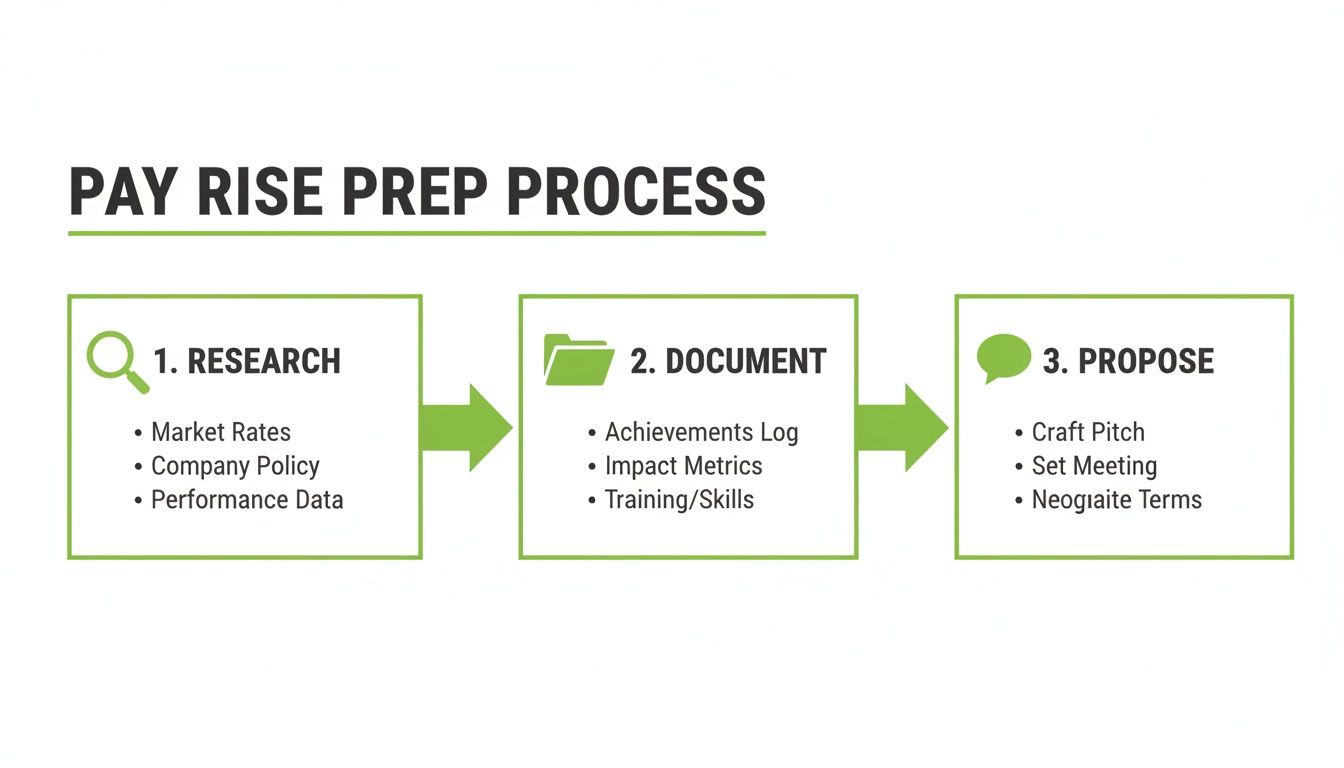
As you can see, a successful proposal is the final step, built on a foundation of solid research and detailed documentation.
The key is to track these wins as they happen, not try to remember them all six months later. To help you stay organised, we’ve put together a simple checklist.
Your Pay Rise Preparation Checklist
This checklist will ensure you’ve covered all your bases before you even think about booking that meeting.
| Preparation Step | Key Action | Why It Matters |
|---|---|---|
| Market Research | Use 2-3 salary tools to find an average salary range for your role, location, and experience. | Provides an objective, data-backed foundation for your salary request. |
| Achievement Logging | List at least 5-7 key achievements from the last 6-12 months, with quantifiable results (e.g., %, £, time saved). | Concrete evidence of your value and impact on the business. |
| Skill Development | Note any new skills, certifications, or responsibilities you’ve taken on since your last review. | Shows growth and demonstrates your increasing value to the company. |
| Company Performance | Briefly check on the company’s recent performance (e.g., quarterly reports, good news). | Helps you time your request when the company is in a good position to say yes. |
| Define Your “Ask” | Decide on a specific percentage or salary figure you’re aiming for, plus a “walk-away” number. | Gives you a clear goal and helps you stay focused during the negotiation. |
Completing this checklist means you’re not just ready—you’re armed with confidence and facts.
The habit of tracking wins is powerful, and it’s a principle that applies to personal finance too. You can learn more about building these kinds of effective habits in our guide on how to track your expenses. By laying all this groundwork, you’ll walk into that conversation ready to present a compelling case for the value you deliver every day.
Finding the Right Moment to Make Your Request

You’ve done the hard work of building your case and tracking your wins. Now comes the part that requires a bit of strategy: timing. Asking for a raise isn’t just about what you say, but when you say it. A perfectly timed conversation can feel like a natural next step, while a poorly timed one can feel like you’re completely out of sync with the business.
Think about it from your manager’s perspective. Their attention and the company’s budget are not infinite. Your job is to make your request when both are most available, turning your ask into a solution rather than another problem on their plate.
Sync Your Ask with Company Cycles
Most businesses run on predictable calendars for financial planning and performance reviews. Tapping into these cycles is one of the smartest things you can do because it dramatically improves your odds. Your manager is already in the right headspace, and more importantly, the money is more likely to be available.
These are the prime opportunities to aim for:
- Annual Performance Reviews: This is the classic, and for good reason. The entire conversation is already about your achievements and value, making it a seamless pivot to discussing how your compensation should reflect that.
- The Start of a New Fiscal Year: Fresh year, fresh budget. Getting your request in as the new financial year kicks off means you can be factored into the new plan, not treated as an unexpected cost down the line.
- Right After a Big Project Win: Just delivered a major project that smashed its goals? This is a golden moment. Your value is crystal clear, and the success is fresh in everyone’s mind.
Understanding these rhythms is key. Research on salary trends, like this data on how employer budgets hold steady from worldatwork.org, shows that these decisions are almost always tied to annual budget planning. Asking for a raise right after the budgets have been locked in for the year makes it incredibly difficult for even the most supportive manager to find the funds.
The best time to ask is when your value is most visible and the company is actively planning its financial commitments. Don’t leave it to chance; align your timing with the company’s calendar.
Capitalise on Your Personal Wins
Beyond the company’s calendar, your own career milestones create powerful windows of opportunity. The goal here is to directly connect your request to a recent, tangible accomplishment. It reframes the entire conversation.
Look for a moment shortly after one of these events:
- You’ve taken on significant new responsibilities and are excelling.
- You’ve earned a new certification or skill that directly benefits the team.
- You’ve received fantastic feedback from a major client or a senior leader.
When you anchor your request to a specific win, it’s no longer just about asking for more money. It becomes a logical conclusion: “I delivered this specific value, and I’m asking for my compensation to be adjusted to reflect it.”
Know When to Hold Back
Just as there are great times to ask, there are absolutely terrible times. A huge part of being strategic is knowing when to stay quiet and wait. Pushing ahead during a difficult period can make you seem tone-deaf and could even damage your professional reputation.
Here are some clear signs it’s time to hit the pause button:
- During a Hiring Freeze or Layoffs: If the company is actively trying to cut costs, asking for more money is almost guaranteed to fail.
- Following Poor Company Results: After a rough quarter or a big missed revenue target, budgets will be under a microscope.
- When Your Manager is Swamped: Never ambush your boss when they’re visibly stressed or putting out fires. Your important request will just become another headache they can’t deal with.
- If You’ve Recently Had a Raise: Unless your role has been completely transformed, asking for another bump within a few months of your last one can come across as unreasonable.
Sometimes, patience is your best tactic. Waiting for the right moment shows good judgment and sets your request up for the best possible outcome.
Framing the Conversation and Booking the Meeting

You’ve done the hard work of gathering your evidence and picking the right time. Now, it’s time to actually get the meeting on the calendar. How you go about this sets the tone for the entire negotiation. The key is to frame this as a positive, forward-looking discussion about your career, not an ambush or a complaint session.
Whatever you do, don’t catch your manager off guard. Popping the question in the hallway, at the end of a team huddle, or over a quick chat message is a surefire way to get a rushed, unhelpful response. This conversation is important, and it deserves their undivided attention. That means booking a proper meeting is non-negotiable.
Choosing the Right Words
When you ask for the meeting, your language should be calm, professional, and confident. You want to signal that this is a constructive chat about your future, which naturally includes your compensation. Using vague or overly aggressive phrasing can put your manager on the defensive before you even sit down.
Try using phrases like these:
- “I’d like to discuss my career progression and future here.”
- “Could we set aside time to review my performance and talk about my growth path?”
- “I’d love to chat about my role and recent contributions.”
This kind of language makes it clear you’re invested in your long-term success with the company. It positions the meeting as a collaborative one, where a salary increase is a logical part of a bigger, more positive conversation about your value.
How to Write the Perfect Meeting Request Email
An email is almost always the best way to request this meeting. It’s professional, gives your manager time to find a good slot in their calendar, and creates a paper trail. Keep your message short, to the point, and clear about the meeting’s purpose without giving away all your cards.
Here’s a simple, effective example you can adapt:
Subject: Chat about career growth
Hi [Manager’s Name],
I’d love to book some time to talk about my performance and career path at [Company Name]. I’m really excited about the work I’m doing and would appreciate the chance to discuss my recent contributions and goals for the next year.
Would you have 30 minutes free sometime next week? Please let me know what day and time works best.
All the best,
[Your Name]
This works because it’s upbeat and professional. It clearly states the topic is “career growth,” which is a perfect umbrella for a pay discussion, but it doesn’t sound demanding. It also shows you respect their schedule by suggesting a length and offering flexibility.
What to Avoid in Your Request
What you don’t say is just as crucial as what you do. Certain words and phrases can instantly create tension and weaken your position from the get-go.
Steer clear of these common missteps:
- Don’t mention money upfront. Never say, “I want to talk about my salary.” Save the financial details for the meeting itself, where you can present your full case.
- Don’t issue ultimatums. Anything that sounds like a threat—”I need a raise or I’m leaving”—is a fast track to a soured relationship and a likely ‘no.’
- Don’t cite personal reasons. Your rent increase or car trouble is irrelevant. This conversation is strictly about your professional value to the business, not your personal finances.
- Don’t compare yourself to colleagues. Saying “I know Sarah makes more than me” is a classic mistake. It makes you sound resentful and shifts the focus away from your own performance.
Think of this initial request as simply getting your foot in the door. By keeping it professional and focused on your career development, you create the right environment for a successful negotiation. This thoughtful approach shows respect for your manager and the process, which can make all the difference.
Leading the Negotiation with Confidence

The meeting is locked in, your “Success Folio” is polished, and you’ve done your homework. This is where all that prep work pays off. It’s completely normal to feel a bit of nervous energy, but keep this in mind: you’re not there to make demands. You’re there to present a clear, logical business case for why your value to the company has grown.
Think of it as a collaborative discussion, not a confrontation. By staying calm, confident, and focused on the facts you’ve gathered, you can guide the conversation towards a win-win. Your goal is to make saying ‘yes’ the most logical decision for your manager.
Setting a Positive Tone
Kick off the meeting with genuine gratitude. Starting on a positive note sets a collaborative mood right away. Thank your manager for their time and mention something specific you enjoy about your job or the company.
This isn’t about being a sycophant; it’s about showing you’re invested.
A simple, effective opener might be: “Thanks for meeting with me. I really appreciate the opportunity to talk about my growth here. I’ve genuinely enjoyed leading the [Project Name] initiative, and I’m excited about what we have planned for the next quarter.” This immediately frames the discussion around your commitment and positive impact.
Presenting Your Case with Impact
After the positive opening, it’s time to smoothly pivot to the reason you’re there. This is your cue to bring out the evidence you’ve compiled in your “Success Folio.” As you walk your manager through your key achievements, avoid just rattling off a list.
For each accomplishment, tell a story using this simple framework:
- The Achievement: “In Q2, I took the lead on streamlining our client onboarding process.”
- The Quantifiable Impact: “By automating the initial paperwork, we cut the average onboarding time by 40%, which saved the team around 10 hours a week.”
- The Business Connection: “This freed up our account managers to focus more on client strategy, which directly contributed to a 5% lift in client retention.”
This method does more than just list your duties; it connects your day-to-day work directly to the company’s bottom line. It changes the narrative from “things I’ve done” to “value I’ve created.”
The most powerful negotiation tactic is undeniable proof of your worth. When you can show, with data, how you’ve made or saved the company money, the conversation shifts from your needs to your impact.
Making the Ask Clearly and Confidently
Once you’ve laid out the evidence of your increased value, it’s time to state your request. You need to be direct, specific, and confident. Ditch hesitant phrases like “I was hoping for…” or “I was thinking maybe…”
Instead, state your researched number with conviction. For example: “Based on my contributions over the last year and the current market rates for this role, I am requesting my salary be increased to £[Your Target Salary].”
It’s also helpful to have a pulse on the wider trends. Recent data from the 2025 Bankrate jobs and pay report shows that while 44% of U.S. workers planned to ask for a raise, outcomes can vary. Knowing this helps you approach your own conversation with a realistic, well-informed perspective.
Now, for the hardest part. After you state your number, stop talking. Seriously. Let the silence hang for a moment. This gives your manager space to process everything and signals that you’re confident in the case you’ve just made.
Handling Common Objections
Don’t be discouraged if you don’t get an immediate “yes.” Your manager might have real constraints or rely on standard objections. Being ready for these responses turns a potential roadblock into an opportunity to show your problem-solving skills. Knowing how to negotiate a salary increase means anticipating the pushback.
Here’s a quick guide to navigating the most common hurdles you might face.
Handling Common Objections
| Objection | Your Strategic Response | Example Phrasing |
|---|---|---|
| “There’s no room in the budget right now.” | Acknowledge the constraint and pivot to a future timeline. This shows you’re a team player but keeps the conversation from ending. | “I understand that budgets can be tight. Could we set a specific time to revisit this in three or six months, perhaps after I’ve hit [X goal]?” |
| “Your performance is good, but not that good.” | Ask for specifics. This moves the discussion from a vague statement to a concrete action plan you can work on. | “Thank you for that feedback. To make sure I’m on the right track, could you help me understand which specific areas I need to develop to reach that level?” |
| “I need to talk to HR/my boss first.” | Be supportive of this step and offer to make their job easier. This reinforces your case while they get approval. | “Of course. To help with that conversation, would a written summary of my key achievements be useful for you to share with them? I’m happy to put that together.” |
By preparing for these common scenarios, you stay in control of the conversation. You’ll come across as professional and committed, no matter what the immediate answer is.
Navigating a No or a Not Right Now
So, you built a rock-solid case, practiced your pitch, and walked in feeling confident. Then you heard the one word you didn’t want to hear: “No.” It’s a gut punch, for sure. It’s easy to let frustration or a sense of being undervalued take over, but how you react in this exact moment is absolutely crucial.
Staying cool and professional is the only way forward. It’s tough, but remember that an immediate ‘yes’ isn’t the only win. A ‘no’ handled with grace can actually set you up for a future ‘yes’ and even strengthen your relationship with your manager.
Think of it less as a rejection and more as the start of a different conversation. Your new mission is to figure out the “why” behind the decision and carve out a clear path to getting what you want down the line. This approach shows a level of resilience and commitment that any good boss will notice.
Deconstruct the No to Create a Plan
If the answer is no, your gut instinct might be to argue your points again. Don’t. Your first move should be to seek understanding. The reasoning behind the decision is the key that unlocks your next steps. The roadblock could be anything from company-wide budget freezes to specific areas where your manager feels you still need to grow.
Whatever you do, don’t leave that room with a vague “not right now.” Politely dig for the details.
- If it’s about the budget: Try something like, “I understand that budgets are tight. Can we set a specific time to revisit this? Perhaps in six months or at the beginning of the next fiscal quarter?”
- If it’s about performance: You could ask, “Thank you for that feedback. So I can focus on the right things, could we outline the specific goals or metrics I need to hit for us to reconsider my salary?”
This approach instantly turns a dead end into a tangible plan. You’ll walk away with a checklist of what to deliver and a date on the calendar for a follow-up, which creates accountability for both you and your manager.
An initial ‘no’ isn’t the end of the road. It’s a chance to get a precise roadmap for what it will take to get a ‘yes’ next time. Use it to your advantage.
By creating this clear path, you stay in the driver’s seat of your career. You’re no longer just hoping for a raise; you’re actively working toward mutually agreed-upon targets that will prove you’ve earned it.
Pivot to Non-Monetary Benefits
What if a salary bump is truly off the table for reasons your manager can’t control? Don’t just pack it in and walk away empty-handed. This is a golden opportunity to negotiate for non-monetary perks that can dramatically improve your job satisfaction and career growth.
Think about what else would be valuable to you.
- A New Title: Ask for a title that better reflects the work you’re already doing. A promotion to “Senior” or “Lead” on your resume can be incredibly powerful for your future earning potential.
- Professional Development: See if the company will sponsor a certification, course, or conference ticket. Investing in your skills makes you a greater asset to them in the long run.
- Increased Flexibility: Could you negotiate more flexible hours, a compressed four-day work week, or an extra remote day?
- Extra Paid Time Off: More vacation days can be just as valuable as cash, helping you recharge and avoid burnout.
Exploring these alternatives shows you’re flexible and committed to your growth within the company—not just chasing a bigger paycheck. These perks can also have a real impact on your finances. For example, more remote work days can slash your commuting and lunch costs, which is a big help if you’re trying to figure out how to budget on a low income.
Ultimately, how you handle a “no” says volumes about your professionalism. By staying positive, seeking a clear path forward, and exploring other options, you can turn a moment of disappointment into a constructive plan. You’ll leave the meeting with either a roadmap to a future raise or some valuable new perks—all while cementing your reputation as a resilient and proactive professional.
Answering Your Lingering Pay Rise Questions
It’s completely normal to have a few last-minute questions, even after you’ve done all your prep work. This is a big conversation, after all. Feeling a little jittery is part of the process.
Let’s clear up some of the most common uncertainties people have. Think of this as the final piece of the puzzle to make sure you walk into that meeting feeling confident and ready for anything.
How Often Can I Ask For a Pay Rise?
A good rule of thumb is to have this conversation about once a year. This timing usually lines up perfectly with annual performance reviews, so it feels like a natural part of the business calendar. It’s when you’re already talking about your contributions over the last 12 months.
But this isn’t set in stone. If your job has fundamentally changed—maybe you’ve absorbed the responsibilities of a former colleague or you’re now leading a major new project—you absolutely have grounds to ask sooner. The trick is to link your request to a real increase in your value, not just because a certain amount of time has passed.
What If I’m Too Scared to Actually Ask?
First off, feeling nervous is a good sign. It means you care. The best antidote to that anxiety is rock-solid preparation. That “Success Folio” we talked about? It’s your best friend here because it’s not just a list of feelings; it’s a file full of facts.
Run through your pitch out loud. Grab a friend or partner and do a practice run. Just hearing yourself say the words makes it ten times less intimidating. Write down your main talking points on a notecard if you need to. Remember, this isn’t a personal favor you’re asking for. You’re a professional presenting a business case for an investment in a valuable asset—you.
The more you practice, the more the nerves will fade and be replaced by confidence. You’ll stop feeling like you’re asking for something and start feeling like you’re demonstrating your worth.
Should I Mention I Have Another Job Offer?
This is a classic high-stakes poker move, and it can go wrong in a heartbeat. Dropping another offer on the table can feel like a power play, but it often poisons the well. Your manager might see it as a threat, and even if they counter, they’ll likely question your loyalty and mark you as a flight risk from that moment on.
The stronger, more professional path is to build your case on your own merits—your accomplishments, your growth, and your market value right where you are. If you’re genuinely ready to walk away and take the other job, then it’s a different story. But don’t make the threat unless you’re prepared for them to shake your hand and wish you the best.
What’s a Realistic Percentage to Ask For?
There’s no single “right” number. The answer is buried in the research you’ve done. For a standard annual raise, something in the 3-5% range is pretty typical—it usually keeps pace with the cost of living.
However, if your digging reveals you’re way below the market rate, or if your responsibilities have exploded, asking for 10-20% (or even more) could be perfectly reasonable. Your research is your justification. Base your request on the hard data you’ve collected about your role’s value, not a random percentage you pulled out of thin air.
At Collapsed Wallet, our mission is to give you the practical, no-nonsense advice you need to manage your money with confidence. We break down tricky financial topics into simple, actionable guides, from building a budget that works to investing for your future. To learn more about building your financial security, explore our resources at https://collapsedwallet.com.
