

Table of Contents
- Your Action Plan to Improve Credit Score Fast
- Lower Your Credit Utilization for a Major Score Bump
- Your Payment History: The Foundation of a Great Credit Score
- Your Credit Mix and New Inquiries: Playing the Long Game
- Building Habits for a Permanently High Score
- Got Questions About Improving Your Credit Score? We’ve Got Answers
This blog post may contain affiliate links. As an Amazon Associate I earn from qualifying purchases.
Trying to improve credit score fast can feel like an impossible task, but it’s more doable than you might think. If you need to see results fast, you need to focus on what moves the needle the most. The two biggest levers you can pull are disputing errors on your credit report and aggressively paying down your credit card balances.
The aim of our blog is to provide valuable insights and practical tips to help readers manage their money more effectively. However, the information shared here is for general guidance and educational purposes only. It should not be regarded as professional financial advice. Any actions taken based on our content are entirely the responsibility of the reader, and we accept no liability for the outcomes of those actions. If you require financial advice tailored to your personal circumstances, we strongly recommend seeking assistance from a qualified financial adviser.
Why these two? Because they target the most influential parts of your score, and the changes can show up in as little as 30 to 60 days.
Your Action Plan to Improve Credit Score Fast
So, where do you start? A higher credit score isn’t just about bragging rights; it’s a key that unlocks better financial opportunities and can genuinely pave the way to financial freedom. Lenders see that number as a reflection of your reliability.
When you have a strong score, you suddenly get access to better loans and credit cards with significantly lower interest rates. We’re not talking about small change, either. Shaving just 1% off the interest rate on a mortgage could save you tens of thousands of dollars over the life of the loan.
Why a Good Credit Score Is a Game-Changer
A solid credit score puts you in the driver’s seat. Instead of you chasing lenders, they start competing for your business. Think of it as being a VIP in the financial world.
Here’s what a better score really gets you:
- Lower Interest Rates: This is the big one. You’ll pay less every month on car loans, mortgages, and credit card balances. More of your money stays in your pocket.
- Higher Loan Approvals: Need a loan for a house or a new business venture? A great score means lenders are more willing to give you the amount you actually need.
- Better Credit Card Perks: Get ready for offers for premium cards with killer rewards—think travel points, serious cashback, and exclusive access to airport lounges.
These first two steps—cleaning up your report and lowering your balances—are the most powerful things you can do right now.
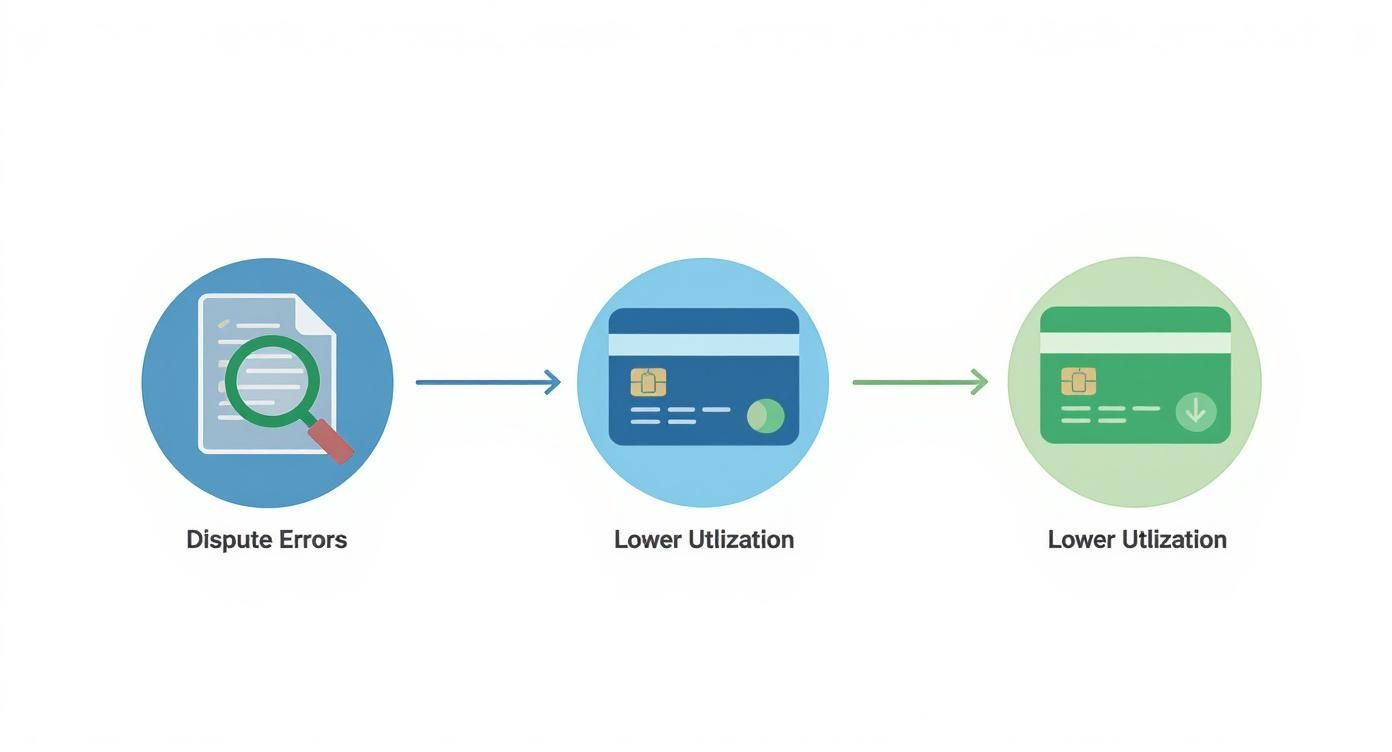
As the infographic shows, these two actions are the foundation for any rapid credit improvement strategy.
What Actually Makes Up Your Credit Score?
To fix your score, you have to understand what’s under the hood. The two main scoring models, FICO and VantageScore, look at similar things, but FICO is the one most lenders use.
Here’s the FICO breakdown:
Payment history is the heavyweight champion, making up 35% of your score. It’s simple: lenders want to see you pay your bills on time, every time. It’s no surprise that 98% of people with the highest FICO scores have a perfect payment record.
The second most important factor is amounts owed, or what’s known as your credit utilization ratio. This accounts for a whopping 30% of your score and looks at how much of your available credit you’re currently using.
If high balances are holding you back, our guide on how to pay off debt fast has some great strategies to get that number down.
The other pieces of the puzzle are length of credit history (15%), your mix of credit types (10%), and new credit inquiries (10%). But if you want to see a fast, meaningful jump, your energy is best spent on those top two: payment history and credit utilization.
For a quick overview, here are the most effective tactics you can deploy right away.
High-Impact Credit Score Tactics
| Tactic | Potential Impact | Estimated Timeframe |
|---|---|---|
| Dispute Report Errors | High (can be 20-100+ points) | 30–60 days |
| Lower Credit Utilization | High (can be 10-50+ points) | 30–45 days |
| Make On-Time Payments | High (protects score) | Immediate & Ongoing |
| Become an Authorized User | Medium (depends on primary account) | 30–60 days |
These strategies are your best bet for seeing a quick and significant improvement. By focusing your efforts here, you’re targeting the factors that have the most weight in credit scoring models.
Lower Your Credit Utilization for a Major Score Bump

After you’ve handled any errors and made sure your payments are on track, the next biggest lever you can pull for a quick credit score boost is your credit utilization ratio (CUR). This is simply the amount of credit you’re using compared to the total credit you have available.
The aim of our blog is to provide valuable insights and practical tips to help readers manage their money more effectively. However, the information shared here is for general guidance and educational purposes only. It should not be regarded as professional financial advice. Any actions taken based on our content are entirely the responsibility of the reader, and we accept no liability for the outcomes of those actions. If you require financial advice tailored to your personal circumstances, we strongly recommend seeking assistance from a qualified financial adviser.
Think of it this way: even if you pay your bill in full and on time every single month, a high balance on your statement date can still temporarily drag down your score. Lenders see a maxed-out card as a sign of financial stress, so getting this number down is one of the most powerful moves you can make.
Aim Lower Than You Think
You’ve probably heard the standard advice to keep your credit utilization below 30%. That’s not bad advice, but if you’re looking for a fast improvement, you need to be more aggressive.
I always tell people to aim for under 10%. Seriously. This is where you’ll see the most significant and immediate results. Credit utilization makes up about 30% of your FICO score, so it carries a lot of weight. Tackling it head-on sends a strong signal to the credit bureaus that you’re a responsible borrower.
Key Takeaway: A high credit utilization ratio can hamstring your score, even with a flawless payment history. Driving this number down is a direct and speedy path to proving your financial stability and seeing your score climb.
If you’re dealing with balances across several cards, having a clear plan is everything. We’ve put together a guide with some great tips for paying off credit card debt that can help you figure out the best approach.
Smart Tactics to Lower Your Utilization—Fast
Bringing your utilization down isn’t just about spending less. It’s about being smart with when and how you pay. Here are a few tricks I’ve seen work wonders for people in a short amount of time.
- Make multiple payments a month. Don’t wait for your statement to arrive. If you make a large purchase, try paying a chunk of it off a week or two before your statement closes. This way, the high balance from that purchase never even gets reported.
- Pay right before your statement date. Find the statement closing date on each of your credit card bills—this is different from the due date. By paying down your balance a few days before this date, you ensure the lowest possible number is sent to the credit bureaus. This simple timing trick can have an instant impact.
- Ask for a credit limit increase. Have you been a good customer with a solid payment history? Give your credit card company a call and ask for a higher limit. This is a fantastic hack because it instantly lowers your utilization ratio without you paying an extra dime. For example, a $500 balance on a $2,000 limit is 25% utilization. If they bump your limit to $4,000, that same $500 balance is now just 12.5% utilization.
Put these strategies into practice, and you could see a real difference in as little as 30 to 45 days—or as soon as your creditors report your new, lower balances.
Your Payment History: The Foundation of a Great Credit Score

While the tips we share are designed to help you manage your money more effectively, remember that this is general educational guidance, not professional financial advice. Everyone’s situation is unique, and any actions you take based on what you read here are your responsibility. If you need financial advice tailored to your specific circumstances, we highly recommend connecting with a qualified financial advisor.
The aim of our blog is to provide valuable insights and practical tips to help readers manage their money more effectively. However, the information shared here is for general guidance and educational purposes only. It should not be regarded as professional financial advice. Any actions taken based on our content are entirely the responsibility of the reader, and we accept no liability for the outcomes of those actions. If you require financial advice tailored to your personal circumstances, we strongly recommend seeking assistance from a qualified financial adviser.
Think of your credit score as a building. While things like credit utilization are the paint job—easy to change for a quick new look—your payment history is the foundation. It accounts for a massive 35% of your score, and building it right is the secret to long-term stability.
It’s not just about paying your bills on time, though that’s absolutely non-negotiable. It’s also about strategically handling past mistakes and creating a positive track record that lenders can trust.
Dealing With Old Late Payments
A late payment can haunt your credit report for up to seven years. The good news? Its sting fades over time. But if you have an otherwise spotless record with a lender and made a one-time mistake, you have a surprisingly effective tool: the goodwill letter.
This is simply a polite request asking a creditor to remove a late payment mark from your report as a courtesy. It’s not a guaranteed fix, but your odds are much better if:
- You’ve been a loyal, on-time customer for a long time.
- The late payment was an isolated incident caused by something specific, like a bank error or a medical emergency.
- Your account is current and in good standing.
A short, honest letter explaining the situation can work wonders. Lenders are often willing to grant a little grace to a good customer, and getting that negative mark removed can give your score a real boost.
Don’t Close That Old Credit Card!
The length of your credit history is another major piece of the puzzle. Scoring models look at the age of your oldest account and the average age of all your accounts. This is why you’ll almost always hear the advice to avoid closing old, unused credit cards.
Shutting down a seasoned account creates a double-whammy for your score. First, it kills your available credit, which can instantly spike your credit utilization ratio. Second, it eventually erases that account’s long history from your report, dragging down the average age of your credit.
Even if you never use that old card, just keep it open. Maybe use it once a year for a small purchase to keep it active. That simple step preserves a valuable part of your credit history.
Building a Positive Track Record from the Ground Up
If you’re new to credit or rebuilding after some trouble, your main job is to prove you can handle it responsibly. Luckily, there are tools designed for exactly that.
- Secured Credit Cards: These are fantastic starting points. You put down a small cash deposit, which usually becomes your credit limit. Use it just like a regular credit card—make small purchases and pay it off on time. Every payment gets reported to the credit bureaus, building a solid history.
- Credit-Builder Loans: These are a clever twist on traditional loans. You don’t get any money upfront. Instead, you make small monthly payments into a locked savings account. Once the “loan” is fully paid off, the money is released to you. It’s a low-risk way for lenders to see you can make consistent payments.
These tools are especially powerful for younger borrowers. In fact, data shows Millennials and Gen Z are climbing the credit ladder faster than older generations. One analysis found that 30% of young people with “thin files” moved into a better credit tier within two years, compared to just 22% of their older counterparts. It really shows how powerful a clean slate and responsible habits can be.
Remember, managing all your debt is part of your payment history. For anyone juggling education debt, it’s a good idea to look into different student loan repayment strategies to make sure those payments stay on track and contribute positively to your score.
By cleaning up past stumbles, protecting your credit age, and using the right tools to build new history, you can transform your payment record from a liability into your greatest asset for a healthy financial future.
Your Credit Mix and New Inquiries: Playing the Long Game
Once you’ve tackled the big hitters—your payment history and credit utilization—it’s time to look at the other pieces of the puzzle. While they don’t offer the same quick wins, your credit mix and new credit inquiries together account for a respectable 20% of your FICO score.
The aim of our blog is to provide valuable insights and practical tips to help readers manage their money more effectively. However, the information shared here is for general guidance and educational purposes only. It should not be regarded as professional financial advice. Any actions taken based on our content are entirely the responsibility of the reader, and we accept no liability for the outcomes of those actions. If you require financial advice tailored to your personal circumstances, we strongly recommend seeking assistance from a qualified financial adviser.
Getting these right is less about immediate point boosts and more about building a strong, resilient score for the future. It shows lenders you’re a pro, not just a one-hit-wonder.
Why a Healthy Credit Mix Matters
Lenders get a good feeling when they see you can juggle different types of debt. A healthy credit mix isn’t about having a ton of accounts; it’s about showing you can handle the two main kinds of credit responsibly.
- Revolving Credit: Think credit cards and lines of credit. The balance goes up and down, and so does your payment. It’s flexible.
- Installment Loans: These are predictable. You have a fixed payment for a set amount of time. Mortgages, car loans, and student loans fall into this category.
Having both types on your report proves your financial maturity. Successfully paying down a car loan while keeping your credit card balances low tells a much better story than just having one or the other.
But here’s a crucial bit of advice: don’t open new accounts just to improve your mix. It’s a relatively small part of your score (only 10%), and the small potential gain isn’t worth taking on debt you don’t need. You’ll also take a small, temporary hit from the new credit inquiry.
My Take: I always tell people to think of credit mix as a supporting character. It’s important, but it’s not the star. Focus on paying your bills on time and keeping balances low. A good mix will naturally fall into place as you go through life—getting a car, maybe a mortgage, and using a credit card for everyday purchases.
How to Handle New Credit Inquiries Like a Pro
Applying for a new credit card or loan triggers a “hard inquiry,” which is just a lender taking a deep dive into your credit report. A single one might ding your score by a few points for a short time, which is no big deal.
The real trouble starts when you have a bunch of them in a short period. To a lender, that can look like desperation. It screams, “I need cash, and I need it now!” That’s why you have to be smart about when and why you apply for new credit.
Hard vs. Soft Inquiries: What’s the Difference?
You’ll hear these terms thrown around, and the distinction is simple but critical.
- Hard Inquiries (The ones that count): These happen when you officially apply for credit. They require your permission and can temporarily lower your score.
- Soft Inquiries (The harmless ones): This is when you check your own score, or when a credit card company sends you a “pre-approved” offer in the mail. They have zero effect on your score.
So, go ahead and check your own credit as often as you like. It’s one of the best financial habits you can develop, and it will never, ever hurt your score.
The Smart Way to Shop for a Loan
So how do you compare mortgage or auto loan rates without wrecking your score? Good news: the scoring models are designed for this exact scenario.
Both FICO and VantageScore know that when you’re shopping for a big-ticket item like a car or a house, you’re going to talk to multiple lenders. Their models bundle multiple inquiries for the same type of loan into one single event, as long as they happen within a short time frame.
This “shopping window” is typically between 14 and 45 days.
This gives you the freedom to find the absolute best rate without being penalized. Just make sure you get all your applications in within a couple of weeks. That way, you’re protecting your score while making sure you don’t overpay on your next big loan.
Building Habits for a Permanently High Score
You’ve put in the work and boosted your credit score. That’s a huge win. But now, the game changes from quick fixes to long-term strategy. The real goal isn’t just to get a high score; it’s to keep it. That’s what unlocks serious financial opportunities down the road.
The aim of our blog is to provide valuable insights and practical tips to help readers manage their money more effectively. However, the information shared here is for general guidance and educational purposes only. It should not be regarded as professional financial advice. Any actions taken based on our content are entirely the responsibility of the reader, and we accept no liability for the outcomes of those actions. If you require financial advice tailored to your personal circumstances, we strongly recommend seeking assistance from a qualified financial adviser.
Think of it less like a sprint and more like building a solid financial foundation, brick by brick. What you do from here on out will determine whether that high score becomes a permanent asset.
Your new mission is to weave smart credit management so deeply into your routine that it becomes second nature. A great score isn’t just a number—it’s the key that makes big goals like buying a house or launching a business easier and cheaper to achieve.
Automate and Simplify Your Payments
If there’s one golden rule for maintaining a great score, it’s this: always, always pay your bills on time. Your payment history is the single biggest factor in your score, making up a massive 35% of the calculation. Just one late payment can erase months of progress.
The simplest way to avoid this is to set up automatic payments for at least the minimum amount due on every single one of your accounts. This is your safety net. You should definitely plan to pay more than the minimum whenever possible, but automation guarantees you’ll never get hit with a late mark.
Pro Tip: I tell everyone to set a calendar alert a few days before their autopay is scheduled. This little reminder gives you a chance to make sure the funds are in your bank account and decide if you can throw a little extra at the principal.
Schedule Regular Credit Check-Ins
You wouldn’t skip a doctor’s check-up, right? Your credit deserves the same routine attention. This isn’t a one-and-done task. Get into the habit of reviewing your credit reports from all three bureaus—Equifax, Experian, and TransUnion—at least once a year.
You’re entitled to a free report from each one annually through AnnualCreditReport.com. A great little trick is to stagger your requests, pulling one report every four months. This ongoing monitoring lets you:
- Catch Errors Early: Spotting inaccuracies or fraudulent accounts before they spiral out of control is crucial.
- Track Your Progress: See firsthand how your good habits are paying off and which accounts are helping your score the most.
- Stay Accountable: Keeping your financial picture in front of you reinforces your goals and motivates you to stick with the plan.
Understand the Impact of Major Financial Decisions
As you navigate life, you’ll run into big financial decisions. Knowing how they affect your credit ahead of time is key to protecting the score you’ve worked so hard to build.
Closing Old Accounts
It’s so tempting to close that old credit card you never use, just to tidy things up. Don’t do it! Closing an old account can actually hurt your score. It reduces your total available credit, which can instantly increase your credit utilization ratio, and it can also shorten the average age of your credit history.
Unless a card has a ridiculously high annual fee, you’re almost always better off keeping it open. Just use it for a small purchase every few months to keep the account active.
Co-signing a Loan
Think very, very carefully before co-signing a loan for anyone. When you co-sign, you are 100% legally responsible for that debt. If the other person misses a payment, it shows up on your credit report as if you were the one who missed it.
Before you agree, be absolutely certain the primary borrower is reliable and, more importantly, that you could comfortably take over the payments yourself if things go south.
Turning these practices into habits is what transforms credit management from a chore into an automatic part of your financial life. Once you automate your payments, schedule your check-ins, and make informed decisions, that high score you earned will be here to stay.
Got Questions About Improving Your Credit Score? We’ve Got Answers
As you start working on your credit, you’re bound to run into some questions. The world of credit scoring can feel like a maze, but getting clear answers is the first step toward making smart, confident moves. Let’s dig into some of the most common questions people ask when trying to boost their credit score fast.
The aim of our blog is to provide valuable insights and practical tips to help readers manage their money more effectively. However, the information shared here is for general guidance and educational purposes only. It should not be regarded as professional financial advice. Any actions taken based on our content are entirely the responsibility of the reader, and we accept no liability for the outcomes of those actions. If you require financial advice tailored to your personal circumstances, we strongly recommend seeking assistance from a qualified financial adviser.
Getting straightforward answers demystifies the whole process, letting you focus your energy on what really moves the needle.
How Quickly Can I Actually Improve My Score?
This is the big one, isn’t it? The honest answer is: it depends entirely on what you’re fixing. Some actions can give you a surprisingly quick boost.
For instance, if you pay down a high credit card balance and get your utilization ratio under that magic 30% mark, you could see a jump in your score in as little as 30 to 45 days. That’s because creditors usually report your new, lower balance to the bureaus at the end of each billing cycle.
Other things, however, require more patience. Building a long history of on-time payments is a marathon, not a sprint. The negative impact of a late payment from a few years back will fade, but it takes time. The key is to set realistic expectations—go for the high-impact, short-term wins while consistently building those long-term positive habits.
Will Checking My Own Credit Score Lower It?
Let’s clear this up once and for all: absolutely not. This is one of the most stubborn myths in personal finance. When you check your own credit score or pull your own report, it’s considered a soft inquiry (or a soft pull).
Soft inquiries have zero impact on your credit score. They’re for your eyes only, and lenders can’t see them. Not only is it safe to monitor your own credit, but it’s one of the best financial habits you can build.
A hard inquiry, on the other hand, is what happens when a lender checks your credit because you’ve applied for new credit, like a loan or credit card. Those can cause a small, temporary dip in your score. So go ahead, check your score as often as you like with a credit monitoring service—it will only help you stay on top of things.
Should I Close Old Credit Cards I Don’t Use Anymore?
I get the temptation to tidy up your finances by closing that old credit card you haven’t touched in years. But in most cases, this is a move you’ll want to avoid, as it can hurt your score in two major ways.
First, you’ll lower your total available credit. Imagine you have two cards, each with a $5,000 limit, giving you $10,000 in total credit. If you’re carrying a $2,500 balance, your credit utilization is a healthy 25%. But if you close one card, your available credit plummets to $5,000, and your utilization instantly spikes to a much riskier 50%.
Second, closing an old account can shorten the average age of your credit history, a factor that makes up 15% of your FICO score. Lenders love seeing a long, stable history of managing credit responsibly.
So, what’s the better move? Keep the old account open. To make sure the issuer doesn’t close it for inactivity, just use it for a small, recurring purchase—like a streaming service—and set up an auto-payment to cover the balance each month. This keeps the account active, your history long, and your score happy.
At Collapsed Wallet, we’re committed to giving you the clear, practical guidance you need to take control of your finances. Explore our resources to build the knowledge and confidence for a secure financial future. Find more money tips at https://collapsedwallet.com.

5 thoughts on “How to Improve Credit Score Fast: Quick, Proven Tips”