
Table of Contents
This blog post may contain affiliate links. As an Amazon Associate I earn from qualifying purchases.
Let’s get one thing straight: negotiating your salary isn’t a confrontation. It’s an expected part of the hiring game, and skipping it is one of the biggest financial missteps you can make in your entire career. A single, successful conversation can literally translate into hundreds of thousands of dollars more over your lifetime. This guide tells you all you need on how to negotiate a salary!
The aim of our blog is to provide valuable insights and practical tips to help readers manage their money more effectively. However, the information shared here is for general guidance and educational purposes only. It should not be regarded as professional financial advice. Any actions taken based on our content are entirely the responsibility of the reader, and we accept no liability for the outcomes of those actions. If you require financial advice tailored to your personal circumstances, we strongly recommend seeking assistance from a qualified financial adviser.
How to Negotiate a Salary- The Staggering Price of Silence
It’s tempting to just accept the first offer, isn’t it? It feels safe, easy, and you get to start the new job without any “awkward” conversations. But that feeling of relief comes with a massive, hidden cost that can sabotage your long-term financial health.
When you don’t negotiate, you’re not just giving up that initial bump. You’re losing all the compounded growth that would have come with it. Every future raise, bonus, and even your 401(k) match will be calculated from a smaller base number. It’s like starting a race a few steps behind everyone else, and that gap only gets wider over time.
The Power of a Single Conversation
The impact of one negotiation is truly mind-boggling. Recent stats show that a massive 78% of people who asked for more money got it. Think about that. Even a modest 5-10% increase from one negotiation could balloon into hundreds of thousands of extra dollars over a 40-year career. That’s money that could be paying off your mortgage, funding your retirement, or fueling your investments. You can dig into the specifics in the full salary negotiation research.
This chart drives the point home—look at the success rate for people who simply decide to ask.
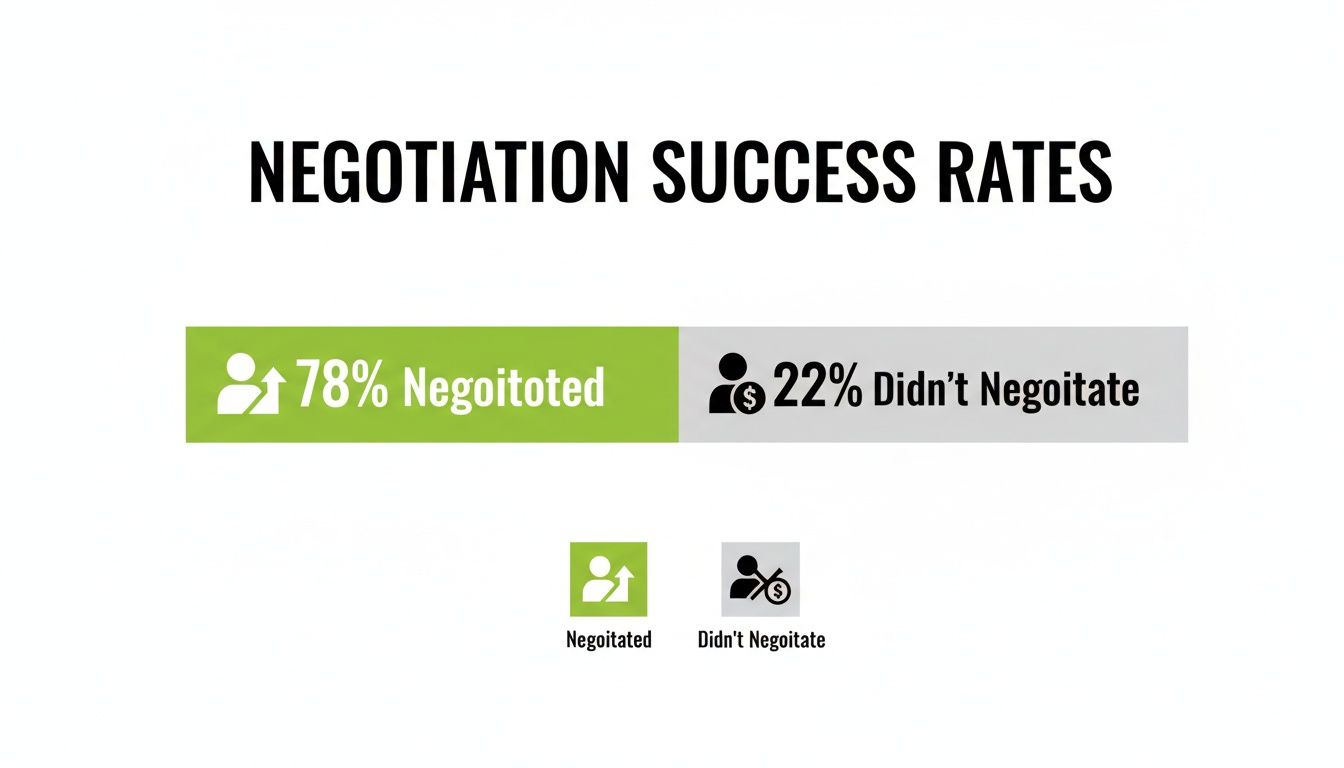
The data doesn’t lie. The odds are overwhelmingly in your favor. It’s a low-risk move with a potentially life-changing reward.
Reframing Your Mindset
A lot of us worry that asking for more money will make us look greedy or ungrateful. I get it. But from the employer’s perspective, it’s the exact opposite. A thoughtful, professional negotiation shows you’re confident, you understand business, and you know your value—all things they want in an employee.
By not negotiating, you are essentially paying your employer thousands of dollars a year for the privilege of avoiding a 15-minute conversation.
Try to see the money you gain as more than just cash. It’s fuel for building wealth and creating financial security. Every extra dollar is a tool that can be used to achieve your financial freedom. This isn’t just about getting a bigger paycheck tomorrow; it’s about fundamentally changing your financial future for the better.
How to Prepare for Your Salary Discussion
Real confidence in a salary negotiation doesn’t come from aggressive tactics or winging it. It comes from solid, methodical preparation. When you walk into that conversation armed with data, you shift the entire dynamic. It’s no longer an emotional plea; it’s a straightforward business case for your value.
This preparation gives you the evidence you need to anchor the conversation right where you want it.

Winning a salary negotiation starts long before you ever sit down with a hiring manager. It begins with a crystal-clear, data-driven understanding of your professional worth and exactly where you fit in today’s job market.
Research Your Market Value
You can’t ask for what you’re worth if you don’t actually know what that number is. The goal here is to establish a precise salary range based on hard evidence, leaving absolutely no room for guesswork.
Start by gathering data points from reputable online salary tools. These platforms can give you a solid baseline filtered by specific criteria. As you dig in, make sure you’re looking at:
- Job Title: Get specific. A “Software Engineer” earns a different salary than a “Senior Software Engineer” or a “DevOps Engineer.” The details matter.
- Location: Compensation can vary wildly from one city to another. A job in San Francisco will pay significantly more than the same role in Omaha simply due to the cost of living.
- Experience Level: Your years in the field and your specific, hard-won skills directly influence your earning potential.
- Company Size and Type: A scrappy pre-seed startup isn’t going to have the same pay structure as a massive, publicly-traded corporation.
Once you’ve got the data, the next step is to add real-world context. Online calculators are great, but they don’t tell the whole story. Chat with trusted peers or mentors in your field. These conversations can uncover nuances and up-to-the-minute insights that static data just can’t provide.
Build Your Value Portfolio
Numbers alone don’t close the deal; compelling evidence does. Your most powerful tool is what I call a “value portfolio”—a simple document that translates your accomplishments into tangible business impact. This isn’t your full resume. Think of it as your personal highlight reel.
Go through your biggest wins and quantify the results. You need to frame your contributions in terms of the value you created for the company. This immediately shifts the focus from what you did to the bottom-line impact you had.
Here’s what that looks like in practice:
- Instead of: “Managed the social media accounts.”
- Try: “Grew social media engagement by 45% in six months, which led to a 15% increase in inbound leads.”
- Instead of: “Helped streamline team workflow.”
- Try: “Introduced a new project management tool that saved the team an estimated 10 hours per week on administrative tasks.”
- Instead of: “Worked on the Q3 sales campaign.”
- Try: “Contributed to the Q3 sales campaign that beat its target by $50,000 by identifying and targeting a new customer segment.”
Your value portfolio is your script. It’s the concrete, undeniable proof of your ability to deliver results, making it incredibly difficult for anyone to dismiss your salary expectations.
Define Your Salary Numbers
With your research done and your value portfolio in hand, you’re ready to define the three key numbers that will steer your negotiation. Having these figures locked in your mind prevents you from getting caught off-guard and gives you the power to respond confidently.
- Your Walk-Away Number: This is your line in the sand. It’s the absolute lowest figure you’ll accept, factoring in your bills, your financial goals, and your professional self-worth. If the final offer dips below this, you have to be ready to walk away. No exceptions.
- Your Target Salary: This is the realistic, data-backed number you’re actually aiming for. It should sit comfortably within your market research and be fully supported by the achievements in your portfolio.
- Your Initial Ask: This is the number you lead with. It should be strategically positioned about 10-15% higher than your target salary. This move creates a psychological anchor, giving you plenty of room to negotiate down while still landing at or even above your target.
Preparing these three numbers completely changes the game. You’re no longer just reacting to whatever the company offers; you’re proactively guiding the conversation toward a number that truly reflects your skills and contributions. This is the foundation of a successful outcome.
Mastering the Timing and Tactics of Your Ask
You’ve done the hard work—you’ve built a rock-solid case backed by market data and a clear picture of the value you bring. Now comes the make-or-break moment: the conversation itself. Knowing precisely when and how to bring up money is just as crucial as the numbers you’ve prepared. Get the timing wrong, and even the most compelling argument can fall flat.
Your approach will naturally shift depending on the situation. Negotiating a new job offer is a different dance than asking for a raise from your current boss. But the core principle is always the same: treat it like a collaborative discussion, not a confrontation. That simple mental shift can change the entire dynamic from a battle of wills to a partnership.

Navigating a New Job Offer
When you’re the final candidate for a new role, patience is your secret weapon. Jump the gun and you could leave a serious amount of money on the table. The golden rule is to wait until you have a formal, written offer in your hands. This is your point of maximum leverage. The company has already gone through the entire hiring process and decided you are the one.
Once that offer lands in your inbox, fight the impulse to say “yes” immediately. Your first move is to express genuine excitement and thank them for the opportunity. This does two things: it reassures them of your interest and kicks off the conversation on a positive, collaborative note.
After showing your enthusiasm, calmly explain that you need a moment to go over everything. A simple, professional line is all you need: “Thank you so much for the offer! I’m incredibly excited about the role. Could I take a day or two to review the full package and get back to you?” This is completely standard and shows you’re thoughtful, not demanding.
Securing a Raise or Promotion
If you’re angling for a raise or promotion at your current job, the strategy is a bit more direct, but it still requires a high degree of professionalism. Whatever you do, don’t ambush your manager during a weekly check-in or catch them in the hallway.
Instead, you need to schedule a dedicated meeting. This signals that the topic is important and ensures you have your manager’s complete and undivided attention. Be clear about your intentions in the meeting request, but frame it constructively.
“I’d like to schedule some time to discuss my career growth and future contributions to the team.”
This phrasing is brilliant because it’s proactive and centers the conversation on the value you provide. It shows you’re invested in your long-term impact on the company, not just chasing a quick pay bump.
The Psychology of Collaborative Language
The specific words you choose can have a huge psychological impact on the outcome. Demanding language immediately puts the other person on the defensive, creating an adversarial relationship. Collaborative language, on the other hand, invites them to be your partner in finding a solution. Your goal is to make the hiring manager or your boss feel like you’re on the same team, working together to land on a number that everyone is happy with.
Think about the difference between these two approaches:
- Demanding: “I need a higher salary.”
- Collaborative: “I’m really excited about this opportunity and would love to discuss the compensation package to see how we can reach a number that feels great for both of us.”
The second one is infinitely more effective. It frames the negotiation as a joint problem-solving exercise. Using phrases like “work together” and “find a solution” keeps the vibe positive and focused on a win-win. This is a powerful skill in any financial conversation, as detailed in our guide on how to negotiate with creditors.
Choosing Your Communication Channel
Should you negotiate over the phone or stick to email? Honestly, it comes down to where you feel most confident and in control. Both methods have their pros and cons.
Phone Negotiations:
- Pros: Allows for a real-time conversation where you can build rapport. You can also read their tone of voice and adjust your strategy on the fly.
- Best For: People who are strong verbal communicators and think well on their feet.
Email Negotiations:
- Pros: Gives you plenty of time to compose your thoughts and carefully word your arguments. It also creates a convenient paper trail of the entire discussion.
- Best For: Anyone who feels more comfortable having their data and notes right in front of them without the pressure of an immediate response.
There’s no one-size-fits-all answer here. Pick the channel that plays to your personal strengths. The goal is to put yourself in the most comfortable position possible, so you can present your well-researched case with total confidence.
Proven Scripts for a Confident Negotiation
It’s one thing to do all the research, but when it’s time to actually talk numbers, a lot of us freeze up. Finding the right words can be the most nerve-wracking part of the whole process. That’s where having a few go-to scripts in your back pocket makes all the difference.
Think of these less like lines you have to memorize and more like frameworks for the conversation. The goal is to make them your own, so they sound natural coming from you. Internalize the key points, and you’ll deliver them with confidence when it matters most.
Opening the Conversation Gracefully
How you start the discussion sets the tone for everything that follows. You want to lead with genuine excitement for the job, then smoothly pivot to the compensation details. This makes the conversation feel like a partnership, not a battle.
After you’ve received the written offer, here’s a simple, effective way to get things rolling:
Opening Script (Phone or Email):
“Thank you so much for the formal offer! I’m incredibly excited about the prospect of joining the team and contributing to [mention a specific project or goal]. I’ve had a chance to review the details, and I’d love to discuss the compensation package to make sure we’re aligned.”
This works beautifully because it’s professional, positive, and direct without being aggressive. You’re clearly signaling your intent to negotiate while doubling down on how much you want the role—the perfect balance.
Presenting Your Counteroffer with Data
Okay, the door is open. Now it’s time to make your case. This is where all that prep work—your market research and your value portfolio—really pays off. Your counteroffer should never feel like a random number you dreamed up; it needs to be firmly anchored in data and your specific accomplishments.
This approach shifts the conversation from “what I want” to “what the market and my skills command.” It’s just smart business.
Counteroffer Script:
“Based on my research for similar roles in [Your City/Region] using sources like Glassdoor and Payscale, the market rate typically falls between [$X] and [$Y]. Considering my [Number] years of experience and my track record of [mention a key quantifiable achievement from your value portfolio], I was anticipating a base salary closer to [$Your Initial Ask]. Is there any flexibility to get closer to that number?”
Why this script is so effective:
- It’s objective. You’re referencing external data, not just your personal feelings.
- It connects to value. You immediately remind them why you’re worth the investment.
- It’s collaborative. The question “Is there any flexibility?” invites a discussion, not a “yes/no” response.
Handling Common Pushback Professionally
It’s almost inevitable you’ll hear something like, “That’s the top of our budget,” or “Our salary bands are fixed.” Don’t panic. This isn’t the end of the road; it’s just the next turn. The key is to acknowledge their constraint and then gently pivot the conversation toward a solution.
When you hit a budget wall, stay calm. Frame yourself as a high-return investment, not just another line-item expense.
Handling Budget Pushback Script:
“I understand and appreciate you sharing that. I am still very enthusiastic about this role and the value I can bring, especially in areas like [mention a key responsibility]. Could we explore other aspects of the total compensation package? For instance, I’m open to discussing a one-time signing bonus or an additional week of paid time off.”
This response shows you’re a reasonable and flexible partner. You respect their position but actively look for other ways to bridge the gap. It keeps the dialogue alive and opens the door to negotiating things beyond just the base salary.
For quick reference, here are a few powerful phrases you can adapt for different moments in the negotiation.
Effective Phrases for Common Negotiation Scenarios
| Scenario | What to Say |
|---|---|
| Expressing Gratitude | “Thank you so much for the offer. I’m thrilled about the possibility of joining the team.” |
| Opening the Discussion | “I’ve reviewed the offer and would love to discuss a few of the details.” |
| Making a Data-Backed Ask | “Based on market data for this role and my experience level, I was targeting a number in the [$X] range.” |
| Highlighting Your Value | “With my background in [specific skill], I’m confident I can deliver significant results on [project].” |
| When the Offer is Low | “This offer is a bit lower than what I was anticipating based on our conversations and my research.” |
| Responding to a Budget Limit | “I understand your budget constraints. Is there any flexibility in other areas, like a signing bonus or performance incentives?” |
| Asking for Time to Consider | “I appreciate you providing the details. Would it be alright if I take a day to review everything and get back to you?” |
| Finalizing the Agreement | “If we can agree on [$X base salary and Y benefit], I’m ready to accept the offer today.” |
Having these phrases ready can help you feel more prepared and navigate the conversation with a professional, confident tone.
Thinking Beyond the Base Salary
A successful salary negotiation is about more than just the number on your paycheck. Don’t get me wrong, a strong base salary is crucial, but if you get tunnel vision on that one figure, you’re likely leaving a lot of value on the table. A truly fantastic offer is a total compensation package, and this is where you can get creative.
So, what happens when a company tells you, “We’re at the absolute top of our budget for this role”? For many people, that sounds like a dead end. But for a savvy negotiator, it’s an open door. It’s your cue to shift the conversation and explore other areas where the company might have more wiggle room.
Pivoting to Non-Salary Benefits
When the base salary is locked, pivoting to other perks can still land you a huge win. This move shows you’re flexible and genuinely interested in finding a solution that works for everyone. More importantly, it lets you customize the offer to better fit your life and financial goals.
Here are a few high-impact areas I always recommend exploring:
- Signing Bonus: A one-time cash payment is often the easiest way for a company to bridge a salary gap. Why? It frequently comes from a completely different budget than salaries, making it a much simpler “yes” for them to give.
- Performance-Based Incentives: This is where you bet on yourself. Ask about the structure for annual bonuses, commission potential, or even profit-sharing plans. Tying your pay to results shows you’re confident you can make a real impact.
- More Paid Time Off (PTO): Never underestimate the power of an extra week of vacation. The value it provides for your well-being and preventing burnout is often worth more than the equivalent bump in salary.
- Flexible Work Options: Securing a permanent remote or hybrid schedule can save you significant amounts of money each year. Consider the savings on commuting costs and other work-related expenses.
If the base salary isn’t flexible, I’d like to explore additional benefits that are important to me, such as remote work flexibility, professional development funding, or additional paid time off. Are any of these options negotiable?
This kind of language keeps things collaborative. You’re not making demands; you’re opening a discussion to build a better overall package.
Investing in Your Growth and Future
Great compensation isn’t just about what you pocket today—it’s about setting yourself up for a better tomorrow. A company’s willingness to invest in your professional growth is one of the most powerful, and often overlooked, benefits you can negotiate.
Pushing for a professional development stipend is one of the smartest things you can do. This is a dedicated budget for you to spend on certifications, industry conferences, or training courses that help you level up. It makes you sharper, more skilled, and ultimately, a more valuable employee. Tuition reimbursement programs are another goldmine for long-term career growth.
And don’t forget about the benefits that build real wealth. A generous 401(k) match or the opportunity for stock options can be massive. Even a 1% increase in a company’s retirement match can compound into tens of thousands of dollars over your career. These perks are direct investments in your financial future, and understanding how to start investing for beginners is the first step to maximizing their potential.
Navigating Common Salary Negotiation Hurdles
Even if you’ve done all your homework, a tricky question or an unexpected turn in the conversation can throw you off your game. The key is knowing what might come up so you can stay cool and guide the discussion where you want it to go. Let’s walk through some of the most common questions and scenarios you’re likely to face.

What If an Application Asks for Salary Expectations Upfront?
This is a classic screening move companies use to filter candidates right out of the gate. Your goal is simple: don’t get pinned down to a number before you’ve had a chance to show your value and learn about the job’s full scope.
The best approach is to sidestep the question. If the online form has an optional salary field, just leave it blank. If you’re forced to enter something, try “Negotiable” or even “00000” to get past the system filter.
If you absolutely must provide a number, give a wide, well-researched range. Frame it professionally with a quick note like, “Based on market data for this role, a typical range is $75,000-$90,000. My final expectation is flexible and depends on the full scope of the role and the total compensation package.”
How Do I Counter a Lowball Offer Without Sounding Ungrateful?
Getting an offer that’s way below what you expected is a gut punch, but how you handle it is critical. The last thing you want to do is sound defensive or disappointed. Instead, start by showing genuine excitement for the role—this keeps the conversation positive and collaborative.
Kick it off with something like, “Thank you so much for the offer! I’m incredibly excited about this opportunity and the chance to join the team.”
Then, you can gently pivot to the numbers. Leaning on your research takes the emotion out of it and grounds the conversation in facts. Try saying, “Based on my market research for this role and considering my experience in driving X% growth, I was anticipating a salary closer to the $X range. Is there any flexibility on the compensation?” This is a firm but professional way to open the door to a real discussion.
Is It Okay to Negotiate for an Internal Promotion?
Not only is it okay, but you absolutely should. A promotion isn’t just a new title on your email signature; it’s a step up in responsibility, expectations, and your overall contribution to the company. Your pay needs to reflect that new reality.
You should treat a promotion negotiation just as seriously as you would an offer from an outside company.
- Do the research: Figure out the market rate for someone with your new title and responsibilities.
- Build your case: Get your wins down on paper. Document your recent accomplishments and lay out your vision for the new role.
- Schedule a formal meeting: Don’t try to have this chat in the hallway. Ask for dedicated time to discuss your new compensation package.
Never assume the first number they put on the table is their final offer. Negotiation is a completely normal and expected part of the promotion process.
A professional, data-backed negotiation demonstrates strong business acumen and reinforces your value to the company. Rescinding an offer over a respectful negotiation is extremely rare and often signals a problematic company culture.
Can a Company Take Back an Offer If I Negotiate?
This is a huge fear for many people, but let me put your mind at ease: it’s incredibly rare for a reputable company to pull a job offer just because you tried to negotiate. As long as you keep it professional, make a reasonable request backed by data, and maintain a collaborative tone, you aren’t putting the offer at risk.
Think about it from their side. They’ve already invested a ton of time and money to find you, interview you, and decide you’re their top choice. They want you to say yes.
In reality, a skilled negotiation actually reinforces the very qualities they liked in you during the interviews. It shows you’re confident, you know your worth, and you have the communication skills to advocate for yourself—all things that make you a great employee. If a company did withdraw an offer for that reason, you’ve likely just dodged a bullet from a place with a very toxic culture.
At Collapsed Wallet, we’re dedicated to providing you with the clear, actionable financial guidance you need to build a more secure future. Explore our resources to master everything from budgeting basics to smart investing. Find more tips and take control of your money at https://collapsedwallet.com.
