
Table of Contents
- Why Effective Expense Management Is Your Secret Weapon
- Building Your Expense Management Framework
- Choosing the Right Tools for Your Business
- Making Your Reimbursement Process Painless
- From Tallying Receipts to Fueling Growth
- Making Tax Season Simple and Stress-Free
- Frequently Asked Questions About Expense Management
This blog post may contain affiliate links. As an Amazon Associate I earn from qualifying purchases.
Staring at a shoebox full of crumpled receipts? You’re not alone. So many small business owners I’ve worked with find that untracked costs—a client coffee here, a software subscription there—quickly snowball, silently draining cash flow and hiding the true financial health of their business. This guide moves beyond simple bookkeeping to show you how a strategic approach to small business expense management isn’t just an administrative chore, but a powerful tool for real growth.
The aim of our blog is to provide valuable insights and practical tips to help readers manage their money more effectively. However, the information shared here is for general guidance and educational purposes only. It should not be regarded as professional financial advice. Any actions taken based on our content are entirely the responsibility of the reader, and we accept no liability for the outcomes of those actions. If you require financial advice tailored to your personal circumstances, we strongly recommend seeking assistance from a qualified financial adviser.
Why Effective Expense Management Is Your Secret Weapon
Let’s be clear: solid small business expense management is about much more than just tracking where your money goes. It’s a strategic discipline that gives you the clarity you need to make informed, profitable decisions.
Without a good system, it’s incredibly easy to lose sight of the small leaks that can sink a business over time. Those untracked costs obscure your true profitability and make financial forecasting feel like pure guesswork. A proactive approach is what turns that chaos into control.
Beyond Bookkeeping: The Strategic Advantage
Expense management is the financial nervous system of your company. It gives you real-time feedback on the health of your operations, letting you react quickly to challenges and jump on opportunities as they appear.
This isn’t about pinching every penny until it squeaks. It’s about spending intelligently. It gives you the power to put your resources where they’ll have the most impact, whether that’s a new marketing campaign, better equipment, or hiring your next key team member.
By mastering your expenses, you create a direct path to improved cash flow, stress-free tax seasons, and more time to focus on what you do best—running your business.
A well-organized system simply gives you a clear view of your financial landscape and highlights exactly where you can improve. That kind of visibility is absolutely crucial for sustainable growth.
The Hidden Costs of Poor Management
Most entrepreneurs seriously underestimate the resources wasted on just handling expenses. It’s a bit shocking, but the average small business spends around 10-15% of its annual budget just on the process—think paperwork, approvals, and chasing down receipts. That’s a massive chunk of cash that could be fueling growth instead. You can dig deeper into this by exploring the future of expense management trends.
This financial drain comes from a few places:
- Wasted Time: Think of the hours you and your team spend manually entering data, fixing errors, and hunting for missing receipts. That’s time you’re not spending on activities that actually make money.
- Missed Deductions: A disorganized pile of receipts almost guarantees you’ll overlook legitimate tax-deductible expenses, leaving money on the table every tax season.
- Lack of Control: Without clear policies and real-time tracking, it’s tough to stop out-of-policy spending or even spot recurring costs for things you no longer need.
Ultimately, getting your expenses in order is a foundational pillar for building a resilient and profitable business. It gives you the control and insight you need to navigate whatever the economy throws at you and build a secure financial future.
Building Your Expense Management Framework
Before you can truly get a handle on your business spending, you have to know exactly where every dollar is going. This is where we build the foundation—moving away from just reacting to bills and starting to proactively manage your finances. Don’t worry, this isn’t about becoming a master accountant overnight. It’s about creating a clear, simple financial map for your business.
The first move is to list out every single business expense. I mean everything. You’ve got your predictable, fixed costs like rent and payroll, but don’t forget the variable costs that can pop up, like a last-minute marketing push or an unexpected equipment repair.
Getting this right is the difference between chaos and control.
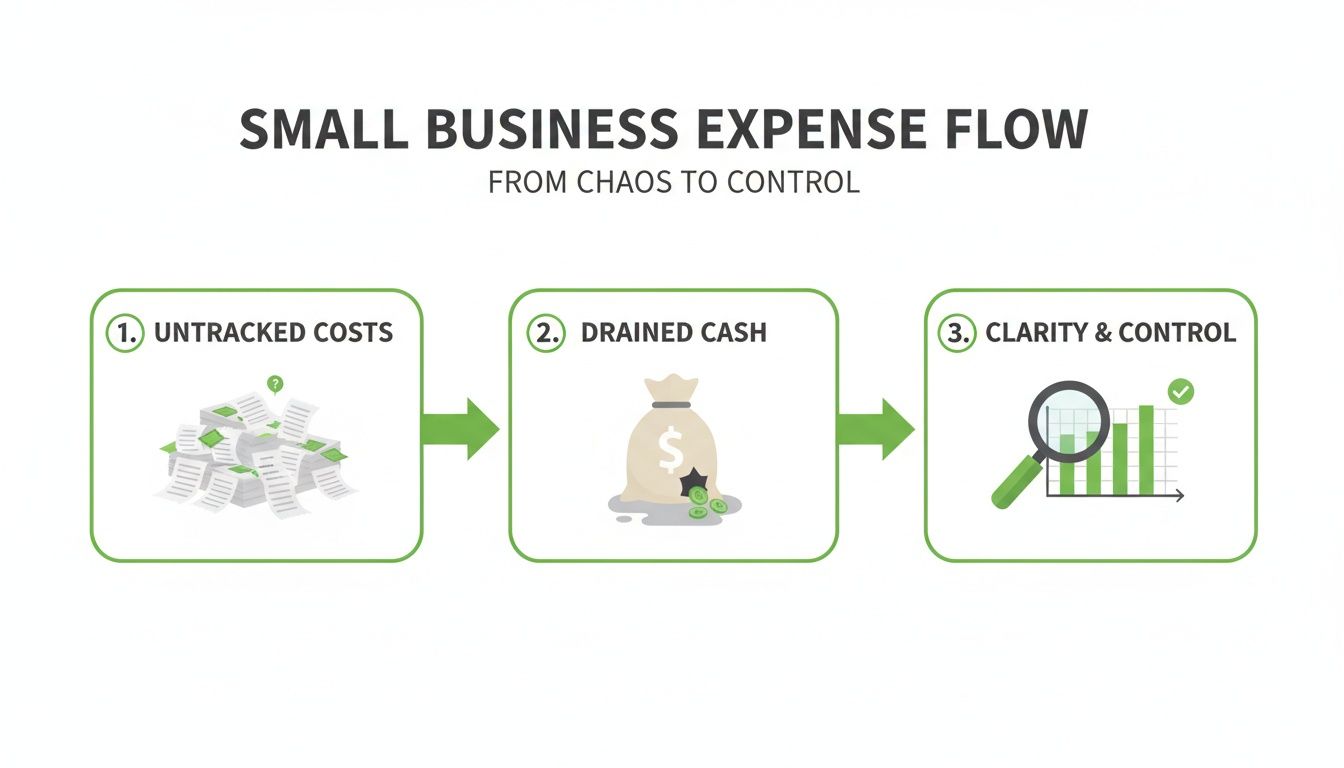
As you can see, letting small costs slip through the cracks is a direct path to draining your cash. But putting a system in place turns that confusion into real, usable insight.
Establishing Clear Expense Categories
Once you have your big list of expenses, it’s time to sort them into categories. This isn’t just for neat bookkeeping; it’s how you uncover spending patterns and, just as importantly, make tax time a whole lot less painful.
Go beyond generic labels. Instead of a single “Travel” category, for example, get more specific. A business trip could be broken down like this:
- Flights & Transportation: Airfare, trains, Ubers, etc.
- Accommodation: Hotels or short-term rentals.
- Meals & Entertainment: Client dinners or team lunches on the road.
This kind of detail immediately shows you where your travel budget is really going, making it much easier to spot places to trim the fat.
Here’s a quick rundown of some core categories most small businesses need. Think of this as your starting point for organizing everything.
Core Small Business Expense Categories
A practical breakdown of common expense categories to organize your spending for clear insights and easier tax preparation.
| Category | Examples | Why It Matters for Your Business |
|---|---|---|
| Office & Utilities | Rent, electricity, internet, phone bills, office supplies | These are the essential costs of keeping the lights on. Tracking them helps you budget for your core operational needs. |
| Salaries & Payroll | Employee wages, contractor payments, payroll taxes, benefits | Your largest expense is likely your people. This category is critical for financial planning and legal compliance. |
| Marketing & Advertising | Social media ads, Google Ads, website hosting, print materials | See which campaigns are actually delivering a return on investment and allocate your marketing budget more effectively. |
| Professional Services | Legal fees, accounting services, consulting fees | These expert costs are often tax-deductible and vital for specialized business functions. |
| Software & Subscriptions | CRM software, accounting tools, project management apps | The monthly SaaS fees add up. Categorizing them helps you audit for unused or redundant subscriptions. |
| Travel & Entertainment | Flights, hotels, client meals, conference fees | Essential for business development, but needs careful monitoring to prevent overspending. |
Getting these categories right from the start will save you countless hours down the road. It transforms a messy pile of receipts into a clear story about your business’s financial health.
A thoughtfully designed categorization system is the backbone of effective expense management. It transforms raw data into actionable intelligence, making it easier to budget accurately and maximize tax deductions.
This is a fundamental step in setting up your framework. You can learn more about how to track business expenses effectively to make sure every dollar is accounted for.
Developing a Simple Expense Policy
If you have a team—even just one or two people—you need an expense policy. I’m not talking about a dense, 50-page legal document. A simple one-page guide is often all it takes to prevent confusion, speed up approvals, and stop unapproved spending in its tracks.
Your policy just needs to cover the basics clearly. For instance:
- Spending Limits: Set clear caps, like a daily meal allowance or a maximum hotel room rate.
- Submission Deadlines: Require expense reports to be submitted within 10 days of a trip or purchase.
- Required Documentation: Make it a rule that every expense needs an itemized digital receipt—no exceptions.
- Approval Workflow: Define who needs to sign off on what.
Putting these rules in writing creates consistency and fairness for everyone. It removes the guesswork for your employees and gives managers a solid standard to follow.
Choosing the Right Tools for Your Business
It’s time to graduate from the shoebox of crumpled receipts and the chaos of never-quite-right spreadsheets. Let’s be honest, that system—or lack thereof—is holding you back. The single best thing you can do for your small business expense management is to embrace the right technology.
The goal here isn’t just to pick a tool; it’s about finding the right tool for your specific business. What works for a solo freelancer is completely different from what a growing team of five needs. You’re looking for something that wipes out human error, automates the soul-crushing tasks, and gives you back your most precious resource: time.
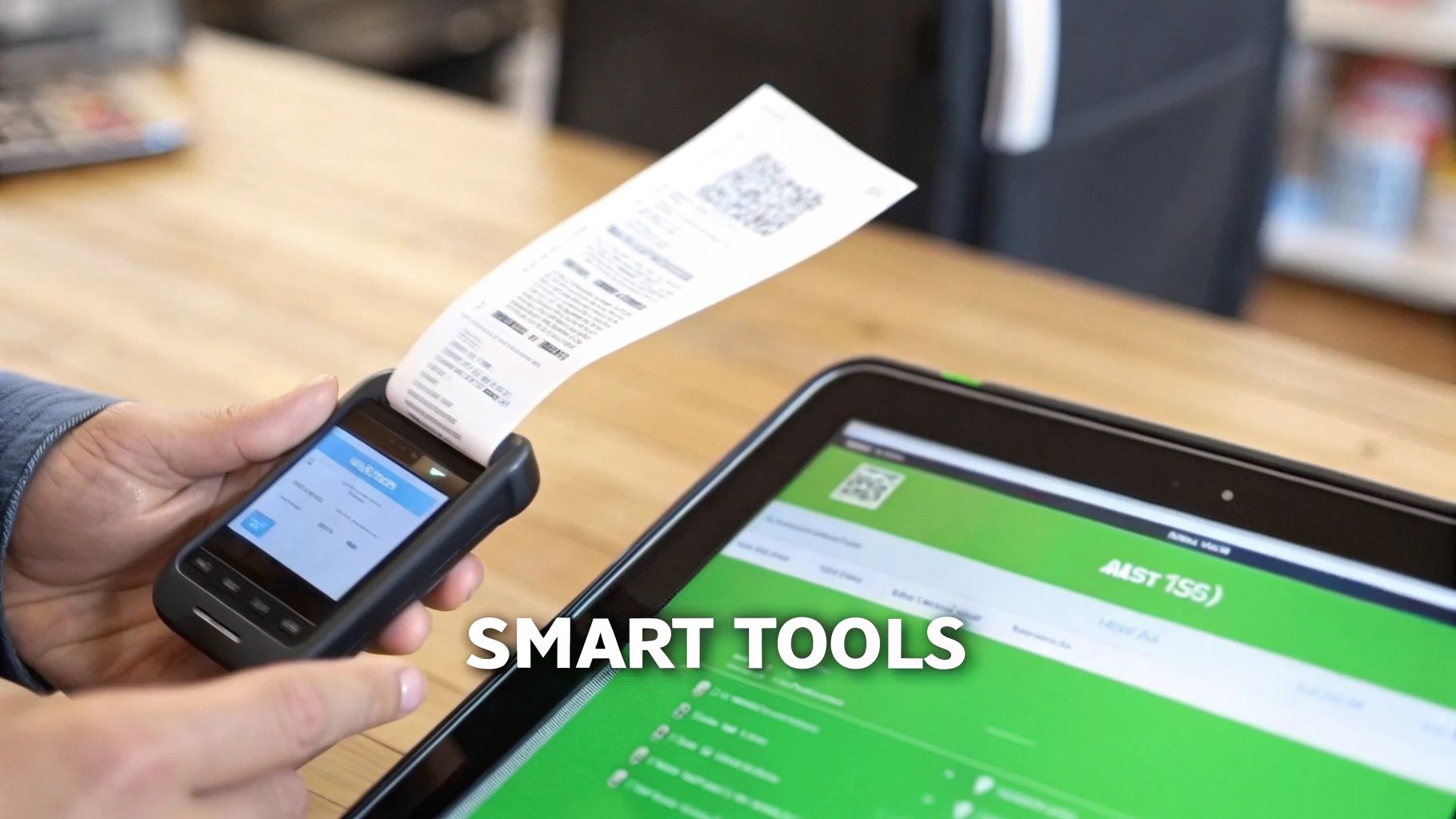
This image nails the transition we’re talking about—moving from manual, disconnected steps to a smooth, digital workflow where a single transaction is captured and categorized instantly. Getting this right is the key to knowing where your business truly stands financially.
From Simple Spreadsheets to Smart Software
When you’re just starting out, a well-organized spreadsheet can feel like a solid first step. It’s cheap (or free) and gets you into the crucial habit of tracking every dollar. But as your business picks up steam, you’ll quickly find that manual data entry is not only a massive time-suck but also a prime breeding ground for costly mistakes.
This is where dedicated expense management apps change the game. Many of the best free budgeting apps have features that work perfectly well for a small-scale business, offering a gentle entry into digital tracking. If you or your team are always on the go, mobile apps with receipt scanning are non-negotiable. Just picture it: your salesperson snaps a photo of a client lunch receipt, and the app instantly pulls the date, vendor, and amount. No more lost receipts.
For businesses that are truly ready to scale, comprehensive cloud-based software is the end goal. These platforms are the heavy hitters, often integrating directly with your accounting system to create a seamless flow of financial data from the moment a purchase is made all the way through to reconciliation.
Non-Negotiable Features to Look For
As you start comparing tools, don’t get distracted by flashy bells and whistles. A few core features are absolutely essential for effective expense management. If a tool doesn’t have these, walk away.
Here’s your must-have checklist:
- Automated Receipt Scanning: To really kill manual data entry, you need solid OCR recognition software built-in. This is the tech that reads and digitizes the info on receipts so you don’t have to type it.
- Real-Time Reporting: You should be able to see where your money is going at any given moment, not just at the end of the month.
- Multi-User Access: If you have a team, you need a system that lets employees submit their own expenses and allows managers to approve them, all in one place.
- Accounting Software Integration: Make sure the tool plays nicely with whatever you use for your books (like QuickBooks or Xero). This prevents the headache of manually transferring data between systems.
- Automated Categorization: A smart tool will learn your habits and suggest expense categories based on the vendor or transaction type, which speeds things up immensely.
Think of the right technology as an investment in your own efficiency and accuracy. A system that automates the grunt work of expense tracking frees you up to focus on the strategic, high-value activities that actually grow your business.
The Impact on Your Cash Flow
Making this switch from manual to automated isn’t just about convenience—it has a direct and powerful impact on your financial stability. Cash flow nightmares are one of the biggest killers of small businesses. In fact, 51% of owners point to uneven cash flow as a top financial challenge.
This problem is often tied directly to poor expense management. When you don’t have a clear, real-time picture of your spending, surprise bills pop up and payments get delayed. With 39% of small businesses carrying over $100,000 in debt, getting a firm grip on your operating expenses has never been more critical. Adopting a tool that gives you a live view of your spending helps you anticipate outflows, manage your budget, and ultimately maintain a healthier cash reserve.
Making Your Reimbursement Process Painless
Even the best expense software will fail if it’s a nightmare for your team to use. The human element is what truly separates a good system from a great one. This is all about building a reimbursement workflow—from submission to approval to payment—that’s so smooth and predictable it becomes second nature.
A clear, repeatable process is your best friend when it comes to fighting late reports and lost receipts. The whole point is to make doing the right thing the easiest path for everyone, whether you’re a team of three or on your way to thirty.
Keep Your Approval Chain Short and Sweet
The approval chain is simply the journey an expense report takes from an employee’s hands to the company’s bank account. If that journey is long and winding, you’ve created a bottleneck. The secret is to keep it as straightforward as your business can handle.
If you’re a tiny operation, you, the owner, might be the only approval needed. Done. As you bring more people on board, you can add a logical layer or two.
Here’s how that might look at a small marketing agency:
- Team Member: Submits a report for a client lunch.
- Project Manager: Checks it against the project budget and gives the first thumbs-up.
- You (or Finance): Give the final sign-off and cut the check (or click “pay”).
This simple, two-step process makes sure expenses are vetted for both project relevance and company policy, but it doesn’t grind things to a halt. You want just enough oversight to stay in control, not so much that you become the reason things move slowly. Research on T&E solutions actually found a good system can free up a finance person for 13 hours a week, mostly by getting rid of these manual back-and-forths.
Your reimbursement workflow should be built for speed and clarity. Every extra step adds friction, which just leads to late reports and frustrated employees. Keep it simple and predictable.
Nailing the Monthly Reconciliation
Alright, so expenses are approved and paid. You’re not quite done yet. Monthly reconciliation is the final, non-negotiable step that ensures your books are 100% accurate. This is where you sit down and match every single reimbursed expense to what actually came out of your bank and credit card accounts.
Think of it as the ultimate fact-check. Did that $50 lunch actually post for $50? Did we accidentally pay for the same software subscription twice? Reconciliation is how you catch these little (and sometimes big) mistakes early, from vendor overcharges to potential fraud.
Skipping this step is like hoping for the best. Your books might look right at a glance, but they could be hiding errors that will turn into massive headaches come tax time or, worse, during an audit.
Smart Ways to Automate and Simplify the Workflow
The dream is to have this whole reimbursement and reconciliation process practically run itself. It’s not about taking people out of the equation, but about letting technology do the tedious, repetitive work that eats up your time.
Here are a few things you can do right away to make it all run smoother:
- Connect Your Tools: Pick an expense tool that talks directly to your accounting software. Once an expense gets the green light, the data should pop right into your general ledger. No more manual data entry, no more typos.
- Set Up Automatic Nudges: Stop chasing people for late reports. Use your software to send out automated reminders each week to anyone with outstanding expenses. It’s a simple nudge that works wonders.
- Use Company Cards: If it makes sense for your business, issuing corporate cards linked to your expense system is a game-changer. Transactions get logged automatically, sometimes even categorized for you. It’s less work for your employee and less work for you.
- Establish Firm Deadlines: Be clear in your expense policy about when reports are due (e.g., within 15 days of the expense). A consistent deadline creates a rhythm and helps you close out your books each month without a last-minute scramble.
Putting these practices into place turns your small business expense management from a monthly chore into a well-oiled machine that works for you, not against you.
From Tallying Receipts to Fueling Growth
Once you’ve nailed down your expense tracking and reimbursement systems, you get to the fun part. This is where managing your expenses stops feeling like an administrative chore and starts becoming a strategic powerhouse for your business. You’re no longer just logging numbers; you’re mining that data for gold—insights that lead to smarter, more profitable decisions.

Think of it as shifting from reactive cleanup to proactive planning. Instead of just plugging financial leaks as they appear, you’ll start to see them coming. By digging into the rich data your system is collecting, you can spot spending patterns, find inefficiencies, and uncover hidden opportunities that go straight to your bottom line.
Find the Story in Your Spending Patterns
Your expense data tells the story of how your business really operates. The first step is to pull some simple financial reports. Most expense management software can spit these out in a few clicks, giving you a bird’s-eye view of where every dollar is going.
But don’t just glance at the grand totals. You have to dig a little. Try filtering your data to get more specific. For instance, pull up your “Marketing & Advertising” spend over the last six months. You might discover that your social media ad costs have悄悄crept up by 20%, but your lead numbers haven’t budged. That’s a clear signal to rethink that campaign.
The real “aha!” moments often come from comparing spending across different time periods, departments, or projects. This turns a list of numbers into actual business intelligence, showing you trends you’d completely miss otherwise.
Make a habit of pulling these reports monthly or quarterly. Soon enough, you’ll get a feel for the financial rhythm of your business, which is the foundation for both cutting costs and making smarter investments.
Pinpoint Real Opportunities to Save
With a clear picture of your spending habits, you can go on a treasure hunt for savings. This isn’t about making painful cuts that hurt your ability to operate. It’s about smart, surgical trims.
Data analysis is great at uncovering these common money drains:
- Subscription Bloat: I see this all the time. Run a report on all your recurring software subscriptions. You’ll likely find you’re still paying for a license for an employee who left months ago or for a tool the team tried once and abandoned.
- Vendor Overspending: Look at how much you’re spending with each vendor. If one supplier is getting a ton of your business, you’ve got leverage. Use that data to start a conversation about negotiating better rates or getting a bulk discount.
- Out-of-Policy Spending: A solid expense system will flag any purchase that breaks your rules. Reviewing these flags can show you where your policy might be confusing or if certain employees need a friendly nudge about the spending limits.
Even small wins here add up fast. Canceling a few forgotten subscriptions and renegotiating one vendor contract can easily free up thousands of dollars over a year—cash you can pour back into growing the business.
Build Budgets and Forecasts You Can Actually Trust
Maybe the biggest win from all this data is the ability to predict the future with some real confidence. When you have a detailed history of what you’ve actually spent, budgeting becomes way less of a guessing game. This is a cornerstone of solid cash flow management for small business, letting you plan for what’s ahead with much more accuracy.
Instead of basing next year’s budget on a gut feeling, you can use hard data. For example, by looking at your travel expenses over the last few years, you can predict the cost of next year’s big sales conference with surprising precision.
This data-first approach helps you set financial goals that are both realistic and achievable. It ensures you put enough money toward what matters most while helping you avoid the cash flow crunches that can sink a growing company. Your expense data becomes your financial roadmap, giving you the confidence to invest in your future.
Making Tax Season Simple and Stress-Free
Let’s be honest, most business owners dread tax season. But what if it didn’t have to be a last-minute scramble fueled by caffeine and panic? When you have a solid small business expense management system humming along all year, that’s exactly what happens. All that effort you put into tracking and categorizing pays off big time, turning a chaotic chore into a smooth, efficient process.
This is about more than just dodging a headache. It’s about putting real money back in your pocket. By making expense tracking a daily habit instead of a frantic annual project, you’re not just saving time—you’re positioning yourself to find thousands of dollars in legitimate tax savings.
Your Record-Keeping Checklist
To keep things simple and stay on the right side of the tax authorities, you need a good paper trail. While your expense management software will do most of the heavy lifting, you still need to know what to keep.
The tax authorities want to see proof for the expenses you claim. It’s that simple. Think of it as the evidence that backs up your numbers.
Here’s a quick rundown of the must-haves:
- Digital Receipts: Get an itemized digital copy for every business purchase. No exceptions.
- Invoices and Bills: Keep everything you get from vendors and suppliers.
- Bank and Credit Card Statements: These are essential for reconciling your books and proving payment.
- Proof of Payment: This could be a canceled check or any record showing a transaction has cleared.
As a rule of thumb, you should hang onto these tax records for at least three years after you file. Having it all stored digitally makes this a breeze.
A disciplined approach to record-keeping transforms tax time from a source of anxiety into a simple administrative task. It’s the final piece of the puzzle in a solid expense management strategy.
Claiming Every Deduction You Deserve
One of the biggest financial wins from tracking your expenses is making sure you claim every single deduction you’re entitled to. You’d be shocked at how quickly small, forgotten expenses add up, leaving a significant amount of money on the table.
Of course, you should always run things by a tax professional, but a great expense system makes it easy to pull the numbers you need.
Common Small Business Tax Deductions
- Office Supplies: Everything from pens and paper to your monthly software subscriptions.
- Utilities: A portion of your internet or phone bill if you work from a home office.
- Business Travel: This includes flights, hotels, and 50% of your meal costs when you’re on the road for work.
- Vehicle Expenses: Track either the standard mileage rate or your actual car expenses for business use.
- Professional Development: The cost of courses, workshops, or conferences that help you grow your skills.
With your expenses already categorized, you’ll have clean, accurate totals ready to go. It removes all the guesswork. This organization not only helps you maximize what you can deduct but also gives you airtight proof if the tax authorities ever come knocking. This is where investing in a proper small business expense management system really proves its worth.
Frequently Asked Questions About Expense Management
Even with the best systems, questions always pop up. Here are some of the most common ones I hear from small business owners as they’re getting their expense management process dialed in.
Is Expense Management Only For Big Companies?
Not a chance. This is one of the biggest myths I see. Modern cloud-based tools have completely leveled the playing field, making powerful small business expense management accessible to everyone.
A solo entrepreneur can now get the same kind of automation and financial control as a huge corporation, all without the hefty price tag or a dedicated IT department.
Do Automated Tools Actually Save Time?
They absolutely do, and the time savings are massive. A well-organized spreadsheet might feel productive, but the hours spent on manual entry, chasing down receipts, and fixing mistakes add up faster than you think.
One study found that a solid expense solution can save a finance team member up to 13 hours a week. That’s time you get back to focus on work that actually grows your business.
What Are The Best Features To Look For In An App?
You’ll want to focus on features that kill manual work and give you a crystal-clear view of your spending. If I were building a “must-have” list, it would include:
- Automated Receipt Scanning: This is a game-changer. Just snap a photo, and the app pulls the data for you. No more typing.
- Real-Time Reporting: You need to see where your money is going right now, not at the end of the month.
- Accounting Software Integration: This ensures all your expense data flows seamlessly into your general ledger, closing the loop.
- Budgeting Controls: The ability to set spending limits directly in the app helps enforce your expense policy without you having to play police.
These core features are what separate a simple receipt tracker from a true management tool.
Will Automation Make My Finance Team Redundant?
Quite the opposite—it makes them more valuable. When you automate the tedious, low-impact tasks like data entry and receipt matching, you free up your finance pros to do what you hired them for.
They can finally shift their focus to strategic financial analysis, forward-looking planning, and finding new ways to save money. That’s where their real value is.
Good expense management isn’t about eliminating jobs; it’s about eliminating mind-numbing work. It lets your team become strategic partners in the business, helping you make smarter decisions instead of just processing paperwork.
Getting your system right is a process, but starting with these fundamentals will put you on the fast track to financial clarity and control.
Ready to take control of your finances and build a more secure future? At Collapsed Wallet, we turn complex financial topics into simple, actionable advice. Explore our guides and tools to start managing your money with confidence today!
