

Table of Contents
- 1. Meal Planning and Prep
- 2. Buying Store Brands and Generic Products
- 3. Using Coupons and Cashback Programs
- 4. Shopping Sales and Using Loss Leaders
- 5. Buying in Bulk and Warehouse Clubs
- 6. Seasonal and Local Produce Shopping
- 7. Reducing Food Waste Through Smart Storage
- 8. Avoiding Convenience Foods and Pre-Packaged Items
- 9. Price Matching and Negotiation Strategies
- 10. Shopping Less Frequently and Making Strategic Store Visits
- Comparison of 10 Strategies to Save Money on Groceries
- Turning Smart Shopping into Lasting Financial Freedom
This blog post may contain affiliate links. As an Amazon Associate I earn from qualifying purchases.
Navigating the supermarket aisles can feel like a direct assault on your wallet, with rising food prices making it harder than ever to stick to a budget. If you’re looking for a clear path to financial freedom, mastering your grocery spending is a non-negotiable first step. This guide moves beyond generic advice, offering 10 specific, actionable strategies that can significantly reduce your food bill without compromising on quality. From leveraging technology to rethinking your shopping frequency, these proven methods will empower you to take control of your expenses and redirect those savings toward your long-term financial goals.
The aim of our blog is to provide valuable insights and practical tips to help readers manage their money more effectively. However, the information shared here is for general guidance and educational purposes only. It should not be regarded as professional financial advice. Any actions taken based on our content are entirely the responsibility of the reader, and we accept no liability for the outcomes of those actions. If you require financial advice tailored to your personal circumstances, we strongly recommend seeking assistance from a qualified financial adviser.
1. Meal Planning and Prep
Meal planning is a systematic approach to deciding what you’ll eat for the week or month ahead. By creating a detailed plan, you generate a precise shopping list, which is one of the most effective strategies to save money on groceries. This method eliminates last-minute decisions, curbs impulse buys at the store, and significantly reduces food waste by ensuring every ingredient you purchase has a purpose. It transforms your grocery shopping from a reactive chore into a proactive financial tool.
The aim of our blog is to provide valuable insights and practical tips to help readers manage their money more effectively. However, the information shared here is for general guidance and educational purposes only. It should not be regarded as professional financial advice. Any actions taken based on our content are entirely the responsibility of the reader, and we accept no liability for the outcomes of those actions. If you require financial advice tailored to your personal circumstances, we strongly recommend seeking assistance from a qualified financial adviser.
How to Implement Meal Planning
Getting started is simpler than it seems. You don’t need a month-long, color-coded spreadsheet on day one.
Start Small: Begin by planning just three or four dinners for the upcoming week. This manageable first step builds the habit without feeling overwhelming.
Theme Your Nights: Assigning themes to certain days can simplify the decision-making process and make planning a routine activity.
Overlap Ingredients: Choose menus that share common components. If you buy a large bag of onions, plan for it to be used in multiple meals. This maximizes your bulk purchases.
Dedicate Prep Time: Set aside a few hours on a Sunday to prepare ingredients. This “prep” phase makes weekday tasks faster and reduces the temptation to opt for expensive alternatives.
By planning ahead, you can align your purchases with weekly sales flyers, focusing on discounted items to maximize savings. For a deeper dive into creating a system that works for you, explore these expert tips for budget-friendly meal planning on collapsedwallet.com. This strategic control over your food budget is a foundational step toward achieving greater financial stability.
2. Buying Store Brands and Generic Products
Opting for store brands and generic products over their name-brand counterparts is a simple yet powerful tactic to save money on groceries. These private-label items, often found right next to the famous brands, typically cost 20-40% less. This significant price difference rarely comes at the expense of quality, as many store brands are produced in the same facilities as national brands, adhering to similar quality and safety standards. Making this switch allows you to reduce your grocery bill without sacrificing the staples your family enjoys.
The aim of our blog is to provide valuable insights and practical tips to help readers manage their money more effectively. However, the information shared here is for general guidance and educational purposes only. It should not be regarded as professional financial advice. Any actions taken based on our content are entirely the responsibility of the reader, and we accept no liability for the outcomes of those actions. If you require financial advice tailored to your personal circumstances, we strongly recommend seeking assistance from a qualified financial adviser.
How to Implement Store-Brand Shopping
Integrating this strategy into your routine is straightforward. You don’t need to switch every item at once; a gradual approach works best.
Start with the Basics: Begin by swapping simple, single-ingredient items like flour, sugar, salt, canned vegetables, and cooking oils. The quality difference in these products is often negligible or nonexistent.
Compare Labels, Not Just Logos: Take a moment to compare the nutrition facts and ingredient lists of the store brand versus the name brand. You’ll often find they are nearly identical, making the price difference the only real factor.
Find Your Favorites: Don’t be discouraged if you dislike one store-brand item. Just like with national brands, quality can vary. Try a few, like Costco’s Kirkland Signature or Target’s Good & Gather, to discover which ones you prefer.
Stock Up on Sales: Even generic products go on sale. When you see a great price on a store-brand staple you use frequently, buy a few to maximize your savings over time.
By embracing store brands, you directly lower your weekly grocery spend, freeing up cash that can be redirected toward other financial goals. Consumer studies consistently show that shoppers can achieve substantial savings without compromising on taste or quality, making this a foundational habit for savvy budget management.
3. Using Coupons and Cashback Programs
Leveraging technology like digital coupons and cashback apps is a powerful, direct-action strategy to lower your grocery bill. This method involves using manufacturer and store coupons, combined with apps that refund a percentage of your purchase. The modern approach, driven by store loyalty programs and smartphone technology, has transformed traditional coupon clipping into a streamlined and highly effective way to save money on groceries with minimal effort.
The aim of our blog is to provide valuable insights and practical tips to help readers manage their money more effectively. However, the information shared here is for general guidance and educational purposes only. It should not be regarded as professional financial advice. Any actions taken based on our content are entirely the responsibility of the reader, and we accept no liability for the outcomes of those actions. If you require financial advice tailored to your personal circumstances, we strongly recommend seeking assistance from a qualified financial adviser.
How to Implement Coupons and Cashback Programs
Integrating these tools into your shopping routine is straightforward and can yield immediate savings. You don’t need to become an “extreme couponer” to see a significant impact.
Go Digital First: Download store apps like Target Circle or the Kroger app. Before you shop, browse their digital coupon sections and “clip” relevant offers directly to your loyalty account. These are applied automatically at checkout.
Embrace Cashback Apps: Use apps like Ibotta or Checkout 51. After shopping, you simply scan your receipt (or link your loyalty card) to earn cash back on qualifying items. Some users save hundreds of dollars a year with this method alone.
Stack Your Savings: The key to maximizing this strategy is “stacking.” This means using a manufacturer coupon (either paper or digital) on an item that is already on sale at the store. If you can then claim a cashback offer on that same item, you’ve stacked three discounts.
Stay Organized and Realistic: Only clip or save coupons for products you and your family will actually use. A 50-cent discount on an $8 item you don’t need is not a saving; it’s a $7.50 expense. Focus on staples and planned purchases.
By consistently applying these techniques, you are actively reducing your out-of-pocket costs and recovering money on every shopping trip. This disciplined approach reinforces smart spending habits and contributes directly to your financial goals, making it a cornerstone of savvy grocery budgeting.
4. Shopping Sales and Using Loss Leaders
Strategic shopping involves timing your purchases to align with store sales cycles and taking advantage of deeply discounted “loss leaders.” A loss leader is an item sold below its market cost to attract customers into the store. By building your shopping list around these weekly deals, you can drastically save money on groceries. This proactive approach shifts you from buying what you want when you want it, to buying what you need when it’s at its absolute lowest price, which is a key principle in effective financial management.
The aim of our blog is to provide valuable insights and practical tips to help readers manage their money more effectively. However, the information shared here is for general guidance and educational purposes only. It should not be regarded as professional financial advice. Any actions taken based on our content are entirely the responsibility of the reader, and we accept no liability for the outcomes of those actions. If you require financial advice tailored to your personal circumstances, we strongly recommend seeking assistance from a qualified financial adviser.
How to Implement Sales-Focused Shopping
Adopting this strategy requires a bit of planning, but the financial payoff is significant. You simply shift your focus from your immediate needs to the opportunities presented in weekly ads.
Check Weekly Ads: Most grocery store ads are released online or in apps on Tuesday or Wednesday. Spend 15 minutes reviewing them before you plan your meals or create your shopping list.
Plan Around Sales: If a certain protein is 50% off, plan your meals around it. If seasonal produce like bell peppers is deeply discounted, incorporate them into your weekly menu.
Identify and Target Loss Leaders: Stores often use staples like milk, eggs, or butter as loss leaders. When you see these items at a rock-bottom price, it’s the ideal time to buy them, even if you aren’t out yet.
Stock Up on Non-Perishables: When pantry items like pasta, canned tomatoes, or cereal are more than 40% off, buy enough to last until the next major sale cycle (typically 6-8 weeks). This ensures you never pay full price for staples.
Freeze Sale Items: Take advantage of sales on perishable goods. Buy extra meat, bread, or even cheese when it’s on sale and freeze it for future use.
This method, often highlighted by budget experts like those at Money Saving Mom, empowers you to control your spending by purchasing goods at their lowest price point. By consistently buying on sale, you avoid the high costs of convenience and align your grocery spending with a disciplined financial strategy, building a foundation for greater savings and financial freedom.
5. Buying in Bulk and Warehouse Clubs
Buying in bulk involves purchasing larger quantities of products to achieve a lower cost per unit, a foundational strategy to save money on groceries. This approach, often associated with warehouse clubs like Costco or Sam’s Club, leverages economies of scale. By paying for a membership, consumers gain access to significant discounts on everything from pantry staples to household goods, turning a long-term shopping habit into a powerful budgeting tool that reduces the frequency of store visits and the overall cost of essential items.
The aim of our blog is to provide valuable insights and practical tips to help readers manage their money more effectively. However, the information shared here is for general guidance and educational purposes only. It should not be regarded as professional financial advice.
Any actions taken based on our content are entirely the responsibility of the reader, and we accept no liability for the outcomes of those actions. If you require financial advice tailored to your personal circumstances, we strongly recommend seeking assistance from a qualified financial adviser.
How to Implement Bulk Buying
Strategic bulk shopping is about more than just buying the biggest box on the shelf. It requires a thoughtful approach to maximize savings and minimize waste.
Calculate Membership Value: Before committing, estimate your annual spending on staples like toilet paper, grains, and canned goods. Compare potential per-unit savings against the membership fee to ensure it’s a financially sound decision for your household.
Focus on Non-Perishables: Prioritize items with a long shelf life, such as rice, pasta, canned tomatoes, and paper products. This ensures you can use everything you buy before it expires.
Divide and Conquer: For perishable items like meat or cheese, buy in bulk and portion them out immediately upon returning home. Use a vacuum sealer or freezer-safe bags to store smaller, manageable quantities, preventing spoilage.
Compare Unit Prices: Always have your phone’s calculator ready. Compare the warehouse club’s per-ounce or per-item price against your regular grocery store’s sale prices. A bulk purchase isn’t always the cheapest option.
By focusing your bulk purchases on items you use consistently, you can lock in lower prices and protect your budget from weekly price fluctuations. For more advanced strategies on making warehouse club memberships pay off, check out this guide to maximizing Costco savings on collapsedwallet.com. This method transforms your pantry into a buffer against inflation and a key component of your financial strategy.
6. Seasonal and Local Produce Shopping
Aligning your fruit and vegetable purchases with nature’s calendar is a powerful yet often overlooked strategy to save money on groceries. Seasonal produce is harvested at its peak, creating an abundance that drives prices down significantly.
When you buy strawberries in June instead of January, you’re not just getting a better price; you’re also getting a fresher, longer-lasting product. This approach reduces your grocery bill and minimizes food waste, turning your shopping cart into a reflection of smart, seasonal financial decisions.
The aim of our blog is to provide valuable insights and practical tips to help readers manage their money more effectively. However, the information shared here is for general guidance and educational purposes only. It should not be regarded as professional financial advice.
Any actions taken based on our content are entirely the responsibility of the reader, and we accept no liability for the outcomes of those actions. If you require financial advice tailored to your personal circumstances, we strongly recommend seeking assistance from a qualified financial adviser.
How to Implement Seasonal and Local Shopping
Embracing this strategy doesn’t require agricultural expertise, just a bit of awareness of your local growing cycles.
Learn Your Seasons: Familiarize yourself with your region’s peak seasons for different produce. A quick online search for a “seasonal produce chart for [your state/region]” provides an easy-to-follow guide.
Explore Farmers Markets: Local markets often offer produce at 30-50% less than major supermarkets. For the best deals, visit near the end of the day when vendors may offer discounts to clear remaining stock.
Consider a CSA: Joining a Community-Supported Agriculture (CSA) program gives you a regular share of a local farm’s harvest at a discounted price. Services like Local Harvest can help you find one nearby.
Preserve the Abundance: When you find a great deal on seasonal items like berries or tomatoes, buy in bulk. You can freeze, can, or pickle them to enjoy the savings and flavor for months to come.
By planning your purchases around what is currently in season, you can drastically cut costs on some of the healthiest items on your list. For instance, asparagus might cost $2 per pound in the spring but jump to $5 per pound in the winter. For more resources on finding local food sources, check out the nationwide directory at LocalHarvest.org. This simple shift in purchasing habits is a direct path to reducing your grocery spending and achieving your financial goals.
7. Reducing Food Waste Through Smart Storage
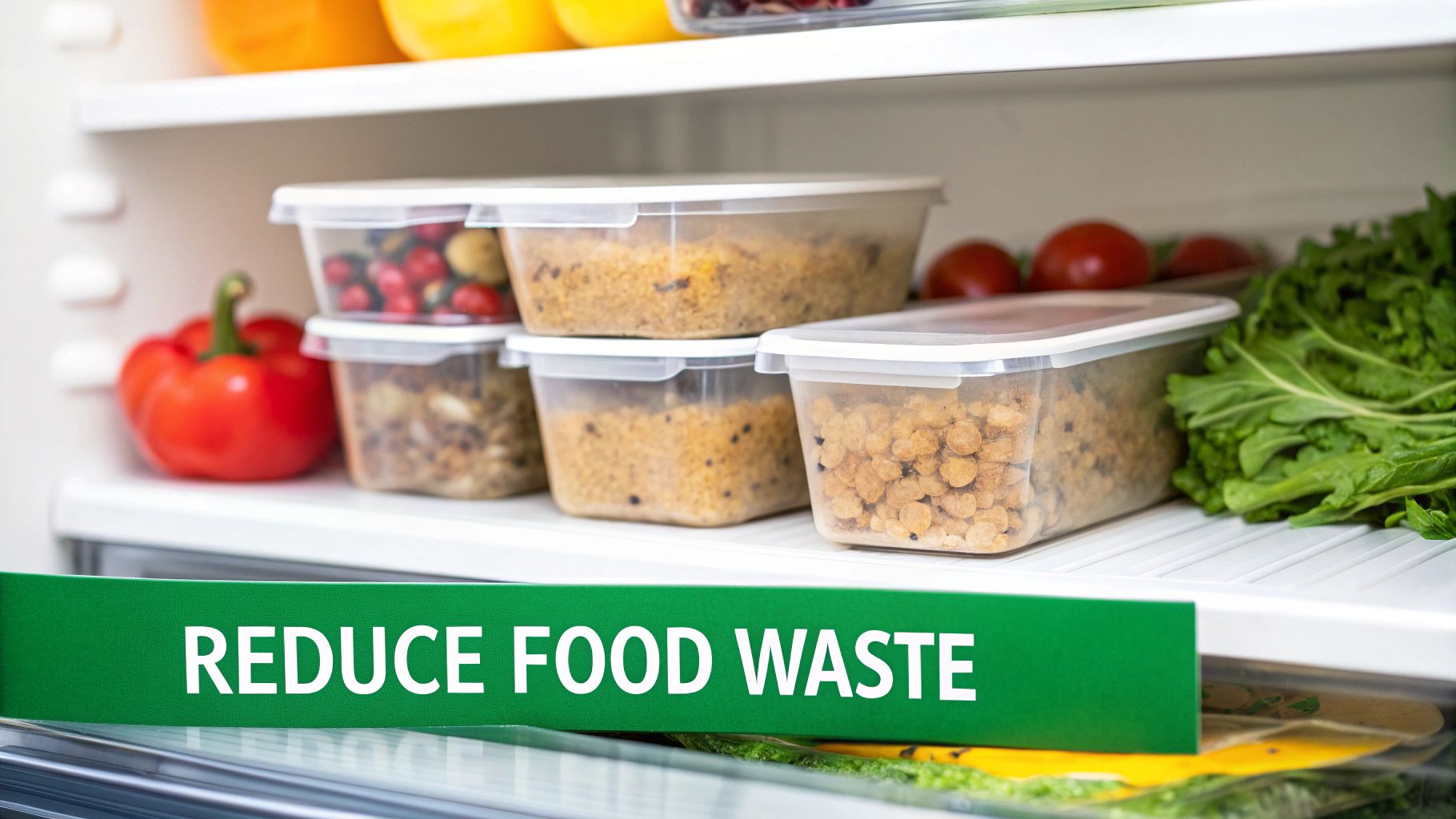
Reducing food waste is a direct and powerful way to save money on groceries, as every item that spoils is essentially cash thrown away. Smart storage involves using proper techniques and organizational systems to extend the shelf life of your food, ensuring you use what you buy. By implementing simple strategies to minimize spoilage, you prevent the common scenario where 30-40% of purchased food is wasted, turning your refrigerator and pantry into assets that protect your budget rather than liabilities that drain it.
The aim of our blog is to provide valuable insights and practical tips to help readers manage their money more effectively. However, the information shared here is for general guidance and educational purposes only. It should not be regarded as professional financial advice.
Any actions taken based on our content are entirely the responsibility of the reader, and we accept no liability for the outcomes of those actions. If you require financial advice tailored to your personal circumstances, we strongly recommend seeking assistance from a qualified financial adviser.
How to Implement Smart Storage
Adopting smart storage habits doesn’t require a complete kitchen overhaul. Start with a few high-impact changes.
Adopt FIFO (First In, First Out): When unpacking groceries, move older items to the front of your fridge and pantry and place new items in the back. This simple rotation ensures you use things before they expire.
Use Clear Containers: Store leftovers and prepped ingredients in clear containers. Seeing what you have prevents food from getting lost and forgotten at the back of a shelf.
Understand Date Labels: Learn the difference between “Use-By,” “Best-By,” and “Sell-By.” Many foods are still perfectly safe to eat past their “Best-By” date, which refers to peak quality, not safety.
Master Produce Storage: Store herbs like cilantro and parsley in a jar of water to extend their life for weeks. Keep root vegetables like potatoes and onions in a cool, dark place, but separate them to prevent premature sprouting.
By properly storing your purchases, from fresh produce to bulk grains, you maximize the value of every dollar spent. This approach not only saves you money but also promotes a more sustainable and less wasteful household, contributing to greater financial efficiency.
8. Avoiding Convenience Foods and Pre-Packaged Items
Choosing whole, unprocessed ingredients over their convenient counterparts is a powerful way to save money on groceries. Convenience items like pre-cut vegetables, grated cheese, or pre-made marinades come with a significant “convenience tax,” often costing 50% to 300% more than their raw forms.
By dedicating a small amount of time to preparation, you reclaim that markup, drastically cutting your food bill while simultaneously improving the nutritional quality of what you consume.
The aim of our blog is to provide valuable insights and practical tips to help readers manage their money more effectively. However, the information shared here is for general guidance and educational purposes only. It should not be regarded as professional financial advice.
Any actions taken based on our content are entirely the responsibility of the reader, and we accept no liability for the outcomes of those actions. If you require financial advice tailored to your personal circumstances, we strongly recommend seeking assistance from a qualified financial adviser.
How to Implement This Strategy
Shifting away from convenience doesn’t mean spending hours in the kitchen. It’s about making small, strategic swaps that add up to big savings.
Start with Easy Swaps: Begin with items that require minimal effort. For example, grating your own block of cheese instead of buying pre-shredded, or mixing your own trail mix instead of buying pre-packaged bags.
Embrace Batch Preparation: Dedicate a short period to prepare core ingredients for the week. Cook a large batch of rice, chop onions and peppers, or prepare proteins. This gives you “convenience” on your own terms.
Calculate Your Savings: Motivation is key. Note the price difference between a whole chicken ($5) and a rotisserie chicken ($8), or a bag of salad ($4) versus a head of lettuce ($1.50). Seeing the tangible savings reinforces the habit.
Invest in Basic Tools: Simple kitchen equipment like a good knife, a food processor, or a blender can make from-scratch preparation incredibly fast and easy, removing the friction that makes convenience so tempting.
By focusing on whole ingredients, you take direct control over your grocery spending. To see how these whole foods can form the basis of a thrifty shopping trip, explore our guide for an inexpensive healthy grocery list on collapsedwallet.com. This approach is a cornerstone of a financially savvy household.
9. Price Matching and Negotiation Strategies
Price matching and negotiation are powerful tools for proactive shoppers looking to reduce their grocery bills. Many retailers will match a competitor’s lower price on an identical item, while others are open to negotiation on products with minor imperfections or nearing their expiration date.
Leveraging these policies is a direct way to save money on groceries, transforming you from a passive price-taker into an active participant in setting the final cost of your items. This strategy can unlock savings of 5-20% on eligible products, turning a standard shopping trip into a more financially rewarding one.
The aim of our blog is to provide valuable insights and practical tips to help readers manage their money more effectively. However, the information shared here is for general guidance and educational purposes only. It should not be regarded as professional financial advice.
Any actions taken based on our content are entirely the responsibility of the reader, and we accept no liability for the outcomes of those actions. If you require financial advice tailored to your personal circumstances, we strongly recommend seeking assistance from a qualified financial adviser.
How to Implement Price Matching and Negotiation
Successfully using these strategies requires a bit of research and confidence at the checkout counter or with a store manager.
Know the Policies: Before you shop, check the price-matching policies of your favorite stores. Retailers like Target often match prices from their own website and major online competitors. Keep in mind that some, like Walmart, have limited or discontinued their in-store ad matching programs, so always verify the current rules.
Use Store Apps: Download the apps for the stores you frequent. These apps often have built-in price scanners and make it easy to pull up competitor pricing on your phone to show the cashier.
Look for Imperfections: A dented can, a bruised apple, or a torn box doesn’t affect the product inside. Politely ask a store manager if they would be willing to offer a discount on such items. Many are happy to do so to avoid having to discard the product.
Check “Best By” Dates: For items approaching their “best by” or “sell by” date, such as dairy, meat, or baked goods, don’t hesitate to ask for a manager’s special. A simple, polite inquiry like, “I see this expires tomorrow, is there any discount you can offer?” can often result in significant markdowns.
By adopting a proactive approach and knowing store policies, you can capture savings that most shoppers miss. For a comprehensive list of stores with favorable price-matching guarantees, check out this guide on stores that price match on thekrazycouponlady.com. This small effort before and during your shop can make a substantial difference in your overall grocery budget.
10. Shopping Less Frequently and Making Strategic Store Visits

Reducing your trips to the grocery store is a powerful, yet often overlooked, strategy to save money on groceries. Each visit, planned or not, presents opportunities for impulse buys, from checkout counter temptations to unlisted “deals” that weren’t part of your plan.
By consolidating your shopping into one weekly or bi-weekly trip, you create a structured system that forces better planning and dramatically reduces spontaneous spending, which can account for a 15-30% increase in your total bill.
The aim of our blog is to provide valuable insights and practical tips to help readers manage their money more effectively. However, the information shared here is for general guidance and educational purposes only. It should not be regarded as professional financial advice.
Any actions taken based on our content are entirely the responsibility of the reader, and we accept no liability for the outcomes of those actions. If you require financial advice tailored to your personal circumstances, we strongly recommend seeking assistance from a qualified financial adviser.
How to Implement Less Frequent Shopping
Adopting this habit requires a shift from reactive “popping in” to proactive, strategic planning. The goal is to make each store visit highly efficient and targeted.
Designate a Shopping Day: Choose one specific day of the week for your grocery run and stick to it. This creates a routine and eliminates the temptation for small, unnecessary mid-week trips.
Create a Comprehensive List: Your shopping list, derived directly from your plan, is your most important tool. It must be detailed enough to cover all your needs until the next planned trip.
Never Shop Hungry: Research shows that shopping on an empty stomach can increase spending by 15-20%, particularly on high-calorie, unplanned items. Always have a snack before you go.
Stick to the List, No Exceptions: The core of this strategy is discipline. Once you are in the store, your mission is to get only what is on your list and leave. This single habit is crucial for financial control.
This disciplined approach transforms shopping from a recurring, budget-draining activity into a controlled, predictable expense. By minimizing your exposure to the store environment, you directly combat the retail psychology designed to make you spend more. To build the mental fortitude required, explore these tips for mastering control over impulse buying on collapsedwallet.com. This method not only saves money but also frees up valuable time, contributing to both financial and personal well-being.
Comparison of 10 Strategies to Save Money on Groceries
| Strategy | Implementation Complexity 🔄 | Resource Requirements ⚡ | Expected Outcomes 📊 | Ideal Use Cases 💡 | Key Advantages ⭐ |
|---|---|---|---|---|---|
| Meal Planning and Prep | Medium–High — upfront planning and routine setup | Time, storage containers | 📊 Reduces waste ~30–40%; saves weekday time | Weekly/bi-weekly households; busy schedules | ⭐ Better financial control; bulk buying |
| Buying Store Brands and Generic Products | Low — simple substitution | Minimal — occasional label checks | 📊 20–40% lower cost on many items | Pantry staples, basics, tight budgets | ⭐ Large recurring savings with little effort |
| Using Coupons and Cashback Programs | Medium — ongoing management and app use | Smartphone/apps, time to track offers | 📊 Typically 10–30% off; variable rebates | Deal-seekers; targeted purchases | ⭐ Stackable savings + extra cash back |
| Shopping Sales and Using Loss Leaders | Medium — ad scanning and timing | Time, possible travel, storage for stockpiles | 📊 40–50% on sale items when timed | Stockpiling non-perishables, seasonal buys | ⭐ Deep discounts during sales cycles |
| Buying in Bulk and Warehouse Clubs | Low–Medium — membership & purchase planning | Upfront cash, storage space, membership fee | 📊 20–50% per-unit cost reduction | Large families, frequent bulk users | ⭐ Lowest per-unit prices; member perks |
| Seasonal and Local Produce Shopping | Medium — requires seasonal knowledge | Flexible schedule, market/CSA access | 📊 30–50% cheaper in season; fresher produce | Produce-centric budgets; supporting locals | ⭐ Higher quality; seasonal savings |
| Reducing Food Waste Through Smart Storage | Low–Medium — system setup and maintenance | Containers, labeling supplies, time | 📊 Prevents ~30–40% of food waste | Households with perishables, bulk buyers | ⭐ Long-term savings; environmental impact |
| Avoiding Convenience Foods and Pre-Packaged Items | Medium–High — requires prep time | Time, basic kitchen equipment | 📊 Saves 50–70% vs convenience items | Budgets focused on whole ingredients | ⭐ Major cost + health improvements |
| Price Matching and Negotiation Strategies | Medium — knowledge of policies and readiness to ask | Smartphone/apps, time at checkout | 📊 Additional 5–20% savings possible | Big-ticket buys, near-expiry/clearance items | ⭐ Extra savings without coupons |
| Shopping Less Frequently and Strategic Visits | Low–Medium — planning and discipline | Accurate plan, storage for bulk buys | 📊 Cuts impulse spending 15–30%; saves time | Busy households aiming to reduce spending | ⭐ Fewer trips; improved spending control |
Turning Smart Shopping into Lasting Financial Freedom
Navigating the grocery aisles with a strategic mindset is far more than just a weekly chore; it is a fundamental act of financial self-care. Throughout this guide, we have explored a comprehensive toolkit of strategies designed to help you save money on groceries, transforming this significant household expense into a powerful engine for your financial goals.
Each tip, from the disciplined art of meal planning and the savvy use of store brands to the technological edge provided by cashback apps and loyalty programs, represents a distinct opportunity to reclaim control over your budget.
We’ve delved into the importance of timing, showing how shopping sales, leveraging loss leaders, and buying produce in season can drastically cut your spending without sacrificing quality. We also uncovered the long-term value of smart pantry management, such as buying in bulk, mastering food storage to eliminate waste, and avoiding the high cost of convenience.
These tactics are about building a sustainable system that optimizes value and prevents your hard-earned money from ending up in the bin. Each decision, whether it’s choosing to shop less frequently or strategically price-matching, chips away at unnecessary expenditure and redirects those funds toward what truly matters.
From Small Savings to Major Financial Wins
The true power of learning how to save money on groceries lies in the cumulative effect of these small, consistent actions. Saving $50 a week might not seem revolutionary at first, but that equates to $2,600 over a year. Imagine what that sum could do for your financial well-being. It could clear a high-interest credit card balance, create a robust emergency fund, or become the seed capital for your first investment in a low-cost ETF.
Key Takeaway: The goal isn’t just to spend less on food. The goal is to consciously reallocate the money you save toward activities that build wealth and reduce financial stress, accelerating your journey toward financial freedom.
This process builds more than just savings; it builds financial discipline. The skills you hone in the grocery store, such as budgeting, planning ahead, and seeking value, are directly transferable to every other area of your financial life. You become a more conscious consumer, less susceptible to impulse purchases and more attuned to the long-term impact of your spending habits.
Your Action Plan for Lasting Change
To avoid feeling overwhelmed, don’t try to implement every strategy at once. Instead, create a phased approach that builds momentum and ensures these new habits stick.
Start with the Foundation: For the next two weeks, focus exclusively on planning and shopping with a list. This is the single most effective change you can make. Track how much you save compared to your previous shopping trips.
Layer in Technology: Once you have a solid planning routine, incorporate a cashback app and digital coupons. Link your store loyalty cards and make scanning your receipts a non-negotiable part of your post-shopping routine.
Optimize Your Shopping Habits: In the following month, experiment with shopping less frequently (e.g., once a week or every two weeks) and start paying close attention to unit pricing. This will train your eye to spot true value beyond the flashy sale signs.
Master Advanced Techniques: Finally, begin exploring strategies like buying key items in bulk, shopping for seasonal produce, and implementing a “zero-waste” food storage system at home.
By progressively integrating these methods, you create a powerful, self-reinforcing system that makes saving money on groceries an automatic and rewarding part of your lifestyle. You are not just cutting costs; you are actively investing in a future with fewer financial worries and more opportunities. This is the path from simple saving to genuine financial empowerment.
Ready to take control of your entire financial picture? At Collapsed Wallet, we provide the tools and insights you need to manage your budget, track your savings, and accelerate your journey to financial freedom. Discover more powerful strategies and resources at Collapsed Wallet to turn today’s smart habits into tomorrow’s wealth.
