
Table of Contents
- 1. Implement a Zero-Based Budgeting System
- 2. Sell Unused Items
- 3. Negotiate Bills and Subscriptions
- 4. Use Cashback and Rewards Programs
- 5. Automate Savings Transfers
- 6. Conduct a Spending Audit
- 7. Embrace the Gig Economy with a Side Hustle
- 8. Refinance High-Interest Debt
- 9. Switch to a Lower-Cost Energy Tariff
- 10. Start a Low-Cost Investment Plan
- 10 Fast Money-Saving Strategies Comparison
- Your Path to Financial Control Starts Now
This blog post may contain affiliate links. As an Amazon Associate I earn from qualifying purchases.
In a world of rising costs and financial uncertainty, finding effective ways to save money fast is no longer just a goal, it's a necessity for achieving financial freedom. Whether you're building an emergency fund, paying off debt, or planning for a major purchase, the ability to accumulate cash quickly can transform your financial outlook. This guide cuts through the noise, offering practical, high-impact strategies designed to boost your savings account without drastic, unsustainable lifestyle changes. We will explore everything from immediate cash injections and recurring bill reductions to powerful mindset shifts that make saving an automatic habit.
The aim of our blog is to provide valuable insights and practical tips to help readers manage their money more effectively. However, the information shared here is for general guidance and educational purposes only. It should not be regarded as professional financial advice. Any actions taken based on our content are entirely the responsibility of the reader, and we accept no liability for the outcomes of those actions. If you require financial advice tailored to your personal circumstances, we strongly recommend seeking assistance from a qualified financial adviser.
This comprehensive list is designed for action. Each strategy is broken down into concrete steps, with details on who it suits best and the potential time-to-impact on your finances. We focus on techniques that deliver tangible results, moving beyond generic advice to provide a clear roadmap for your savings journey. From leveraging technology to automate your financial goals to identifying and eliminating hidden spending, these methods are built for immediate implementation. Prepare to take control of your cash flow and discover how small, strategic changes can lead to significant and rapid financial gains, putting you on a faster track toward escaping financial worries.
1. Implement a Zero-Based Budgeting System
One of the most effective ways to save money fast is to adopt a zero-based budgeting system, a method where every dollar of your income is assigned a specific job. Instead of tracking spending after the fact, you proactively allocate your entire income to categories like housing, utilities, savings, and debt repayment until your income minus your expenses equals zero. This forces you to be intentional with your money, revealing precisely where it goes and exposing wasteful habits.
The aim of our blog is to provide valuable insights and practical tips to help readers manage their money more effectively. However, the information shared here is for general guidance and educational purposes only. It should not be regarded as professional financial advice. Any actions taken based on our content are entirely the responsibility of the reader, and we accept no liability for the outcomes of those actions. If you require financial advice tailored to your personal circumstances, we strongly recommend seeking assistance from a qualified financial adviser.
How It Works and Potential Impact
The core principle is simple: Income – Expenses = 0. Before the month begins, you sit down and create a plan for every dollar you expect to earn. If you have $3,000 in income, you must account for all $3,000. This method eliminates the "where did my money go?" mystery at the end of the month.
Many users of this system report a significant and rapid shift in their financial health. It’s not uncommon for families to identify and redirect $300-$500 per month from unintentional spending toward savings or debt. Young professionals often find an extra $200-$400 by cutting back on unexamined subscriptions and discretionary purchases.
Actionable Steps for Implementation
- Analyze Past Spending: Review your last two to three months of bank and credit card statements to create realistic budget categories and starting amounts.
- Utilize Technology: Apps like YNAB (You Need A Budget) are designed specifically for this methodology and can automate much of the tracking process.
- Prioritize Savings: Treat your savings and debt repayment goals as non-negotiable bills. Assign money to these categories first.
- Be Realistic: Include a "fun money" or "miscellaneous" category. An overly restrictive budget is hard to stick with and often leads to failure.
- Review and Adjust: A budget is a living document. Review it weekly to stay on track and adjust it each month as your income or expenses change. Strong money management skills are crucial for this process. To dive deeper, you can explore more about improving your financial literacy on collapsedwallet.com.
2. Sell Unused Items
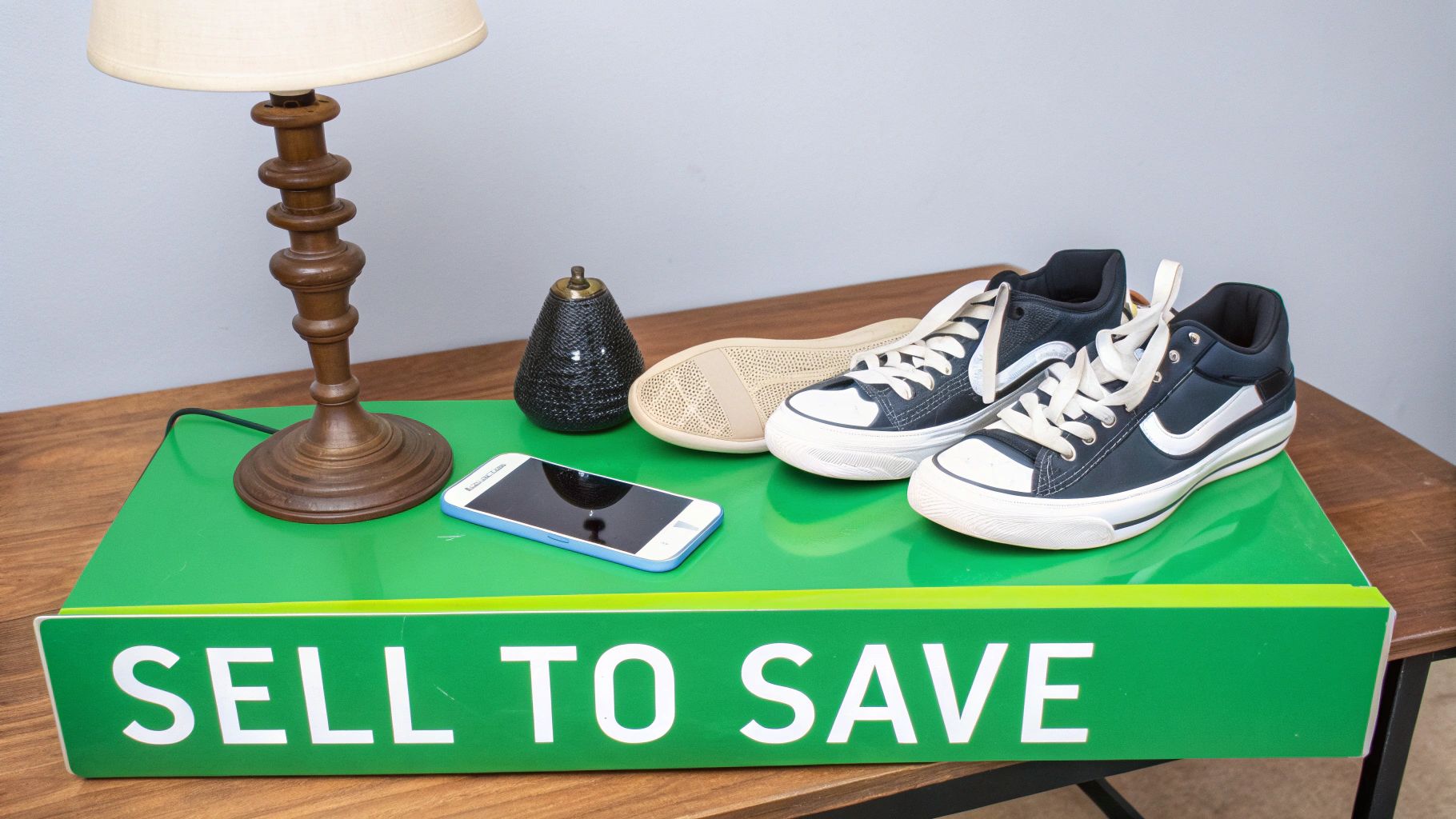
One of the most immediate ways to save money fast is to convert clutter into cash by selling items you no longer use or need. This strategy liquidates possessions through online marketplaces or consignment shops, providing a direct and rapid injection of funds into your budget. By decluttering your space, you can quickly accumulate a significant amount of money without making any changes to your daily lifestyle or spending habits.
The aim of our blog is to provide valuable insights and practical tips to help readers manage their money more effectively. However, the information shared here is for general guidance and educational purposes only. It should not be regarded as professional financial advice. Any actions taken based on our content are entirely the responsibility of the reader, and we accept no liability for the outcomes of those actions. If you require financial advice tailored to your personal circumstances, we strongly recommend seeking assistance from a qualified financial adviser.
How It Works and Potential Impact
The principle is straightforward: Identify -> List -> Sell. You systematically go through your home, identify items of value that are no longer in use, list them on an appropriate platform, and convert them into cash. This process not only generates income but also frees up physical and mental space associated with clutter.
The financial impact can be substantial and nearly instantaneous. Individuals using platforms like eBay or Facebook Marketplace frequently report earning an extra $200 to $500 per month by consistently selling old electronics, furniture, or designer clothing. This newfound money can be immediately allocated to an emergency fund, used to pay down high-interest debt, or put toward a savings goal, helping you achieve financial freedom faster.
Actionable Steps for Implementation
- Prioritize High-Value Items: Start with electronics, branded clothing, furniture, and collectibles, as these typically have a higher resale value and attract more buyers.
- Leverage Multiple Platforms: List your items on several platforms simultaneously to maximize visibility. Use eBay for niche or shippable goods, Facebook Marketplace for local sales, and Poshmark or thredUP for fashion items.
- Price Competitively: Research what similar items have recently sold for on your chosen platform. Pricing your items slightly lower can lead to a quicker sale.
- Create Compelling Listings: Take clear, well-lit photos from multiple angles against a neutral background. Write a detailed and honest description, including any flaws.
- Offer Flexible Options: Providing both local pickup and shipping options can significantly widen your pool of potential buyers. For local sales, prioritize safety by meeting in a public place.
3. Negotiate Bills and Subscriptions
One of the quickest ways to save money fast is by directly challenging your recurring monthly expenses. Many people accept their bills for services like internet, phone, and insurance as fixed costs, but they are often negotiable. By actively contacting your providers and auditing your subscriptions, you can unlock significant savings without sacrificing the services you need, freeing up cash for your financial goals.
The aim of our blog is to provide valuable insights and practical tips to help readers manage their money more effectively. However, the information shared here is for general guidance and educational purposes only. It should not be regarded as professional financial advice. Any actions taken based on our content are entirely the responsibility of the reader, and we accept no liability for the outcomes of those actions. If you require financial advice tailored to your personal circumstances, we strongly recommend seeking assistance from a qualified financial adviser.
How It Works and Potential Impact
The strategy is straightforward: contact your service providers and ask for a better rate, or cancel subscriptions you no longer use. Companies value customer retention and often have unadvertised loyalty discounts or promotional rates available to prevent you from switching to a competitor. A single 15-minute phone call can yield substantial recurring savings.
The financial impact can be immediate and significant. Negotiating your internet bill could save you $10-$20 per month, while shopping for better car insurance rates might save $50-$150 monthly. A thorough audit of streaming and app subscriptions can easily free up another $50-$200 per month. This is money that goes directly back into your budget.
Actionable Steps for Implementation
- Gather Your Bills: Collect your recent statements for internet, cable, cell phone, and insurance to understand what you're currently paying.
- Research Competitor Rates: Before you call, look up what rival companies are offering new customers. Use this information as leverage in your negotiation.
- Call and Be Polite but Firm: Clearly state that you are reviewing your budget and looking for ways to lower your monthly costs. Mentioning competitor offers can be a powerful tactic. If the first representative can't help, politely ask to speak with the retention department or a supervisor.
- Audit All Subscriptions: Scrutinize your bank and credit card statements for any recurring charges. Cancel anything you don't use or value. This is a simple but effective way to stop financial leaks.
- Leverage Technology: Consider using automated services like Trim or BillShark. These platforms can negotiate bills on your behalf for a fee, saving you time and effort. You can learn more about how to manage these recurring costs by exploring resources on improving your financial literacy on collapsedwallet.com.
4. Use Cashback and Rewards Programs
One of the most strategic ways to save money fast without changing your spending habits is to leverage cashback and rewards programs. This method involves using credit cards, shopping apps, and loyalty programs that return a percentage of your spending back to you as cash, points, or credits. Essentially, you are earning a small rebate on purchases you would be making anyway, creating a stream of passive savings that accumulates over time.
The aim of our blog is to provide valuable insights and practical tips to help readers manage their money more effectively. However, the information shared here is for general guidance and educational purposes only. It should not be regarded as professional financial advice. Any actions taken based on our content are entirely the responsibility of the reader, and we accept no liability for the outcomes of those actions. If you require financial advice tailored to your personal circumstances, we strongly recommend seeking assistance from a qualified financial adviser.
How It Works and Potential Impact
The principle is to get paid for your regular spending. By strategically using a credit card that offers 3% back on groceries or a shopping portal like Rakuten that gives you 5% back at your favorite online store, you are reducing the net cost of every purchase. This approach requires minimal effort for a consistent return.
The financial impact can be substantial. A household strategically using a mix of rewards cards and apps can easily earn $500 to $1,000 annually in pure cashback. For example, the sign-up bonus alone on a premium travel card like the Chase Sapphire Preferred can be worth over $750. Similarly, apps like Rakuten report that active users earn an average of several hundred dollars per year.
Actionable Steps for Implementation
- Match Cards to Spending: Analyze your budget to identify your highest spending categories (e.g., groceries, fuel, dining) and choose credit cards that offer bonus rewards in those areas.
- Pay Balances in Full: This is the most critical rule. The high interest rates on credit cards will quickly negate any cashback earned if you carry a balance. Only use this method if you can pay your statement in full each month.
- Stack Your Rewards: Combine offers for maximum savings. For instance, click through a cashback portal like Rakuten or Ibotta before making a purchase online with your rewards credit card to earn from both sources.
- Leverage Sign-Up Bonuses: Monitor welcome offers on new credit cards. These bonuses can provide a significant initial boost to your savings, but be sure you can meet the minimum spending requirement without overspending.
- Combine with Loyalty Programs: Always link your store loyalty accounts. Paying with a rewards card at a store where you have a loyalty membership often allows you to earn both credit card points and store-specific rewards simultaneously.
5. Automate Savings Transfers
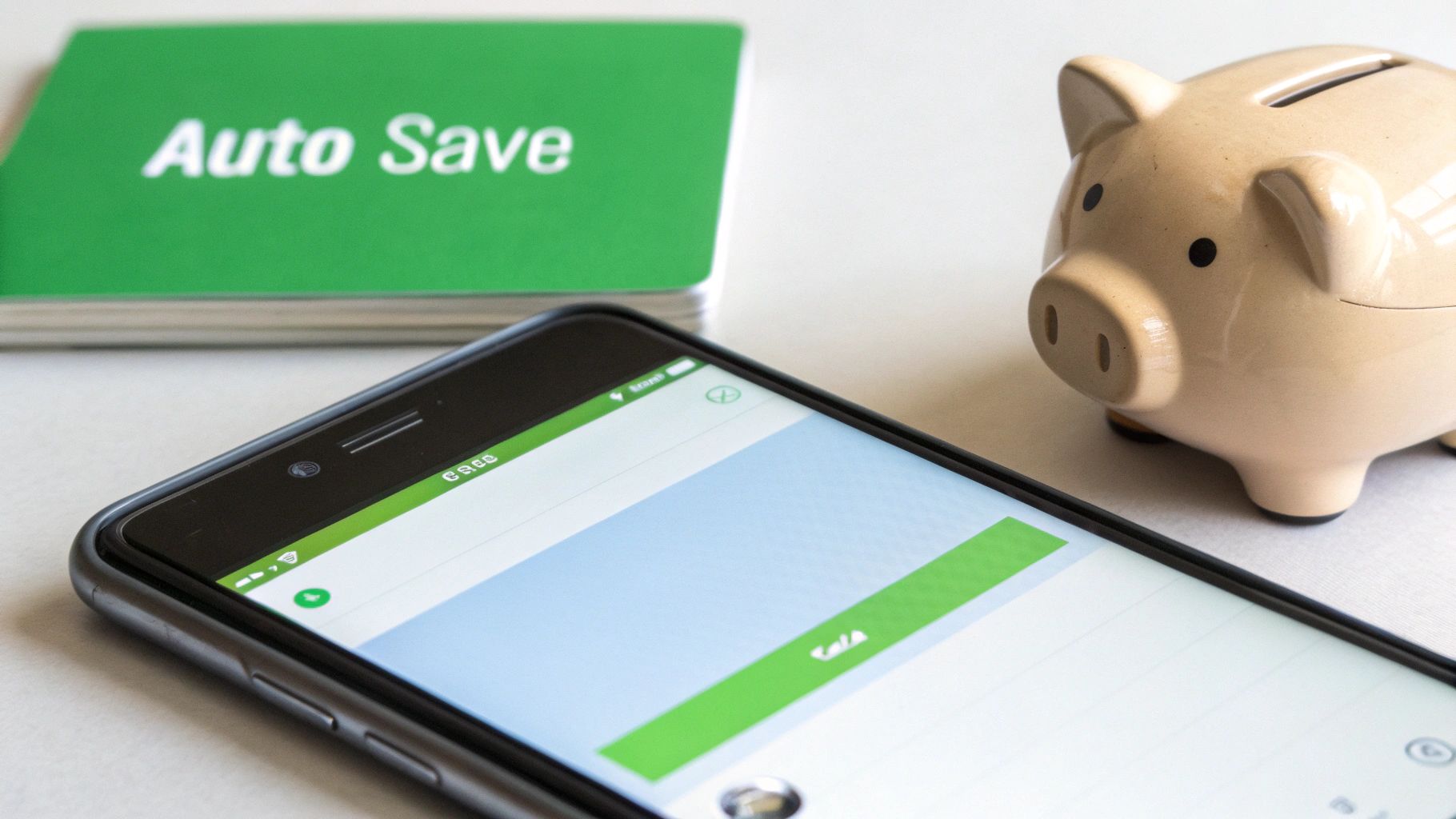
One of the most powerful and simple ways to save money fast is to automate the process entirely. By setting up automatic transfers from your checking account to your savings account, you treat your savings goal like any other recurring bill. This "pay yourself first" strategy removes willpower and temptation from the equation, ensuring a consistent portion of your income is saved before you even have a chance to spend it.
The aim of our blog is to provide valuable insights and practical tips to help readers manage their money more effectively. However, the information shared here is for general guidance and educational purposes only. It should not be regarded as professional financial advice. Any actions taken based on our content are entirely the responsibility of the reader, and we accept no liability for the outcomes of those actions. If you require financial advice tailored to your personal circumstances, we strongly recommend seeking assistance from a qualified financial adviser.
How It Works and Potential Impact
The principle is to make saving effortless by leveraging technology. You instruct your bank to automatically move a predetermined amount of money to a separate savings account on a specific schedule, typically on your payday. This simple action leverages behavioral economics; by making the default action saving, it becomes a seamless habit rather than a monthly chore.
The results can be significant and swift. It's common for individuals to accumulate an extra $200-$500 per month without feeling the pinch, as the money is out of sight and out of mind. Over a year, this can amount to thousands of dollars, rapidly building an emergency fund or a down payment. Many people successfully build a full three to six-month emergency fund within 12 months using this method alone.
Actionable Steps for Implementation
- Calculate Your Savings Amount: Start with a comfortable percentage, such as 10% of your after-tax income, and increase it over time.
- Schedule the Transfer: Log in to your online banking portal and set up a recurring transfer. Schedule it for the same day you get paid to ensure the funds are available.
- Use a High-Yield Savings Account (HYSA): Open an HYSA to maximize your returns. These accounts often offer interest rates significantly higher than traditional savings accounts, accelerating your progress.
- Create Savings Buckets: Many online banks allow you to create separate "buckets" or sub-accounts for different goals, like "Emergency Fund," "Vacation," or "New Car." Automate transfers to each one.
- Explore Savings Apps: Consider using apps like Qapital or Acorns, which can automate savings through "round-ups" on purchases or by following custom rules you set. You can learn more about valuable money-saving tips at collapsedwallet.com.
6. Conduct a Spending Audit
One of the most powerful and immediate ways to save money fast is to conduct a detailed spending audit. This strategy involves meticulously tracking every dollar you spend over a set period (e.g., 30 days) to gain complete clarity on your financial habits. By doing so, you can identify and eliminate "spending leaks" and redirect that cash toward your financial goals, escaping the cycle of living paycheck to paycheck.
The aim of our blog is to provide valuable insights and practical tips to help readers manage their money more effectively. However, the information shared here is for general guidance and educational purposes only. It should not be regarded as professional financial advice. Any actions taken based on our content are entirely the responsibility of the reader, and we accept no liability for the outcomes of those actions. If you require financial advice tailored to your personal circumstances, we strongly recommend seeking assistance from a qualified financial adviser.
How It Works and Potential Impact
The core principle is to track everything to reveal unconscious spending. By creating a detailed log of your expenses, you confront the reality of where your money goes, often exposing surprising patterns like frequent small purchases that add up significantly. This awareness is the first step toward regaining control.
The financial impact is often staggering. People who perform their first spending audit regularly discover they are spending $150-$400 more than they thought on non-essential categories like subscriptions, daily coffees, and convenience purchases. The real win comes from identifying these patterns and making conscious choices to change them, directly boosting your savings potential.
Actionable Steps for Implementation
- Choose Your Tracking Method: Use a dedicated budgeting app like Mint or YNAB, a simple spreadsheet, or even a physical notebook. The tool is less important than the consistency.
- Log Every Transaction: For 30 days, record every single purchase, no matter how small. Be brutally honest with yourself.
- Categorize Your Spending: At the end of the 30 days, group your expenses into categories like housing, transportation, debt repayment, and discretionary spending.
- Analyze and Identify Targets: Look for surprising totals and categories where you can realistically cut back. Are you spending $100 on coffee? Could you reduce that by half?
- Create an Action Plan: Based on your findings, set specific, achievable goals to reduce spending in targeted areas and reallocate that money toward your financial freedom.
- Use Technology: Leverage apps that automatically categorize transactions from your linked bank accounts to streamline the entire process and make it easier to stick to. You can find more ideas for getting started by exploring how to build an inexpensive healthy grocery list on collapsedwallet.com.
7. Embrace the Gig Economy with a Side Hustle
While most saving strategies focus on cutting expenses, one of the most powerful ways to save money fast is to increase your income. Engaging in the gig economy or starting a side hustle directly addresses the income side of the financial equation, allowing you to generate extra cash that can be funneled straight into your savings or debt repayment goals without altering your current lifestyle. This approach accelerates your progress by creating a new, dedicated stream of revenue.
The aim of our blog is to provide valuable insights and practical tips to help readers manage their money more effectively. However, the information shared here is for general guidance and educational purposes only. It should not be regarded as professional financial advice. Any actions taken based on our content are entirely the responsibility of the reader, and we accept no liability for the outcomes of those actions. If you require financial advice tailored to your personal circumstances, we strongly recommend seeking assistance from a qualified financial adviser.
How It Works and Potential Impact
A side hustle is any flexible work you do outside of your primary job to earn additional income. This can range from driving for a rideshare service to freelancing online. The impact can be substantial and immediate. For example, driving for a service like Uber Eats or DoorDash can net an extra $15-$25 per hour, while offering specialized skills on platforms like Upwork or Fiverr can generate an additional $500-$3,000 per month.
Many people use this strategy to aggressively pay down debt or build an emergency fund in a fraction of the time it would take by only cutting costs. Earmarking all side hustle income for a specific financial goal prevents lifestyle inflation and maximizes its impact.
Actionable Steps for Implementation
- Leverage Existing Skills: Identify skills you already possess, such as writing, graphic design, or organization. Platforms like TaskRabbit and Upwork allow you to monetize these talents quickly without a steep learning curve.
- Start Small and Scale: Begin with one gig to avoid burnout. Once you establish a routine, you can consider adding another or finding ways to increase your rates and efficiency.
- Set Clear Income Goals: Instead of working indefinitely, set a specific monthly target. Aiming for an extra $500, for instance, makes the effort feel more manageable and purposeful.
- Track and Allocate Funds: Use a separate bank account for your gig income to easily track earnings and expenses. Immediately transfer this money toward your savings or debt goal.
- Plan for Taxes: Remember that you are an independent contractor. A good rule of thumb is to set aside 25-30% of every payment for taxes to avoid a surprise bill at the end of the year. This is a critical money management skill for any gig worker. For a deeper understanding of handling irregular income, you can learn more about managing your personal finances on collapsedwallet.com.
8. Refinance High-Interest Debt
One of the most impactful ways to save money fast is to tackle the cost of debt itself. If you're carrying high-interest debt from credit cards, personal loans, or even a mortgage, refinancing can significantly reduce your monthly payments and the total interest you pay over the life of the loan. This strategy directly frees up cash flow by lowering your obligations, allowing you to redirect those funds toward savings and financial freedom.
The aim of our blog is to provide valuable insights and practical tips to help readers manage their money more effectively. However, the information shared here is for general guidance and educational purposes only. It should not be regarded as professional financial advice. Any actions taken based on our content are entirely the responsibility of the reader, and we accept no liability for the outcomes of those actions. If you require financial advice tailored to your personal circumstances, we strongly recommend seeking assistance from a qualified financial adviser.
How It Works and Potential Impact
The core principle is to replace expensive debt with cheaper debt. This typically involves taking out a new loan with a lower interest rate to pay off one or more existing high-interest loans. This can be done through a balance transfer credit card, a debt consolidation loan, or refinancing a mortgage or auto loan. The impact can be substantial and rapid, especially for those with significant credit card debt.
Consolidating $10,000 of credit card debt from an average rate of 20% to a personal loan at 8% could lower your monthly payments by over $100 and save you thousands in interest over the loan term. Refinancing a mortgage when rates drop can easily save $200-$500 per month, directly boosting your savings capacity.
Actionable Steps for Implementation
- Check Your Credit Score: Your eligibility for lower interest rates depends heavily on your credit score. Use a free service to check your score and report before you apply.
- Explore Balance Transfer Cards: For credit card debt, look for cards offering a 0% introductory APR. This allows you to pay down the principal without accruing interest for a set period (typically 12-21 months).
- Shop for Consolidation Loans: Compare personal loans from different lenders, including banks, credit unions, and online platforms. Look for the lowest fixed interest rate and minimal fees.
- Consider Mortgage or Auto Refinancing: If interest rates have dropped since you took out your loan or your credit has improved, use a mortgage calculator to see how much you could save by refinancing.
- Read the Fine Print: Pay close attention to fees, the length of the new loan term, and any introductory rate periods. The goal is to lower your total borrowing cost. This approach can be a powerful tool for achieving your financial goals faster by reducing unnecessary spending.
9. Switch to a Lower-Cost Energy Tariff
One of the most powerful yet often overlooked ways to save money fast is to optimize your home's energy costs. Many people remain on default or outdated energy tariffs, unknowingly paying more than they need to. By actively comparing providers and switching to a more competitive plan, you can unlock significant recurring savings on a major household expense, freeing up cash for your financial freedom journey.
The aim of our blog is to provide valuable insights and practical tips to help readers manage their money more effectively. However, the information shared here is for general guidance and educational purposes only. It should not be regarded as professional financial advice. Any actions taken based on our content are entirely the responsibility of the reader, and we accept no liability for the outcomes of those actions. If you require financial advice tailored to your personal circumstances, we strongly recommend seeking assistance from a qualified financial adviser.
How It Works and Potential Impact
The principle is simple: shop around for a better deal on your energy. Energy markets are competitive, and providers frequently offer better rates to attract new customers. Using a price comparison tool, you can quickly find a cheaper tariff and switch with minimal effort.
The financial impact can be substantial. Depending on your location and usage, switching energy providers can save a typical household $300-$600 per year. The process is often seamless, with no interruption to your service. This is one of the easiest ways to find "free money" in your existing budget, which can then be allocated to savings or debt repayment.
Actionable Steps for Implementation
- Gather Your Information: Have a recent energy bill handy. You'll need details like your current provider, tariff name, and annual energy consumption (usually shown in kWh).
- Use a Comparison Website: Utilize a reputable energy price comparison tool. These websites allow you to enter your details and see all the available tariffs in your area, ranked by price.
- Compare Tariff Details: Don't just look at the price. Consider the contract length, any early exit fees, and whether the rate is fixed or variable. A fixed rate provides stability and protects you from price hikes.
- Initiate the Switch: Once you've chosen a new provider, the switching process is usually handled entirely by them. They will contact your old supplier and manage the changeover.
- Consider Green Energy: Often, renewable or green energy tariffs are competitively priced. Switching can be a great way to save money while also reducing your environmental impact, contributing to a more sustainable financial future.
10. Start a Low-Cost Investment Plan
One of the most effective long-term ways to save money fast is to make your money work for you through investing. While it may not provide instant cash, starting a consistent, automated investment plan in low-cost index funds or ETFs can rapidly accelerate your journey towards financial freedom. This strategy leverages the power of compound interest, where your returns start earning their own returns, creating a powerful wealth-building engine.
The aim of our blog is to provide valuable insights and practical tips to help readers manage their money more effectively. However, the information shared here is for general guidance and educational purposes only. It should not be regarded as professional financial advice. Any actions taken based on our content are entirely the responsibility of the reader, and we accept no liability for the outcomes of those actions. If you require financial advice tailored to your personal circumstances, we strongly recommend seeking assistance from a qualified financial adviser.
How It Works and Potential Impact
The core principle is consistent investing over time. Rather than trying to pick individual winning stocks, you invest in broad-market Exchange Traded Funds (ETFs) or index funds, which hold a diverse collection of stocks (like the S&P 500). This approach minimizes risk through diversification and keeps costs extremely low.
While market returns fluctuate, the historical average is around 7-10% annually. By automating a small, regular investment (e.g., $100 per month), you can build significant wealth over time. This method turns saving into an asset-building activity, which is crucial for escaping financial worries and achieving true financial independence.
Actionable Steps for Implementation
- Open a Brokerage Account: Choose a low-cost brokerage firm that offers commission-free trading on ETFs and index funds.
- Choose a Broad-Market ETF: Start with a simple, diversified ETF that tracks a major index like the S&P 500 (e.g., VOO or IVV) or the total stock market (e.g., VTI).
- Automate Your Investments: Set up a recurring automatic transfer from your bank account to your brokerage account to purchase a set amount of your chosen ETF each month. This is known as dollar-cost averaging.
- Keep Costs Low: Pay close attention to the "expense ratio" of any fund you choose. Aim for funds with an expense ratio below 0.10%.
- Think Long-Term: The key to successful investing is to remain invested through market ups and downs. Avoid the temptation to sell during downturns and trust in the long-term growth of the market. Strong money management skills are crucial for this process. To dive deeper, you can explore more about improving your financial literacy on collapsedwallet.com.
10 Fast Money-Saving Strategies Comparison
| Item | 🔄 Implementation Complexity | ⚡ Resource Requirements | 📊 Expected Outcomes | 💡 Ideal Use Cases | ⭐ Key Advantages |
|---|---|---|---|---|---|
| Zero-Based Budgeting System | 🔄 High — monthly detailed tracking and review | ⚡ Time for tracking, budgeting app or spreadsheets | 📊 Significant control and savings; ~$300–$500+/mo | 💡 Households needing comprehensive financial control | ⭐ Comprehensive awareness and high savings potential (5/5) |
| Sell Unused Items | 🔄 Low–Medium — list, communicate, ship/manage pickups | ⚡ Moderate time for listings, photos; possible shipping costs | 📊 Immediate cash; $200–$1,000+ depending on items | 💡 Quick cash needs; decluttering; high‑value items | ⭐ Fast asset‑to‑cash conversion (4/5) |
| Negotiate Bills and Subscriptions | 🔄 Medium — research and calls or service use | ⚡ Low monetary cost, moderate time investment | 📊 Recurring monthly savings; $10–$150+/mo; results in 1–2 weeks | 💡 Households with many recurring services | ⭐ Ongoing savings with no lifestyle cutbacks (4/5) |
| Use Cashback and Rewards Programs | 🔄 Low–Medium — manage cards/apps and categories | ⚡ Requires credit access, tracking multiple programs | 📊 Passive earnings; ~$100–$1,000+/yr depending on spend | 💡 Regular spenders with good credit | ⭐ Passive value from existing spending (4/5) |
| Automate Savings Transfers | 🔄 Low — one‑time setup, runs automatically | ⚡ Minimal time; bank/app support required | 📊 Consistent, ongoing savings; typical $200–$500+/mo | 💡 People who struggle to save manually; paycheck‑based incomes | ⭐ Highest success for consistent saving (5/5) |
| Conduct a Spending Audit | 🔄 Medium — tracking and analysis for 30 days | ⚡ Time upfront, tracking tool (app/spreadsheet) | 📊 High financial awareness, identifies savings of $150-$400/mo | 💡 Anyone unsure where their money goes; pre-budgeting step | ⭐ Reveals hidden spending habits (4/5) |
| Gig Economy and Side Hustles | 🔄 Medium — onboarding, scheduling, client work | ⚡ Time investment, possible platform fees, tax prep | 📊 Rapid income increase; $500–$2,000+/mo possible | 💡 Those with extra time/marketable skills seeking income | ⭐ Direct scalable income potential (5/5) |
| Refinance High-Interest Debt | 🔄 Medium — requires research, applications, good credit | ⚡ Time to compare lenders; credit check required | 📊 Lower monthly payments; saves $100-$500+/mo | 💡 Individuals with credit card, personal, or mortgage debt | ⭐ Frees up significant cash flow (4/5) |
| Switch to a Lower-Cost Energy Tariff | 🔄 Low — use comparison tool to switch online | ⚡ Recent energy bill, internet access | 📊 Large annual savings; $300–$600+ possible | 💡 Homeowners and renters who pay their own utility bills | ⭐ High recurring savings for minimal effort (4/5) |
| Start a Low-Cost Investment Plan | 🔄 Low–Medium — account setup and fund selection | ⚡ Initial research, willingness to accept market risk | 📊 Long-term wealth growth (7-10% avg annual return) | 💡 Building long-term wealth for financial independence | ⭐ Leverages compound interest for maximum growth (5/5) |
Your Path to Financial Control Starts Now
You've just explored a powerful arsenal of ten distinct, high-impact strategies designed to help you save money fast. We've moved beyond generic advice, diving into actionable methods ranging from the immediate cash injection of selling unused items to the long-term, systemic change offered by zero-based budgeting. The journey from financial stress to financial control is not a single leap but a series of deliberate, well-executed steps. The tactics detailed in this article, from negotiating your monthly bills to automating your savings, are those very steps. They are your building blocks for a more secure and empowered financial future.
The core takeaway is that speed and substance are not mutually exclusive. Quick wins, such as refinancing high-interest debt or leveraging cashback programs, generate immediate momentum and tangible results. This initial success is crucial; it fuels your motivation to tackle more involved strategies like launching a side hustle or starting an investment plan. Each strategy serves a unique purpose, but their true power is unlocked when you combine them. Imagine negotiating a lower internet bill, automating the saved amount directly into a high-yield savings account, and supplementing that with income from a weekend gig. This layered approach transforms small, individual actions into a powerful, wealth-building engine.
Turning Knowledge into Actionable Results
The difference between reading about financial freedom and achieving it lies in implementation. Merely knowing these ways to save money fast is not enough; you must act. The most common pitfall is feeling overwhelmed by the number of options and, as a result, doing nothing at all. To avoid this paralysis, your immediate goal should be to select just one or two strategies that feel most achievable for your current lifestyle and financial situation.
Consider these starting points:
- If you need immediate cash: Prioritize selling unused items and exploring gig economy opportunities. Dedicate a weekend to listing items online and signing up for a flexible side hustle platform. The goal is a quick, tangible financial boost.
- If you're battling high monthly expenses: Focus on negotiating bills, switching energy tariffs, and refinancing debt. These activities can free up significant recurring income with minimal ongoing effort.
- If you struggle with saving discipline: Automating your savings transfers is your non-negotiable first step. Set it up today. This "pay yourself first" method builds your savings without relying on willpower.
- If you feel a lack of control over your spending: Implement the zero-based budgeting system for one month. This will provide unparalleled insight into where your money is actually going and empower you to redirect it purposefully.
The Bigger Picture: Beyond Quick Savings
Mastering these techniques is about more than just accumulating a lump sum of cash in the short term. It's about fundamentally rewiring your relationship with money. By actively engaging with your finances, you shift from being a passive passenger to an active driver of your financial destiny. Each bill you negotiate, each dollar you intentionally save, and each side hustle you pursue is a vote for a future defined by choice, not by constraint.
This proactive stance builds financial resilience. When you have a solid savings buffer and controlled expenses, unexpected events like a car repair or a medical bill become manageable inconveniences rather than catastrophic emergencies. This is the true essence of financial security: the peace of mind that comes from knowing you have a plan and the resources to handle whatever life throws your way. The journey to saving money fast is the training ground for long-term wealth creation and the ultimate goal of financial independence. Start with these sprints, build your endurance, and you will be well-equipped to run the marathon toward your most ambitious financial goals.
Ready to take your financial management to the next level? The strategies in this article are powerful, but tracking your progress is key to staying motivated. Discover how Collapsed Wallet can help you visualize your savings, manage your budget effortlessly, and stay on track with your goals using intuitive, powerful tools. Visit Collapsed Wallet today to see how our platform can accelerate your journey to financial control.

1 thought on “10 Proven Ways to Save Money Fast in 2025”