
Table of Contents
- Understanding the Foundations of Passive Income
- Active Income vs Passive Income: A Head-to-Head Comparison
- Proven Passive Income Streams You Can Start Building
- Building Passive Income With a Small Budget
- The Hard Truths About Passive Income
- Your First Steps Toward Financial Freedom
- Your Top Passive Income Questions Answered
This blog post may contain affiliate links. As an Amazon Associate I earn from qualifying purchases.
So, you want to make money while you sleep. That’s the dream, right? That’s the whole idea behind passive income: earning money from something you built or invested in, long after the initial heavy lifting is over. Think of it less like a get-rich-quick scheme and more like building a financial engine that, once started, mostly runs on its own.
The aim of our blog is to provide valuable insights and practical tips to help readers manage their money more effectively. However, the information shared here is for general guidance and educational purposes only. It should not be regarded as professional financial advice. Any actions taken based on our content are entirely the responsibility of the reader, and we accept no liability for the outcomes of those actions. If you require financial advice tailored to your personal circumstances, we strongly recommend seeking assistance from a qualified financial adviser.
Understanding the Foundations of Passive Income

So, what does passive income actually look like in the real world? It’s not magic, and it’s certainly not getting something for nothing. It’s all about front-loading the work. You put in the time, money, or skill upfront to create an asset that keeps paying you back with minimal day-to-day involvement later.
Here’s a simple analogy: imagine planting an apple tree. That first year, you’re doing all the work—digging the hole, planting the sapling, watering it, and making sure it survives. But once it’s established, that tree will produce apples for years with just a little maintenance. The harvest is your passive income. You did the hard work once, and now you get to enjoy the rewards over and over.
The “Easy Money” Myth
Let’s get one thing straight: passive income is almost never truly “passive” at the beginning. The internet is flooded with gurus promising effortless cash, but real, sustainable passive income streams are built on a solid foundation of active work.
Whether you’re pouring hours into writing an ebook, coding an app, or saving every spare penny for a down payment on a rental property, there’s always an initial grind. The “passive” part only kicks in after your asset is up and running, generating revenue on its own.
The goal isn’t to stop working. It’s to stop trading your time directly for money. This is the fundamental shift that unlocks real financial flexibility.
Why Bother With Passive Income?
Building these income streams isn’t just for Wall Street investors or tech entrepreneurs. It’s a powerful financial strategy for anyone who wants to take control of their future. It’s a mindset that can help you achieve your biggest goals.
Here’s why it’s worth the effort:
- Financial Security: Having multiple sources of income acts as a safety net. If you lose your job or face an unexpected bill, you’re not starting from zero.
- More Freedom: When your income isn’t tied to a 9-to-5 grind, you have more control over your time. You get to decide how to spend your days.
- Faster Wealth Building: You can reinvest the money you earn passively to make it grow even faster. It’s the magic of compounding, supercharged.
Ultimately, getting a clear picture of what passive income really is—and what it isn’t—is the first step. It’s about putting your money and assets to work for you, creating a more resilient financial life that active income alone can rarely provide.
Active Income vs Passive Income: A Head-to-Head Comparison
To really get a handle on what passive income is, it helps to see it next to its more familiar cousin, active income. I like to think of it this way: active income is like carrying buckets of water from a well. The second you stop carrying, the water stops flowing. It’s a direct trade—your time and effort for money.
Passive income, on the other hand, is like building a pipeline from that well right to your home. It takes a ton of work upfront—you have to design it, dig the trench, and lay the pipe—but once it’s done, water flows with just a little maintenance here and there. That fundamental difference is what financial freedom is all about.
The Core Distinctions
The biggest difference between active and passive income comes down to the link between your time and your money. With active income, it’s a straight line: work 40 hours, get paid for 40 hours. Stop working, and the paychecks stop.
Passive income breaks that link. The work you put in today can keep paying you for months, or even years, down the road. This idea is catching on, especially with younger folks. Recent surveys from Surveymonkey.com found that roughly 72% of workers either had a side hustle or were thinking about starting one. Even more telling, 46% of Gen Z are specifically looking into investment-based passive income, showing a real shift in how we think about building wealth.
The critical shift is moving from an earner’s mindset (trading time for money) to an owner’s mindset (building assets that generate money). This change is where long-term wealth is built.
Active Income vs Passive Income: A Head-to-Head Comparison
So, how do these two income types really stack up against each other? Breaking them down attribute by attribute makes it clear why a solid financial plan usually includes both, with the long-term goal of growing your passive streams.
Let’s look at a direct comparison.
| Attribute | Active Income | Passive Income |
|---|---|---|
| Time Commitment | Ongoing and direct; earnings stop when you stop working. | Primarily upfront; requires minimal ongoing effort to maintain. |
| Scalability | Limited by the number of hours you can work. | Highly scalable; an asset can serve unlimited customers. |
| Earning Potential | Capped by your salary or hourly rate. | Potentially unlimited, depending on the asset’s success. |
| Risk Profile | Lower initial risk but high dependency on a single source. | Higher upfront risk (time/money), but diversifies income later. |
| Example | Salary from a 9-to-5 job, freelance work, hourly wages. | Rental income, stock dividends, royalties from a book. |
For most of us, a mix of both is the most realistic path forward. Your active income pays the bills today, while you use any extra cash and time to build the passive income streams that will support you tomorrow. Many students get their start on this path by finding flexible ways to earn on the side. If that sounds interesting, you might want to check out our guide on some great side hustle ideas for students.
A quick note: The information here is for educational purposes and to get you thinking. It’s not professional financial advice. For guidance tailored to your specific situation, it’s always best to chat with a qualified financial advisor.
Proven Passive Income Streams You Can Start Building
Now that we have a clear line between active and passive income, let’s get into the good stuff: how to actually build it. This is where theory turns into action. Getting to know the different roads you can take is the first step in picking a path that fits your money, skills, and what you’re trying to achieve.
The world of passive income is huge, but most strategies boil down to one of three main types. Each one asks for a different kind of upfront investment—some need more cash, others more time—and they all come with their own mix of risks and rewards.
This image really drives home the difference between the two income types we’ve been talking about.
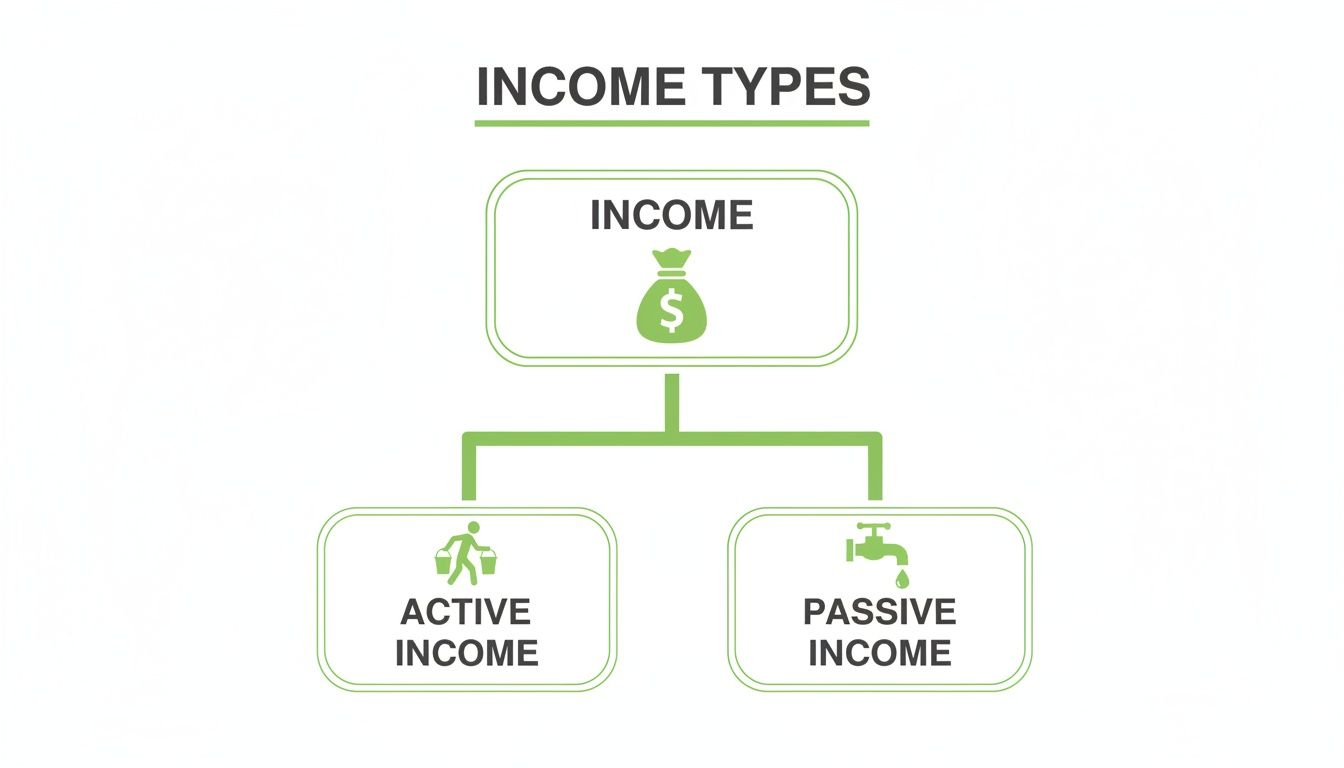
You can see active income is like constantly hauling buckets of water, a non-stop effort. Passive income, on the other hand, is like turning on a faucet—a system that works for you.
Investing Your Money to Make Money
This is the classic way to earn passively. You use the money you already have to buy assets that pay you back over time. The main thing you need here is capital, but don’t underestimate the need for solid research and a bit of knowledge.
A few popular ways to do this include:
- Dividend-Paying Stocks and ETFs: When you own a piece of certain companies or funds (ETFs), they share a slice of their profits with you. These payments, called dividends, can create a regular income stream without you ever having to sell your shares.
- Real Estate Investment Trusts (REITs): Want to invest in real estate without the headache of being a landlord? REITs let you buy into a collection of properties—like office buildings or apartment complexes—that are managed by someone else.
- Peer-to-Peer (P2P) Lending: Online platforms now let you act like a bank, lending your money directly to other people or small businesses. You earn interest on the loans, but it’s important to remember there’s always a risk the borrower might not pay you back.
The real magic here is the power of compounding. When you reinvest the income your assets generate, your money starts to grow exponentially. If this is new territory for you, our guide on how to start investing for beginners is a great place to build a solid foundation.
Creating an Asset That Pays You
This route is all about building or buying an asset—either physical or digital—that you can rent out, license, or sell again and again. Unlike straight-up financial investing, this usually requires a serious investment of your time and skills upfront.
The goal is to put in the hard work once to create something that generates money on repeat. You’re building a system that keeps working for you long after you’ve finished the initial heavy lifting.
Think about these popular asset-based streams:
- Rental Properties: Owning a house or apartment and renting it out is a time-tested way to generate passive income. It takes a lot of capital to get started and requires ongoing management (or paying someone to do it), but it can deliver a very reliable monthly cash flow.
- Royalties from Creative Work: If you’re a writer, musician, or photographer, you can earn royalties every time someone buys your book, streams your song, or uses your photo. All the work is front-loaded into the creative process.
- Licensing Intellectual Property: Have a great invention or a patent? You can license it to other companies and collect a fee every time they use it. Once the deal is signed, the income is truly passive.
Building a Business That Runs Itself
The final category is about setting up an automated business that makes money with very little daily input from you. This is where you let technology and smart systems do most of the work. Your initial investment here is almost all sweat equity—time, knowledge, and skill.
Here are a few powerful examples:
- Affiliate Marketing: By starting a blog, a YouTube channel, or even just a popular social media account, you can recommend products you love. You get a commission for any sale made through your unique link, and a single piece of content can keep earning for years.
- Selling Digital Products: Ebooks, online courses, and software templates are perfect examples. You pour your time into creating the product one time, and then automated systems can handle the sales and delivery forever.
- Developing an App or Software: This definitely requires serious tech skills (or the money to hire a developer), but a useful app can bring in revenue from downloads, subscriptions, or ads with very little ongoing effort.
The right path for you really depends on where you’re starting. If you have a decent chunk of savings, dividend investing might be a great fit. If you have more time and creative skills than cash, starting a blog for affiliate marketing could be the way to go.
It’s also critical to have realistic expectations. For example, putting €20,000 into a stock portfolio with a 4% average dividend yield will net you around €800 a year. As you can learn in this detailed passive income breakdown, a moderate amount of capital usually leads to modest but steady returns. Every path has its merits, but understanding the trade-offs between your time, money, and comfort with risk is what will help you make the smartest choice for your financial future.
Building Passive Income With a Small Budget

It’s one of the biggest myths out there: you need a mountain of cash to start building passive income. While having a lot of capital certainly speeds up the journey for things like rental properties or dividend investing, it’s absolutely not the only way to get on the path.
For most of us, the journey starts by investing time and skill, not money. If you’ve got more time than cash, your best bet is to focus on creating digital assets. Think of these as products you build once that can then be sold over and over again with very little hands-on effort. This strategy lets you turn your know-how into a real revenue stream, sidestepping the need for a big upfront investment.
Leveraging Skills Over Savings
The secret to building wealth on a shoestring is to pinpoint a skill you already have that other people would find valuable. Are you a pro at organising? A natural writer? A whiz with design software? Any of these abilities can be the foundation for a low-cost passive income project.
Here are a few ideas that are heavy on effort but light on funds:
- Creating Digital Templates: If you’re comfortable with tools like Canva, Excel, or Notion, you could design templates for things like CVs, social media graphics, or budget planners. Once they’re made, you can sell them on marketplaces like Etsy, earning a little money every single time someone hits “download.”
- Writing a Short Ebook: You don’t need a publishing deal to become an author. If you’ve got deep knowledge on a niche topic—anything from container gardening to the basics of Python—you can package that information into a helpful guide and sell it through platforms like Amazon KDP or Gumroad.
- Starting a Niche Blog: A blog is definitely a long-term play, but the startup costs are tiny. By zeroing in on a topic you’re genuinely passionate about, you can gradually build an audience and earn money through affiliate marketing—that’s where you get a commission for recommending products you love.
The most powerful asset you have is your own knowledge. Finding a way to package and sell it digitally is one of the most effective low-budget strategies for creating passive income.
Of course, this approach still requires smart money management. Knowing how to budget on a low income is a foundational skill that helps you cover the minimal startup costs, like a website domain, without feeling the pinch.
Step-by-Step: Starting a Niche Affiliate Blog
Let’s break down how you could start a blog with affiliate links, which is a classic low-cost strategy. The idea is simple: create genuinely useful content that naturally features links to products or services. When a reader clicks and buys, you earn a small commission at no extra cost to them.
- Choose Your Niche: Pick a topic you actually enjoy and know something about. It could be anything from sustainable fashion to collecting vintage cameras. A tight focus helps you attract a loyal, engaged audience.
- Set Up Your Blog: You can get started with a basic web hosting plan and a domain name for under £100 a year. Platforms like WordPress are incredibly user-friendly and don’t require you to be a coding genius.
- Create Valuable Content: Focus on writing articles that solve a problem for your readers. For example, if your blog is about home coffee brewing, you could review different grinders or write a step-by-step guide to pulling the perfect espresso shot.
- Find Affiliate Programs: Tons of companies have affiliate programs. Amazon Associates is a popular place to start, but you can also find independent programs for software, online courses, and specific brands related to your niche.
- Integrate Links Naturally: Weave your affiliate links into your content where they feel helpful, not forced. The golden rule is authenticity—only recommend products you genuinely stand behind. Always be transparent and include a disclosure that you might earn a commission.
The Snowball Method: Reinvesting Your Earnings
Don’t be discouraged if your first few months only bring in a few pounds. That’s completely normal. The real magic begins when you apply the snowball method to those earnings. Instead of spending that income, you put it right back to work.
At first, you might use it to buy a premium tool to improve your blog. As your earnings grow, you can start funnelling that money into more capital-intensive income streams. That £50 per month from your blog could eventually buy your first dividend-paying ETF, which then creates a second, even more passive, stream of income. This slow and steady process of reinvesting is how tiny acorns grow into mighty oaks over time.
The Hard Truths About Passive Income
The idea of making money while you sleep is incredibly appealing. Who wouldn’t want that? But the internet is overflowing with slick “gurus” selling a dream that’s more fantasy than reality. Before you jump in, let’s cut through the noise and talk about what passive income is really like.
The biggest lie out there is that passive income means “money for nothing.” It’s often sold as this magical stream of cash that appears overnight with zero effort. The truth? While the income might eventually flow with little daily management, getting to that point is almost always an intensely active process.
Think of it this way: every successful passive income stream is built on a solid foundation of hard work. That “active” phase could be the hundreds of hours you spend writing blog posts, the years you spend saving for a down payment on a rental property, or the steep learning curve you climb to create and market a digital product. The “passive” part only kicks in after all that heavy lifting is done.
Myth 1: It’s a Get-Rich-Quick Scheme
If someone tells you passive income is a shortcut to instant wealth, you should be skeptical. In the real world, it’s almost always a slow burn. Seeing that first pound come in from an affiliate link or a dividend payment is an amazing feeling, but it’s rarely a life-changing sum.
Real success is built on consistency and patience, not one magical moment.
True passive income is a long-term strategy for building wealth, not a lottery ticket. It’s about laying one brick at a time, day after day, until you’ve built a solid financial structure.
It’s more like planting a forest than a single tree. Your first income stream might only bring in a few pounds a month. But by reinvesting those earnings and methodically adding new streams, you can cultivate real growth over years. This is a marathon, not a sprint.
Myth 2: You Need to Be an Expert or a Genius
You don’t need a world-changing idea or a Mensa-level IQ to make this work. That’s another myth that holds people back. In fact, many of the most reliable passive income ventures are based on simple, proven models executed with commitment.
Forget about inventing the next big thing and focus on what you can do consistently.
- Solve a Common Problem: Could you create a simple digital template that saves people time? Or a short guide that answers a question you see popping up online all the time?
- Share Your Journey: You don’t have to be the world’s leading authority. A blog that documents your progress learning a new skill can build a loyal audience and earn affiliate income along the way.
- Invest Systematically: You don’t have to be a stock-picking wizard to make money in the market. Consistently putting small amounts into a broad market ETF is a classic, non-genius strategy that works.
At the end of the day, the secret ingredient isn’t brilliance; it’s discipline. Showing up, doing the work, and staying the course are far more powerful than waiting around for a flash of inspiration that might never arrive. By facing these hard truths head-on, you can sidestep the scams, set achievable goals, and start your journey with the right mindset for success.
Your First Steps Toward Financial Freedom
Getting your head around passive income is one thing, but it’s time to stop just thinking about it and actually do something. This is where the rubber meets the road—turning all that theory into a real, tangible plan.
The goal here isn’t to build a financial empire overnight. It’s about taking that first step, and then the next. Think of it as a marathon, not a sprint. We’re aiming for small, early wins to keep the motivation high for the long journey ahead.
A Simple Checklist to Get You Started
If you’re wondering if this is even possible, consider this: the global side-hustle economy, a space where many passive income streams are born, was recently valued at over $556.7 billion. Experts expect it to keep growing by about 16.18% every year. That’s not just a trend; it’s a massive movement of people just like you building new sources of income. You can see the full side-hustle statistics and get a sense of the opportunity.
Ready to join in? Let’s break it down into three simple, manageable steps.
- Take Stock of What You Have: Be honest with yourself. How much time can you realistically spare each week? What skills do you already have that people would pay for? And what’s your starting capital, even if it’s just a little bit? This isn’t about having a lot—it’s about knowing what you’re working with.
- Pick ONE Idea and Stick With It: This is crucial. Don’t try to launch a blog, a YouTube channel, and an Etsy store all at once. You’ll burn out. Based on your self-assessment, pick the one path that makes the most sense. Low on cash but have some free time? A niche blog could be perfect. Got a bit of savings? Maybe it’s time to buy your first shares in a dividend-paying fund.
- Set a Tiny, Achievable First Goal: Forget about “making £1,000 a month” for now. Your first goal should be something you can knock out quickly. Write one blog post. Create one digital printable. Invest your first £25. The point isn’t to get rich; it’s to prove to yourself that you can start.
This checklist cuts through the noise and gives you a clear, actionable starting point. It’s how you go from dreaming about passive income to actually building it.
Your Top Passive Income Questions Answered
Diving into passive income can feel a bit overwhelming, and it’s natural to have a lot of questions. Let’s clear up some of the most common ones I hear, so you can start your own journey with a bit more clarity and confidence.
How Much Money Do I Actually Need to Get Started?
This is the big one, isn’t it? And the answer is surprisingly encouraging: you can get started with as little as £0. It’s easy to think you need a huge pile of cash for things like rental properties or dividend stocks, and for those, you do. But some of the most powerful income streams are built on sweat equity, not a massive bank account.
Think about creating something from scratch. If you have a skill or some niche knowledge, you can write an ebook, create a pack of digital templates, or launch a blog with affiliate links. The startup cost for something like a blog can be less than a couple of coffees a month for basic web hosting. You’re simply trading your time and effort now to build an asset that pays you later.
What’s the Most Realistic Way for a Beginner to Make Passive Income?
If you’re just starting out, I’d say the most realistic and accessible path is affiliate marketing through a niche blog or a YouTube channel. The financial risk is incredibly low, and it gives you the chance to build a business around something you genuinely enjoy.
Of course, it’s not a get-rich-quick scheme. The process is straightforward but takes time: you create genuinely helpful content that solves a specific problem for your audience. Within that content, you can naturally recommend products or services you actually use and trust. As that content gets discovered over time, it can keep earning commissions for months or even years, creating a real source of passive income.
How Does the Tax Man Treat Passive Income?
This is a crucial point that many people overlook: passive income is still income, and yes, it’s taxable. How it’s taxed really depends on where the money comes from and your local tax laws. In the UK, for instance, the rules differ quite a bit:
- Rental income is generally taxed like your regular salary, but only after you’ve deducted allowable expenses.
- Dividend income gets its own tax-free allowance, and the tax rates are usually lower than standard income tax.
- Interest from savings or peer-to-peer lending is also taxed as income, though most people have a Personal Savings Allowance that keeps some of it tax-free.
Tax rules can get complicated fast. My best advice is to keep meticulous records from day one and seriously consider chatting with an accountant to make sure you’re doing everything by the book.
Is It Really Possible to Replace My Full-Time Job with This?
Yes, it absolutely is. But—and this is a big but—it’s a marathon, not a sprint. Replacing your salary is a long-term goal that requires patience, a solid strategy, and a healthy dose of realism. Nearly everyone who has achieved this started with a single, small income stream that maybe made just enough to cover a phone bill.
The magic is in the “snowball” effect. You take the money from that first small win and reinvest it to build another stream, and then another. That first £50 a month from your blog could be used to buy your first dividend stocks. Those dividends then add another trickle of income. By repeating this process over years, those trickles can combine into a river strong enough to give you real financial freedom.
Ready to take control of your finances and build a more secure future? The team at Collapsed Wallet is here to help with practical, no-jargon guides on everything from budgeting to investing. Explore our resources today and start your journey. Find out more at https://collapsedwallet.com.

1 thought on “What is Passive Income: Practical Steps to Build Real Wealth”