

Table of Contents
- Your First Step: Getting a Clear Picture of Your Finances
- Choosing Your Debt Payoff Method: Snowball vs. Avalanche
- Simplifying Payments With Consolidation And Refinancing
- Advanced Strategies When Your Debt Feels Insurmountable
- Building Habits To Stay Debt-Free For Good
- Common Questions About Debt Reduction
This blog post may contain affiliate links. As an Amazon Associate I earn from qualifying purchases.
It’s easy to feel like you’re drowning when you’re facing a mountain of debt. But the very first step toward getting your head above water isn’t about making a payment—it’s about getting honest with yourself and understanding exactly where you stand. This isn’t about shame or blame. It’s about turning that vague, heavy feeling of dread into a clear, manageable list. This is your ultimate guide to debt reduction strategies!
The aim of our blog is to provide valuable insights and practical tips to help readers manage their money more effectively. However, the information shared here is for general guidance and educational purposes only. It should not be regarded as professional financial advice. Any actions taken based on our content are entirely the responsibility of the reader, and we accept no liability for the outcomes of those actions. If you require financial advice tailored to your personal circumstances, we strongly recommend seeking assistance from a qualified financial adviser.
Your First Step: Getting a Clear Picture of Your Finances
You can’t fight an enemy you can’t see. To get out of debt, you have to look it square in the eye. That means gathering up every single bill and statement to build a complete inventory of what you owe.
Don’t skip anything, no matter how small. That old store credit card with a $200 balance? It counts. Pulling everything together transforms the “debt monster” in your head into a concrete set of numbers you can actually tackle.
Building Your Debt Inventory
Let’s get practical. Grab a notebook or open a spreadsheet and create a list. For every single debt, you need to jot down four key pieces of information. This simple exercise is often the most empowering thing you can do to kickstart your journey.
Here’s what you need for each debt:
- Creditor: Who you owe (e.g., Chase, Wells Fargo, your local credit union).
- Total Balance: The exact amount you owe today.
- Interest Rate (APR): This is the most important number. It’s the “price” you’re paying for the loan, and it’s your biggest enemy.
- Minimum Monthly Payment: What you’re required to pay each month just to stay current.
I know seeing that total debt number in black and white can be a gut punch. Take a deep breath. This is the moment you stop reacting to bills and start making strategic, proactive decisions. This is where you take back control.
Using Technology to Make It Easier
If hunting down statements feels like a chore, you’re in luck. Technology can do the heavy lifting for you. There are plenty of fantastic financial apps out there—both free and paid—that can securely connect to your accounts.
These tools automatically pull in your balances, interest rates, and due dates, putting everything into a single, easy-to-read dashboard. You get a real-time snapshot of your financial health without all the manual data entry.
It’s interesting to see that this push for clarity is happening on a global scale, not just in our personal lives. Since 2021, private debt worldwide has actually dropped from 159% of global GDP to under 143% by 2024—the lowest it’s been since 2015. It seems households and businesses everywhere are getting more intentional about their finances. You can dig into the data yourself in the IMF’s 2025 Global Debt Monitor.
Once you have this complete debt inventory, the next logical step is to see where your money is going each month. Pairing your debt list with a solid spending plan is the key. To get that part sorted, check out our guide on how to track expenses.
Choosing Your Debt Payoff Method: Snowball vs. Avalanche
Alright, you’ve laid all your cards on the table and have a complete picture of your debt. Now for the fun part: choosing your weapon. This is where you move from analysis to action.
When it comes to paying off debt, two tried-and-true strategies dominate the conversation: the Debt Snowball and the Debt Avalanche.
Your choice here isn’t just about crunching numbers; it’s deeply personal. It’s about understanding what truly motivates you. The best strategy is always, without a doubt, the one you’ll actually stick with for the long haul.
The Debt Snowball: Psychology in Action
The Debt Snowball method, famously championed by financial expert Dave Ramsey, is all about psychology. It’s built on the power of quick wins to keep your motivation high.
Here’s how it works: you list your debts from the smallest balance to the largest, completely ignoring the interest rates. You throw every extra dollar you have at the smallest debt while making only the minimum payments on everything else.
Once that first debt is gone—poof!—you take the entire amount you were paying on it (the minimum plus your extra payments) and roll it over to the next smallest debt. This creates a “snowball” effect. As each debt is paid off, the payment you apply to the next one gets bigger, helping you knock them down faster and faster.
The Debt Avalanche: A Purely Mathematical Approach
On the other side, we have the Debt Avalanche. From a purely financial standpoint, this method is the most efficient way to get out of debt. It saves you the most money in the long run.
With the Avalanche, you prioritize your debts by their interest rate (APR), from highest to lowest. You attack the debt with the highest interest rate first, making minimum payments on all your other accounts.
This approach saves you money because you’re wiping out the most expensive debt first. High-interest debt, like the kind you see with credit cards or payday loans, can grow frighteningly fast. Tackling it head-on minimizes the total interest you’ll pay on your journey to becoming debt-free.
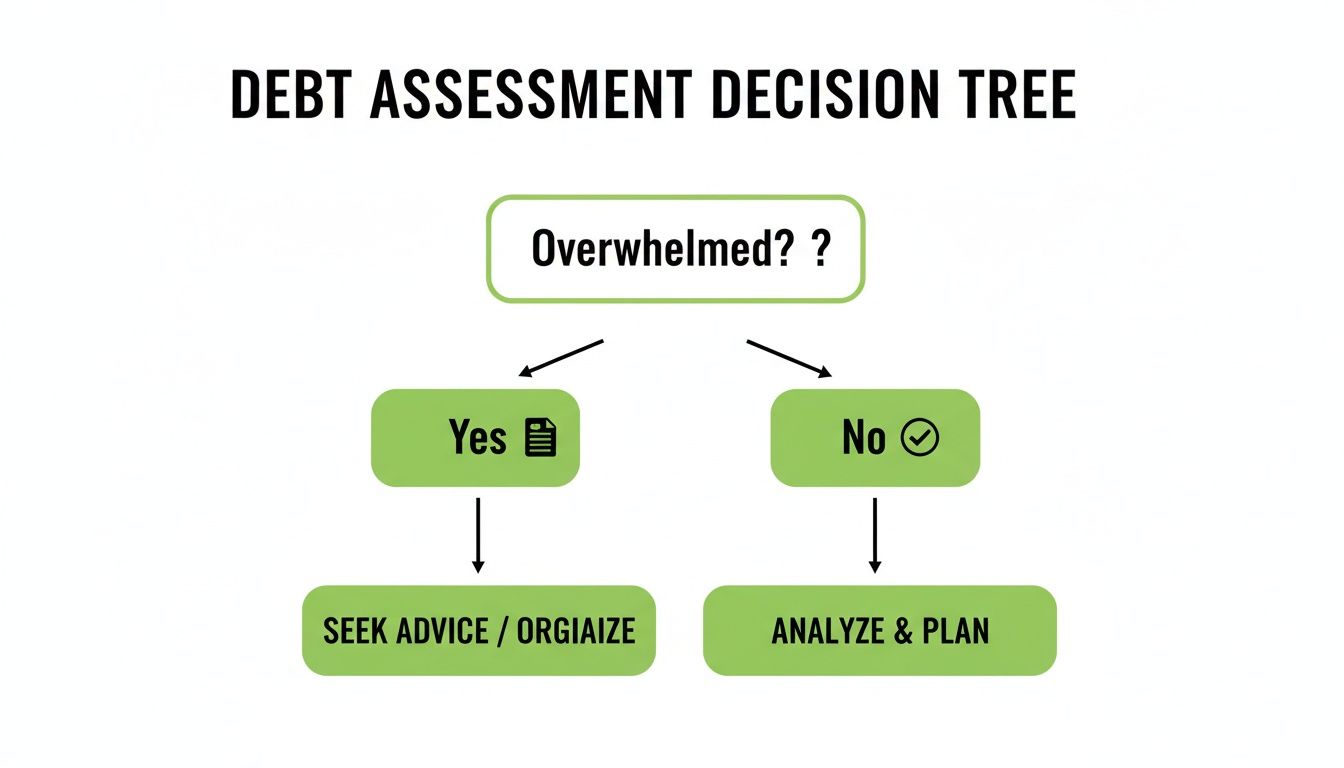
The decision tree below can help you visualize where you stand. If you’re feeling overwhelmed, your first step is simply getting organized. If you’ve already done that, you’re ready to pick your strategy.
Debt Snowball vs. Debt Avalanche: A Quick Comparison
To make the choice clearer, here’s a side-by-side comparison of these two powerhouse strategies. Think about your personality and what will keep you in the fight when deciding which is the right fit for your financial journey.
| Feature | Debt Snowball | Debt Avalanche |
|---|---|---|
| How It Works | Pay off debts from the smallest balance to the largest. | Pay off debts from the highest interest rate to the lowest. |
| Primary Focus | Behavioral and motivational. | Mathematical and cost-effective. |
| Best For | People who need quick wins to stay motivated and build momentum. | People who are disciplined and want to save the most money on interest. |
| Key Advantage | Provides powerful psychological boosts with each paid-off debt. | Minimizes the total amount of interest paid over the life of the loans. |
| Potential Downside | May cost more in interest over time by ignoring high-APR debts. | Can feel slow at the start, as the first debt might be large and take a while. |
Ultimately, both paths lead to the same destination: a debt-free life. The key is picking the route you’re most likely to follow to the end.
Real-World Scenarios Unpacked
Let’s put some real numbers to this. Imagine this is your debt situation:
- Credit Card: $3,000 at 22% APR
- Personal Loan: $8,000 at 10% APR
- Student Loan: $20,000 at 5% APR
You’ve managed to find an extra $300 per month to accelerate your payoff. Here’s how the two approaches would look:
- With the Debt Snowball: You’d go after the $3,000 credit card first because it has the smallest balance. Wiping that out quickly will feel like a huge victory and give you the fuel to keep going.
- With the Debt Avalanche: You would also attack the $3,000 credit card first, but for a different reason: it has the highest interest rate. If your personal loan had a higher APR, you’d start there instead, even with its larger balance.
The core difference really boils down to motivation versus optimization. The Snowball keeps you fired up with frequent wins, while the Avalanche ensures you pay the absolute least amount of money to get out of debt.
The crushing weight of high interest rates isn’t just a personal struggle; it’s a global one. A recent report from UNCTAD revealed that in 2023, developing countries paid a mind-boggling $847 billion in net interest on their debts—a 26% jump from 2021. This just goes to show how critical tackling high-interest debt is, whether for an individual or a nation.
So, you have a choice to make, and it requires some honest self-reflection. Do you thrive on seeing progress quickly? Or are you driven by pure numbers and the goal of being as efficient as possible? Neither answer is wrong. The right strategy is the one that feels right for you.
Simplifying Payments With Consolidation And Refinancing
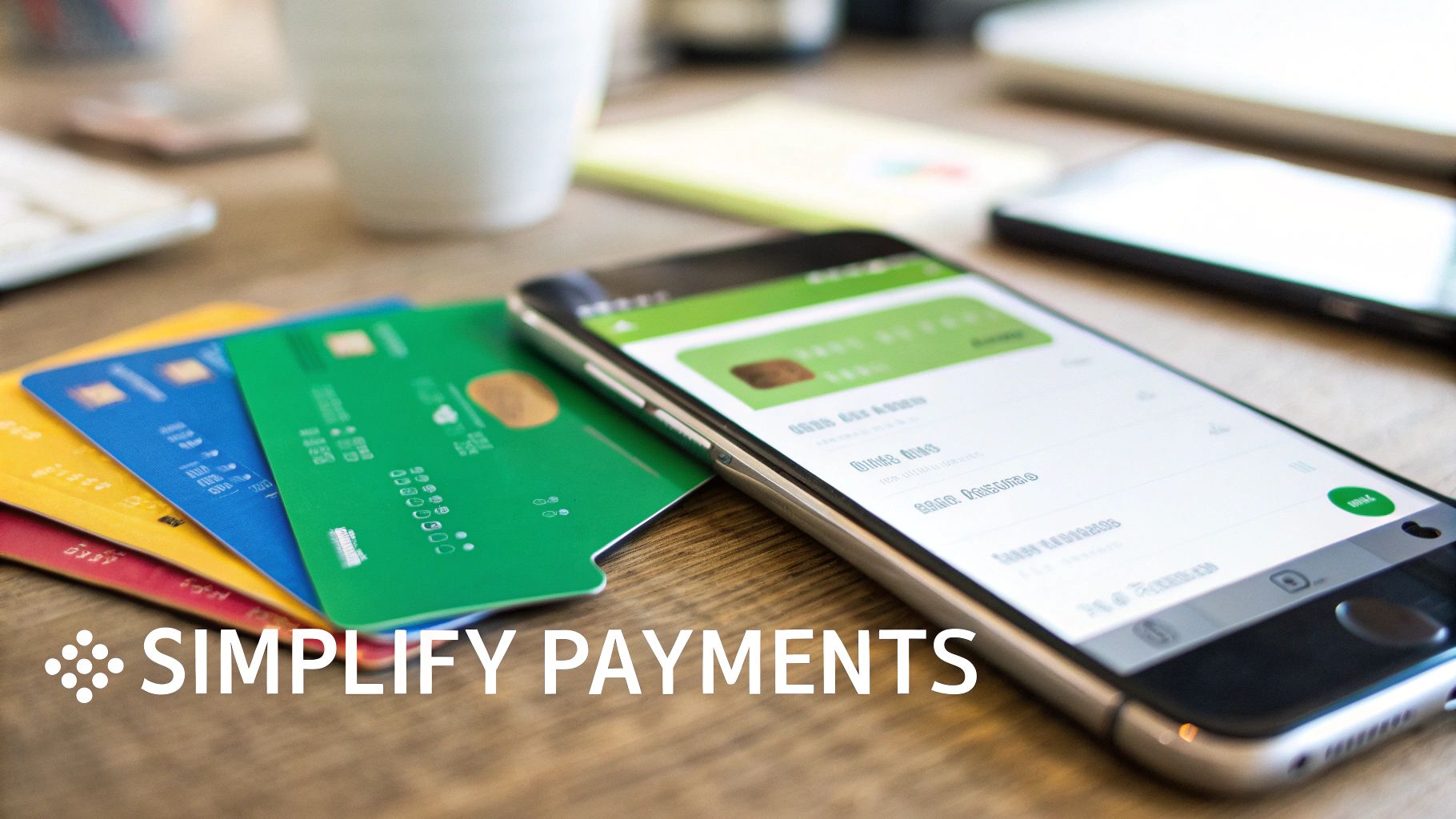
Trying to keep track of a bunch of different due dates, interest rates, and minimum payments is more than just a headache—it’s a surefire way to lose money. If you’re staring at a list of high-interest debts, especially credit cards, pulling them all together through consolidation or refinancing might be one of the smartest moves you can make.
This isn’t about magically erasing what you owe. Think of it as restructuring. The whole point is to combine those scattered debts into one new, single loan. Ideally, this new loan comes with a much lower interest rate, so more of your monthly payment actually chips away at what you owe instead of just feeding the interest beast.
Unpacking Your Consolidation Options
When you hear “debt consolidation,” it usually refers to a few specific financial tools. Each one has its own set of pros and cons, so it’s critical to understand what you’re getting into before signing on the dotted line.
Here are the most common paths people take:
- Debt Consolidation Loans: These are straightforward personal loans. You get a lump sum to pay off all your other creditors, leaving you with just one predictable monthly payment and a clear end date for your debt.
- Balance Transfer Credit Cards: This is a popular play for credit card debt. You move balances from your high-interest cards over to a new one offering a 0% introductory APR for a set period, usually between 12 and 21 months.
- Home Equity Loans or HELOCs: If you own your home and have built up equity, you can borrow against it. These loans typically have great interest rates, but there’s a huge catch: your home is the collateral. That’s a risk you have to take very seriously.
The Power Of A Lower Interest Rate
The real magic of consolidation is how much you can save on interest. Let’s run a quick scenario. Imagine you have $15,000 spread across three credit cards, with an average APR of a painful 21%. If you can consolidate that into a personal loan at a 9% APR over five years, you’re looking at saving thousands of dollars in interest alone.
This is where the logic of the debt avalanche method really clicks into place—you’re slashing the cost of your debt, which helps you get rid of it faster. But none of this works without one crucial ingredient: discipline.
Consolidating debt frees up your old lines of credit. The biggest risk is falling into the trap of running up new balances on those now-empty credit cards, which puts you in a far worse position than where you started.
Balance Transfers: The Strategic Sprint
A balance transfer card can feel like a game-changer for credit card debt. For that promotional 0% APR period, interest stops piling up. Every single dollar you pay goes straight to the principal. It’s an incredibly powerful way to knock out a balance if—and this is a big if—you can pay it all off before the intro offer ends.
But before you apply, watch out for the gotchas:
- Balance Transfer Fees: You’ll almost always pay a one-time fee of 3% to 5% of the amount you transfer. That fee gets tacked right onto your new balance from day one.
- The “Cliff”: Once that sweet 0% period is over, the interest rate skyrockets to the card’s standard APR, which is often very high. Any balance left over will start getting hit with that new, punishing rate.
Think of this strategy as a short-term, aggressive payoff plan. You can dive deeper into the nuts and bolts in our comprehensive guide on how to consolidate credit card debt.
Is Consolidation Right For You?
Deciding to consolidate means taking an honest look at your credit and your habits. Lenders aren’t just handing out low-interest loans; you’ll typically need a good-to-excellent credit score to get the best rates.
Ask yourself these questions before moving forward:
- Is your credit score strong enough? Lenders save their best offers for people with a proven track record of responsible borrowing.
- Will the new interest rate actually save you money? After factoring in any fees, the new rate has to be significantly lower than what you’re paying now to make sense.
- Are you ready to change your spending habits? Consolidation is a logistical fix, not a behavioral one. It won’t solve the issues that created the debt in the first place.
At the end of the day, consolidation is a powerful tool, not a miracle cure. It can give you the breathing room and the mathematical edge you need to get out of debt faster, but it absolutely requires a commitment to not repeating the mistakes of the past.
Advanced Strategies When Your Debt Feels Insurmountable
Sometimes, the snowball or avalanche methods just don’t cut it. Maybe you’ve lost your job, faced a medical emergency, or had another major life event completely derail your finances. When the numbers just don’t add up anymore and you’re barely treading water, it’s easy to feel trapped.
This is the point where you need to look beyond the standard repayment plans. There are other, more powerful strategies designed for these overwhelming situations. They aren’t easy fixes, but they offer a real path forward when you feel like you’ve hit a wall. Let’s walk through them with a clear head.
Negotiating Directly With Creditors
One of the most hands-on approaches is called debt negotiation, or debt settlement. The idea is simple: you call your creditors and try to strike a deal to pay back a lump sum that’s less than what you actually owe.
Why would they agree to this? Because getting some money from you is a whole lot better than getting nothing, which is exactly what could happen if you end up filing for bankruptcy. This strategy works best for unsecured debts like credit cards and personal loans—don’t expect to negotiate your mortgage or car loan this way.
Be warned, though. This path is tricky. While legitimate debt settlement companies do exist, the field is crawling with scams. If a company demands a huge upfront fee or makes promises that sound too good to be true, run the other way.
Working With Non-Profit Credit Counseling
A safer, more structured route is to team up with a reputable non-profit credit counseling agency. These aren’t businesses trying to sell you something; their entire mission is to provide financial education and help people like you get back on their feet.
A certified credit counselor will sit down with you (virtually or in person) and go over your entire financial picture—income, expenses, every single debt. From there, they help you build a budget you can actually live with. If it’s a good fit, they might recommend a Debt Management Plan (DMP).
A DMP is a formal program where you make one single monthly payment to the credit counseling agency. They then take that money and distribute it to all your creditors for you. It’s a game-changer.
Here’s why a DMP can be so effective:
- Lower Interest Rates: Counselors have established relationships with creditors and can often negotiate your sky-high interest rates way down.
- Waived Fees: They can usually get late fees and over-limit penalties erased.
- Simplified Payments: You go from juggling multiple due dates to making just one payment a month. The relief from that alone is huge.
Most DMPs take three to five years to complete. The trade-off is that you’ll likely have to close the credit accounts included in the plan, which is a good way to keep you from digging a deeper hole.
Understanding Bankruptcy As A Last Resort
What if even a DMP isn’t enough? For some, the debt is so crushing that no amount of negotiating or budgeting can fix it. In these dire situations, bankruptcy becomes the final option on the table. It’s a serious decision with long-term consequences, so it should never be taken lightly.
There are two primary types of personal bankruptcy:
- Chapter 7 Bankruptcy: Often called “liquidation,” this process involves selling certain non-exempt assets to pay back creditors. After that, your remaining eligible debts are discharged—completely wiped out.
- Chapter 13 Bankruptcy: This is a “reorganization.” Instead of selling your assets, you work with the court to create a repayment plan that lasts three to five years. You get to keep your property as long as you stick to the plan.
Filing for bankruptcy immediately triggers an “automatic stay,” which legally stops creditors from calling you, suing you, or trying to collect. But that relief comes at a cost: the bankruptcy will stay on your credit report for 7 to 10 years, making it incredibly difficult to get new credit, loans, or a mortgage.
The concept of debt cancellation isn’t just a personal finance tool; it’s been used on a global scale. The Heavily Indebted Poor Countries (HIPC) initiative, for example, resulted in $77 billion in debt cancellation for 18 countries by 2005. It proved that strategic forgiveness can provide critical relief and create a path to recovery. You can read more about these fascinating global debt dynamics to see the bigger picture.
These are complex financial and legal moves. Before you make any decisions, you absolutely must get professional guidance from a qualified credit counselor or a bankruptcy attorney. They can help you understand the nuances and choose the path that gives you the best shot at a genuine fresh start.
Building Habits To Stay Debt-Free For Good
That moment you make your final debt payment is incredible. It’s a huge weight off your shoulders. But the real win isn’t just hitting zero—it’s staying there for good. This is where you take everything you learned getting out of debt and turn those lessons into permanent, wealth-building habits.
Lasting financial freedom isn’t about one specific payoff method. It’s about the small, intentional choices you make every single day. You’re shifting from a defensive battle against debt to a proactive strategy for building the life you actually want.
From Repayment Plan To Spending Plan
The strict budget that got you here has done its job. Now, it’s time for it to evolve. You’re no longer working with a “repayment plan”; you’re building a “spending plan.” The mindset shifts from restriction to intentional allocation.
Your money needs new assignments. That extra $500 a month that used to disappear into a credit card payment can now be pointed toward your future. This is your chance to give every dollar a purpose that actually excites you—saving for a house, boosting your retirement accounts, or planning for your financial independence.
The Emergency Fund: Your Debt-Proof Shield
If one thing can keep you from ever sliding back into debt, it’s a fully-funded emergency fund. Think of it as your non-negotiable financial firewall. Life happens. Cars break down, the AC unit dies in July, and medical bills show up unannounced.
Without cash set aside, these surprises often land right back on a credit card, undoing all your hard work. An emergency fund breaks that cycle forever. It transforms a potential crisis into a manageable inconvenience you can handle without borrowing a dime.
Building a robust emergency fund is the single most important step you can take to protect your debt-free status. It’s not just a savings account; it’s an insurance policy against future debt.
You don’t need to fund it all at once. Just start and be consistent. If you want a clear roadmap, our guide on how to build an emergency fund breaks it down step-by-step. This is a true cornerstone of your new financial life.
Actively Boosting Your Income
Cutting expenses is how you survive the debt payoff journey, but increasing your income is how you truly thrive afterward. With high-interest payments gone, every extra dollar you earn is yours to keep and put to work.
Here are a few practical ways to get your income moving in the right direction:
- Negotiate a Raise: Don’t just ask for more money—build a case for it. Research your market value, document your wins at work, and schedule a formal meeting to discuss your compensation.
- Develop New Skills: Investing in yourself pays the best dividends. Earning a certification or taking courses in a high-demand field can unlock promotions or entirely new, higher-paying roles.
- Start a Side Hustle: Turn a skill or hobby into a new income stream. Whether it’s freelance writing, graphic design, tutoring, or consulting on the side, it all adds up to boost your financial freedom.
Even a small bump in what you bring home can make a massive difference when that money is working for you, not for your old creditors.
Automate Your Good Habits With Technology
One of the surest ways to make your new financial habits stick is to put them on autopilot. Modern banking and apps make this incredibly simple. You can build a system that saves and invests for you without you even having to think about it.
Try putting these powerful automation techniques to work:
- Automate Your Savings: Set up recurring transfers from your checking to your savings and investment accounts for the day after you get paid. Treat your savings like a bill that must be paid first.
- Use Budgeting Apps: Tools like YNAB (You Need A Budget) or Mint connect to your accounts, giving you a real-time picture of your spending so you can stick to your new plan.
- Round-Up Your Purchases: Apps like Acorns can round up your debit card purchases to the nearest dollar and automatically invest the spare change. It’s a painless way to start building your investments.
By automating these key moves, you take willpower out of the equation. Saving becomes your default setting, creating a permanent buffer between you and debt.
Common Questions About Debt Reduction
Starting the journey to get out of debt can feel overwhelming, and it’s totally normal to have a ton of questions swirling around in your head. Knowing what to expect can make the whole process feel less like a climb up a mountain and more like a manageable path forward. Let’s dig into some of the most common worries people have when they first start tackling their debt.
How Long Will It Really Take To Get Out Of Debt?
This is the million-dollar question, isn’t it? The honest answer is, it’s different for everyone. There’s no magic timeline, but your payoff date really comes down to a few key things that are completely within your control.
The aim of our blog is to provide valuable insights and practical tips to help readers manage their money more effectively. However, the information shared here is for general guidance and educational purposes only. It should not be regarded as professional financial advice. Any actions taken based on our content are entirely the responsibility of the reader, and we accept no liability for the outcomes of those actions. If you require financial advice tailored to your personal circumstances, we strongly recommend seeking assistance from a qualified financial adviser.
Obviously, the total amount you owe is the starting point. But the real game-changers are your interest rates and—most importantly—how much extra you can throw at your debt each month. Someone aggressively paying down their debt with a method like the debt avalanche will get there much faster and save a lot more money than someone just sticking to the minimums.
The most powerful way to speed things up is to widen the gap between what you earn and what you spend. Every single extra pound you can put toward the principal is a direct step toward freedom.
Will Paying Off Debt Hurt My Credit Score?
This is a huge fear for many people, and I get it. The short answer is that paying off debt is overwhelmingly good for your credit score in the long run. That said, you might see a small, temporary dip along the way.
Here’s why that can happen:
- Closing Old Accounts: Once you pay off a credit card, you might be tempted to close the account. Doing so can shorten the average age of your credit history, which can cause a slight dip. It’s often better to keep old, no-fee accounts open.
- Changing Credit Utilization: As you pay down balances, you drastically lower your credit utilization ratio (how much credit you’re using versus how much you have available). This is a massive positive for your score and usually far outweighs any negative from closing an account.
Don’t let the fear of a small, temporary dip stop you. In the long run, a lower debt-to-income ratio and a solid history of on-time payments are what really build a strong credit profile.
What Is The Very First Thing I Should Do?
If you’re feeling completely frozen by the sheer size of what you owe, the best first move is the simplest one. Forget about choosing a strategy or trying to find extra money just yet.
Your first action is to create your debt inventory.
That’s it. Just open a notebook or a spreadsheet and list out every single debt. For each one, write down who you owe, the total balance, the interest rate (APR), and the minimum monthly payment. This one act takes the problem from a scary, abstract monster in your head and turns it into a concrete set of numbers on a page. It’s a small step, but it’s incredibly empowering. It gives you clarity and control, which is the perfect foundation for everything else you’ll do.
At Collapsed Wallet, our goal is to give you the clear, practical tools you need to build a stronger financial future. Explore more of our guides and take the next step on your journey to financial freedom at https://collapsedwallet.com.
