

Table of Contents
This blog post may contain affiliate links. As an Amazon Associate I earn from qualifying purchases.
Let's be honest, life throws curveballs. One minute everything is fine, and the next you're staring at a massive car repair bill, a surprise medical expense, or even a sudden job loss. This is where an emergency fund becomes your financial MVP. It's the bedrock of your financial stability—a dedicated cash cushion that shields you from life's unpredictable moments, preventing a single setback from derailing your long-term goals.
The aim of our blog is to provide valuable insights and practical tips to help readers manage their money more effectively. However, the information shared here is for general guidance and educational purposes only. It should not be regarded as professional financial advice. Any actions taken based on our content are entirely the responsibility of the reader, and we accept no liability for the outcomes of those actions. If you require financial advice tailored to your personal circumstances, we strongly recommend seeking assistance from a qualified financial adviser.
Why an Emergency Fund Is Your Financial Safety Net
Building an emergency fund is like buying yourself peace of mind. It gives you the freedom to handle a crisis with a clear head instead of sheer panic. This financial safety net means you can cover urgent costs without having to:
- Pile on high-interest debt: Turning to credit cards or personal loans in an emergency can easily trap you in a debt cycle that’s incredibly hard to break.
- Raid your long-term investments: Cashing out retirement funds often comes with hefty tax penalties and puts your future financial security at risk.
- Make desperate choices: When you're under financial pressure, you're more likely to make poor decisions. Having a cash buffer allows you to navigate challenges from a position of strength.
Ultimately, having this reserve is a cornerstone of solid money management skills. It’s about taking control.
How Much Is Truly Enough?
So, what’s the magic number? You’ll hear financial experts recommend saving enough to cover three to six months of essential living expenses, and for good reason. This isn't some random figure; it’s a time-tested benchmark based on how long it realistically takes to recover from a major financial hit, like finding a new job.
This buffer gives you breathing room. It's the critical window you need to get back on your feet after a job loss, recover from an illness, or handle a major repair without going into a financial tailspin.
The reality is, many people are walking a tightrope. A recent report found that only 46% of adults have enough saved to cover three months of expenses. Even more concerning, a staggering 24% have no emergency savings at all.
The same study revealed that when emergencies do hit, the cost is often between $1,000 and $2,499. This just goes to show how even a relatively small fund can be a total game-changer. You can dig into the specifics in this emergency savings report.
Pinpointing Your Personal Savings Target
We've all heard the "three to six months" rule, and it's a decent starting point. But let's be honest—a generic target doesn't work for real life. To build an emergency fund that actually gives you peace of mind, you need to figure out your number, based on what it truly costs to run your life each month. This process is about turning a vague idea like "I need to save more" into a clear, concrete goal you can actually hit.
The aim of our blog is to provide valuable insights and practical tips to help readers manage their money more effectively. However, the information shared here is for general guidance and educational purposes only. It should not be regarded as professional financial advice. Any actions taken based on our content are entirely the responsibility of the reader, and we accept no liability for the outcomes of those actions. If you require financial advice tailored to your personal circumstances, we strongly recommend seeking assistance from a qualified financial adviser.
The first move is to separate your needs from your wants. This isn't about feeling guilty over that morning latte; it’s a practical exercise to identify the absolute bare-bones cost of living if your income suddenly vanished.
Calculating Your Essential Monthly Expenses
Time to get out a notepad or a spreadsheet and list your non-negotiable expenses. These are the bills you have to pay, no matter what. They're the foundation of your financial security.
Your list of essentials will likely include:
- Housing: Your rent or mortgage payment.
- Utilities: The basics like electricity, water, gas, and internet.
- Food: Your realistic grocery budget, not your "eating out" budget.
- Transportation: Car payments, insurance, gas, or public transit passes to get to work.
- Insurance Premiums: Health, auto, and home or renters insurance.
- Minimum Debt Payments: The absolute minimum you need to pay on loans or credit cards to stay in good standing.
Add those up, and you've got your magic number: your total essential monthly cost. This is the figure your emergency fund is built on. If your essentials come to $2,500 a month, your 3-month goal is $7,500 and your 6-month goal is $15,000.
To help you get started, I've put together a simple calculator. Jot down your own numbers in the middle column to see what your personal targets look like.
Essential vs Discretionary Monthly Expense Calculator
Use this table to calculate your essential monthly expenses and determine your 3-month and 6-month emergency fund goals.
| Expense Category | Your Monthly Cost (Essential) | Example Cost |
|---|---|---|
| Rent/Mortgage | $1,500 | |
| Utilities (Electric, Water, Gas) | $200 | |
| Internet | $60 | |
| Groceries | $400 | |
| Car Payment & Insurance | $450 | |
| Gas/Public Transit | $150 | |
| Health Insurance Premium | $300 | |
| Minimum Debt Payments | $140 | |
| Total Essential Expenses | $______ | $3,200 |
| 3-Month Fund Goal | $______ | $9,600 |
| 6-Month Fund Goal | $______ | $19,200 |
Once you've filled this out, you have a tangible goal to work toward. This isn't just a random number; it's a safety net custom-built for your life.
An emergency fund isn't built to cover discretionary spending. Things like streaming subscriptions, gym memberships, dining out, and hobbies are the first things you would pause in a true financial crisis. Separating them now gives you a realistic picture of your survival budget.
Tailoring Your Target to Your Personal Situation
So, should you aim for three months or six? The guideline is a spectrum, not a one-size-fits-all rule. Where you land depends entirely on your job, family, and what helps you sleep at night.
Let's look at a few real-world examples:
- A freelance graphic designer with an unpredictable income stream would be smart to aim for a six-month fund. That larger cushion can smooth out the gaps between big projects.
- A dual-income household where both partners have stable jobs in high-demand fields might feel totally secure with a three-month fund, since the odds of both losing their jobs at once are pretty low.
- Someone with a high-deductible health plan or a chronic illness should lean toward a beefier fund—closer to six months or even more. That money is there to prevent a medical issue from becoming a financial catastrophe.
This visual really captures the core purpose of your fund: to be a shield against life's unexpected curveballs.
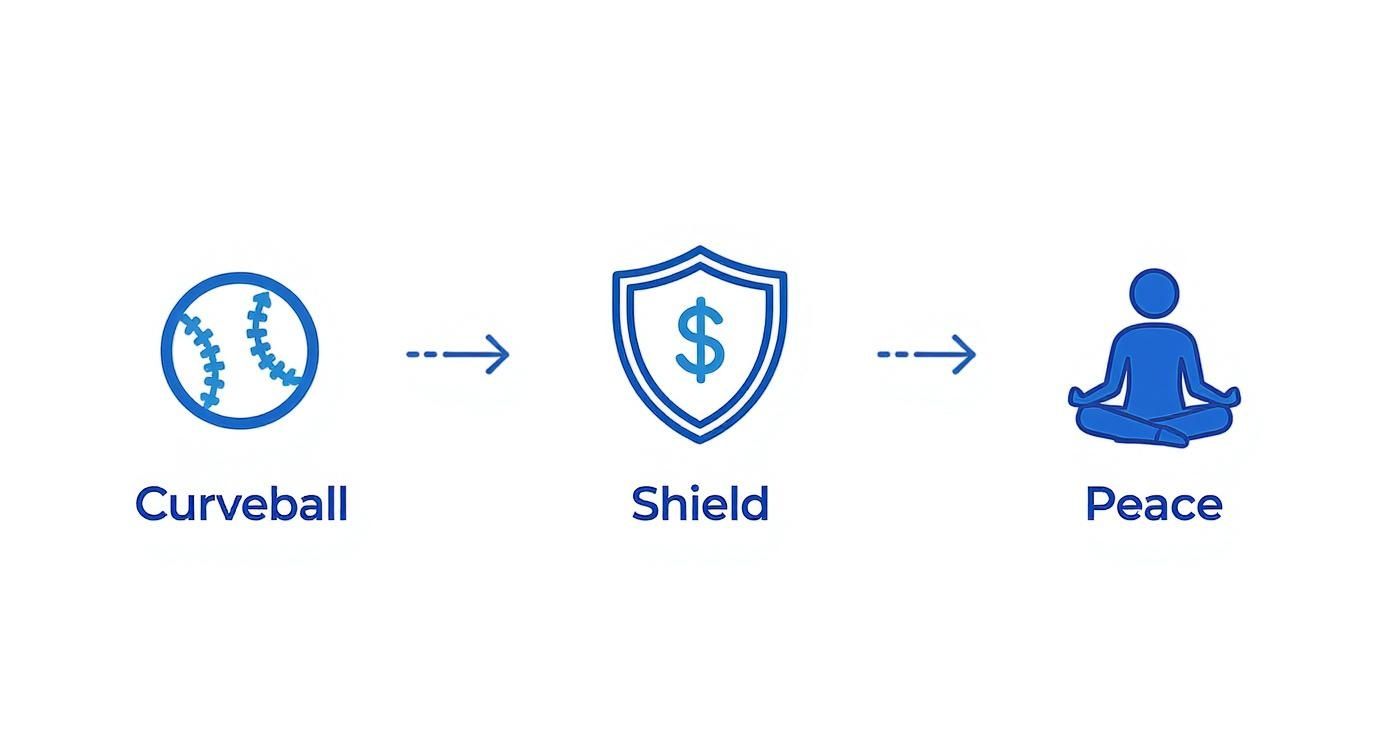
Ultimately, your emergency fund is a powerful tool that turns a potential disaster into a manageable problem. The goal isn't just about hitting a specific dollar amount. It's about building a financial foundation that fits your life, giving you the confidence to handle whatever comes your way.
Finding the Cash to Fuel Your Fund
Knowing your target number is a huge step, but let's be honest—the real challenge is figuring out where that money will actually come from. This is where you get to put on your detective hat and turn what feels like a massive goal into a series of small, totally doable actions.
The trick is to avoid making drastic, all-or-nothing cuts that you can't stick with for more than a week. A better plan is to attack it from two angles: trimming the fat from your current budget and actively looking for ways to bring in a little more cash.
Identifying and Plugging Spending Leaks
Most of us have "spending leaks." These are those small, almost invisible expenses that quietly drain your bank account over time. Finding and plugging these can free up a surprising amount of money without making you feel like you're sacrificing everything you enjoy.
The best way to start is by tracking your spending for a solid month. Don't judge yourself; just gather the data. Once you see exactly where every dollar is going, you'll spot patterns and know exactly where to make some smart adjustments.
You'd be surprised where you can find extra cash:
- Forgotten Subscriptions: That streaming service you signed up for a free trial or the gym membership you haven't used since January? They could be costing you hundreds per year.
- The Daily Coffee Run: I get it, that morning latte is a ritual. But a $5 daily habit adds up to $1,500 over a year. Making coffee at home most days can redirect a huge chunk of change to your fund.
- Brand-Name Groceries: Switching to store brands for staples can easily shave 15-30% off your grocery bill. You can find more tips in our guide on how to save money on groceries.
This isn't just about saving a few bucks; it's about building a buffer against a world that's getting less predictable. We're seeing the economic impact of global disasters grow, with annual costs surging. This underscores just how vital a personal financial safety net has become. For more on this trend, the UNDRR's Global Assessment Report has some eye-opening insights.
Boosting Your Income Streams
Cutting back on expenses can only get you so far. If you really want to kick your savings into high gear, you have to look at the other side of the equation: increasing your income. Even a small boost can make a massive difference in how quickly you hit your goal.
Take a look at the skills and time you already have. Is there a way to turn them into a little extra cash on the side?
Pro Tip: You don't need to launch a full-blown startup. Even a few small freelance projects or a couple of hours of work each week can add up to a significant amount by the end of the month.
Here are a few ideas to get the wheels turning:
- Negotiate a Raise: If you've been crushing it at work and taking on more responsibility, it might be time to ask for a pay increase. Do your homework on what your role is worth, build your case, and schedule a chat with your boss.
- Start a Side Hustle: Put a skill you already have to work. Are you great with words, a whiz with spreadsheets, or a talented artist? Platforms like Upwork or Fiverr are great places to find people who will pay for your expertise.
- Sell Your Unused Stuff: We all have things sitting around collecting dust. Go through your home and sell those electronics, clothes, and furniture you no longer need on Facebook Marketplace or eBay for a quick cash injection.
Let Technology Do the Heavy Lifting
Manually moving money into savings can feel like a chore, and it's easy to forget. This is why automation is your best friend in this process. You can set up systems that save money for you without you even thinking about it.
Here are a few of my favorite tech-savvy approaches:
- Round-Up Apps: Apps like Acorns or the "Save When I Spend" feature from Chime automatically round up your debit card purchases to the nearest dollar and tuck that spare change away. It's painless saving.
- Cashback Browser Extensions: Tools like Rakuten or Honey are a no-brainer. They automatically find and apply coupons when you shop online, and you can have the cashback you earn sent right to your savings account.
- Automated Transfers: This is the big one. Set up an automatic transfer from your checking to your savings account for the day you get paid. Treat it like any other bill. This "pay yourself first" strategy is the single most effective way to ensure your fund grows consistently.
By combining these three strategies—plugging leaks, boosting income, and automating—you create a powerful system that works for you. You'll turn building an emergency fund from a daunting chore into an empowering journey.
Where to Keep Your Emergency Savings
Alright, you're building up your savings and gaining momentum. That's a huge step. But now you have a new problem to solve: where do you actually put this cash?
The home for your emergency fund is just as important as the fund itself. This isn't just another pot of money; it’s your financial first-aid kit. It has to be liquid (easy to grab fast, no penalties) and safe (the balance won't drop). Period. These two rules make the decision-making process a whole lot simpler.
Why Your Emergency Fund Isn't an Investment
It’s incredibly tempting to look at a growing pile of cash and think, "This could be working harder for me in the stock market." I get it. But putting your emergency fund into stocks or ETFs is one of the worst mistakes you can make. The market is just too unpredictable for money you might need at a moment's notice.
Think about it: the market tanks right after you get a pink slip. Not only is your paycheck gone, but your emergency savings—your lifeline—has just shrunk by 10%, 20%, or more. That's a catastrophic double-whammy. The whole point of this fund is to eliminate risk, not take on more of it.
Your emergency fund is your insurance policy, not a lottery ticket. The 'return' you get from it is peace of mind, not capital gains. Keep your investing and emergency savings separate—always.
On the flip side, a standard checking account isn't right either. Yes, it's liquid, but it's too liquid. When your emergency cash is mixed in with your bill-paying and coffee-buying money, it’s far too easy to dip into it for non-emergencies. A little separation creates a crucial mental barrier.
The Best Accounts for Your Emergency Savings
So where does that leave us? The sweet spot is an account that offers safety, easy access, and a decent interest rate. You want your money secure and available, but there's no reason it can't earn a little something while it's waiting in the wings.
Here are the top places I recommend parking your fund:
-
High-Yield Savings Accounts (HYSAs): For most people, this is the gold standard. HYSAs, usually offered by online banks, crush the interest rates you'd find at a traditional bank. The money is FDIC-insured up to $250,000, so it’s completely safe, and you can get your cash via an electronic transfer.
-
Money Market Accounts (MMAs): Think of these as a close cousin to HYSAs. They also offer competitive interest rates and FDIC insurance. The main difference is that MMAs sometimes come with a debit card or check-writing features, which can be handy. Just watch out for any minimum balance requirements or limits on how many withdrawals you can make each month.
Ultimately, choosing between these two comes down to the little details and your personal preference. The most important thing is that the account is separate from your daily checking. That little bit of friction—a one or two-day transfer time—is often just enough to make you stop and think, "Is this really an emergency?"
Here’s a simple table to help you weigh your options as you figure out how to build an emergency fund.
Emergency Fund Account Comparison
A comparison of the best account types for storing your emergency savings, based on liquidity, safety, and potential earnings.
| Account Type | Key Benefit | Main Drawback | Best For |
|---|---|---|---|
| High-Yield Savings Account (HYSA) | Significantly higher interest rates than traditional savings, FDIC insured. | Transfers can take 1-3 business days; may have no physical branch. | Savers prioritizing growth and safety who are comfortable with online banking. |
| Money Market Account (MMA) | Competitive interest rates, FDIC insured, and often includes a debit card or checks. | May have higher minimum balance requirements and limit the number of monthly withdrawals. | Individuals who want a slightly higher level of access than an HYSA provides. |
| Traditional Savings Account | Extremely accessible, usually linked to your checking account at a physical bank. | Very low interest rates, meaning your money's buying power may decrease over time. | Getting started with a very small fund or for those who prioritize in-person banking. |
Choosing the right account removes temptation and keeps your safety net ready for when you actually need it. Pick one, set up your automatic transfers, and let it grow.
Make Saving Effortless with Automation
Let’s be honest, relying on willpower to save money is a recipe for failure. The most successful savers I know don't have superhuman discipline—they have great systems. Automation is your secret weapon for building an emergency fund because it takes the daily "should I save or should I spend?" debate completely off the table.
The whole strategy boils down to one powerful idea: pay yourself first. It's a small mental shift that makes a huge difference. Before you pay rent, bills, or even buy groceries, a piece of your income goes directly into savings.
By setting up an automatic transfer from your checking to your savings account right after every payday, you start treating your savings like any other non-negotiable bill. The money is gone before you even see it, which turns saving from a chore into something that just happens in the background.
Setting Up Your Automatic Savings Plan
Getting this system running is usually a one-and-done task. Just log into your online banking portal and find the option for recurring or automatic transfers.
Here’s what you’ll need to do:
- Pick an amount: Decide how much you can realistically transfer from each paycheck. Whether it's $50, $100, or more, what matters most is consistency. You can always adjust it later.
- Time it right: Schedule the transfer for your payday or the day after. This is crucial—it gets the money out before you're tempted to spend it.
- Choose the destination: Make sure the money is going into that dedicated high-yield savings account you picked out for your emergency fund.
- Set it and forget it: Once confirmed, you can let it run on its own. Your emergency fund will now grow on autopilot.
What If You Have an Irregular Income?
A fixed transfer amount doesn't work so well when you're a freelancer, work on commission, or have an income that bounces around. The "pay yourself first" principle still works, you just have to adapt it. Instead of a fixed dollar amount, think in percentages.
When your income is unpredictable, your consistency comes from the habit, not the dollar amount. Make a commitment to immediately transfer a set percentage—say, 10% or 15%—of every single client payment or commission check into savings the moment it lands in your account.
Many modern banking apps are perfect for this. Some even let you create rules that automatically siphon off a percentage of any deposit into a separate savings "pot."
This way, you’re always saving when you’re earning, but you won't feel the pinch during a slow month. The goal is to build a system where progress happens by default, without you having to constantly think about it.
Even small, steady contributions grow into a serious safety net over time. Once this is automated, you also free up mental energy for other financial goals.
How to Use and Replenish Your Fund
Sooner or later, you're going to need that safety net you've worked so hard to create. Knowing exactly when to dip into your emergency fund is just as important as building it in the first place. This isn't vacation money or a budget for a new gadget; it's a lifeline for true financial shocks.
A genuine emergency usually checks three boxes: it's unexpected, urgent, and necessary. We're talking about things like a sudden job loss, a flooded basement, or a medical bill that insurance won't touch. These are the curveballs that would otherwise send you scrambling for a high-interest credit card.
Making a Withdrawal and Rebuilding
Once you've had to use some of that cash, your top priority flips. Now, the goal is to get that fund back to its full strength as quickly as you can. Your fund did its job, which is great, but don't get complacent. It's time to rebuild that buffer before life throws its next punch.
Here’s a simple game plan to get back on track:
- Hit pause on other goals: It's okay to temporarily scale back extra contributions to your retirement or investment accounts. You can ramp them back up once your emergency fund is whole again.
- Ease up on extra debt payments: Keep making all your minimum payments to stay in good standing, but for now, stop sending extra money toward your loans.
- Funnel all extra cash to savings: Every dollar you've freed up from the steps above should go straight into your high-yield savings account until you're back at your target.
Keep Your Fund Aligned with Your Life
Your emergency fund isn't a one-and-done project. It’s a living part of your financial plan that needs to adapt as your life changes. It’s smart to give it a quick review at least once a year to make sure it still makes sense for you.
A fund that was perfect last year might be totally inadequate today. Getting a raise, having a baby, or moving to a city with a higher cost of living all shift your financial baseline. When that happens, it's time to recalculate your savings target.
This need for personal preparedness is really a small-scale version of what happens on a global level. We see organizations having to plan for growing crises all the time. For example, the World Health Organization estimated it would need $1.5 billion to respond to 42 health emergencies in 2025 alone. You can read more about these global emergency funding needs on WHO.int.
Just like major institutions have to prepare for the unexpected, a well-maintained personal fund is what ensures you can weather your own financial storms.
Got Questions About Your Emergency Fund? We’ve Got Answers.
As you start socking away cash for a rainy day, some questions are bound to pop up. It's totally normal. Getting clear on the details can make all the difference in sticking with your plan, so let's tackle some of the most common ones I hear all the time.
Should I Pay Off Debt or Save First?
Ah, the classic dilemma. It's a real tug-of-war, especially if you're dealing with high-interest credit card debt. Why save money earning a tiny bit of interest when you've got debt costing you a fortune? The best strategy is actually a bit of a hybrid approach.
Your first move should be to build a small starter emergency fund of about $1,000. Think of this as your immediate buffer. It’s what keeps a flat tire from turning into a new credit card balance. Once you have that initial safety net in place, you can pivot and attack your high-interest debt with everything you've got before coming back to build out your full three-to-six-month fund.
Aren't Sinking Funds and Emergency Funds the Same Thing?
It’s an easy mistake to make, but they have very different jobs. Both are savings buckets, yes, but what you use them for is night and day.
- An emergency fund is your financial firefighter. It’s for true, unpredictable surprises—a sudden job loss, a medical crisis, or a tree falling on your roof. It's purely reactive.
- A sinking fund is for big expenses you know are on the horizon. Think: saving for a down payment, next year's holiday gifts, or your annual car insurance premium. It's a proactive tool that helps you plan for future costs without going into debt.
What if I Feel Like I’m Too Broke to Save?
This is probably the biggest hurdle for most people. When you're living paycheck to paycheck, the idea of saving a thousand dollars—let alone thousands—can feel completely out of reach. So, don't start there. The trick is to start so small it feels almost silly.
The initial goal isn't the dollar amount; it's the consistency. Automating just $5 a week into a separate savings account proves to yourself that you can save, creating momentum.
Once that habit is locked in, you can start looking for small wins, like a tiny budget cut or a quick side gig. The most important thing is just to begin. That first step, no matter how small, is everything.
Can I Invest My Emergency Fund for Better Returns?
I get the temptation—you see that cash just sitting there and think it could be working harder for you. But the answer here is a firm no. Investing your emergency fund is a risky game you don't want to play.
The whole point of this money is safety and immediate accessibility, not growth. Imagine a market downturn hitting right when you lose your job. Your "safety net" could suddenly be worth 30% less just when you need it most. Keep it boring. Keep it safe in a high-yield savings account where it's liquid and secure.
At Collapsed Wallet, our goal is to give you the clear, practical guidance you need to take control of your money. For more actionable tips on building financial security, explore our resources at https://collapsedwallet.com.

14 thoughts on “How to Build an Emergency Fund and Secure Your Future”