
Table of Contents
This blog post may contain affiliate links. As an Amazon Associate I earn from qualifying purchases.
When you’re trying to budget money on low income, it doesn’t feel like a matter of choice; it feels like a necessity. But I want to reframe that: this isn’t about restriction. It’s about taking back control and finally getting some breathing room. The first step, before you change a single spending habit, is to get a brutally honest look at your finances. This means tracking where every dollar goes, gathering up all your paperwork, and seeing the complete picture. This awareness is everything—it’s the bedrock of your entire plan.
The aim of our blog is to provide valuable insights and practical tips to help readers manage their money more effectively. However, the information shared here is for general guidance and educational purposes only. It should not be regarded as professional financial advice. Any actions taken based on our content are entirely the responsibility of the reader, and we accept no liability for the outcomes of those actions. If you require financial advice tailored to your personal circumstances, we strongly recommend seeking assistance from a qualified financial adviser.
Your First Steps to Gaining Financial control
Let’s be real: trying to budget when you’re on a low income can feel completely overwhelming. It often seems like every single cent is already spoken for before you even get it. The mental load is heavy, I get it. But the very first move to lighten that load is just to understand your own financial landscape.
This isn’t about judging yourself or making huge, painful cuts right away. It’s just about building a foundation of knowledge. Think of this initial phase as pure observation. By tracking what you spend for one full month, you stop guessing where your money goes and you start knowing. That clarity is what gives you the power to make smart, intentional decisions down the road.
Gather Your Financial Puzzle Pieces
Before you can make a plan, you need to lay out all the pieces of the puzzle. This means grabbing every document that tells a story about your money. Don’t stress about organizing it perfectly just yet—the goal for now is just to get everything in one spot.
Here’s what you’ll want to round up:
- Proof of Income: This includes all your recent payslips, any benefit statements, or records of earnings from a side gig.
- Bank and Credit Card Statements: Pull at least the last 30-60 days of statements so you can see your transaction history.
- Regular Bills: This is everything from your utility bills (electric, water, gas) to your phone and internet, insurance statements, and any loan or debt repayment summaries.
Doing this gives you two critical numbers: your total monthly income and your total fixed expenses.
Track and Categorize Your Spending
With your documents in hand, the next job is to track your variable spending—the money that doesn’t go to those fixed bills. For 30 days, write down every single purchase, no matter how small. A coffee, a bus ticket, a pack of gum—it all needs to be on the list. You can use a simple notebook, a spreadsheet, or a free budgeting app.
After the month is up, group these expenses into categories like “Groceries,” “Transportation,” “Utilities,” and “Personal Care.” This isn’t just about adding up what you spent; it’s about spotting the patterns. You might be genuinely surprised to see where your money has actually been going.
Before you build a full budget, it helps to see the process as three simple, foundational steps. These are the non-negotiables for getting started on the right foot.
The 3-Step Foundation for Your Low-Income Budget
| Action Step | Why It's Essential | Quick Tip |
|---|---|---|
| Gather All Documents | You can't plan without knowing your exact starting point—your total income and fixed costs. | Create a "money" folder or box. Toss everything in there as it comes in so it's all in one place when you're ready. |
| Track Every Penny | It moves you from guesswork to facts. This reveals unconscious spending habits you'd never spot otherwise. | Use the notes app on your phone to quickly log purchases the moment you make them. Don't wait until the end of the day. |
| Categorize Spending | This shows you exactly where your money is going and highlights the areas where you can make impactful changes later. | Start with broad categories like Food, Housing, and Transport. You can get more specific as you go. |
Completing these three actions gives you the raw, honest data you absolutely need to build a budget that will actually work for you.
Key Takeaway: This initial tracking and categorizing phase is the most important step of all. Without an honest look at your current financial reality, any budget you create will be based on a fantasy and is pretty much guaranteed to fail.
This exercise also sets the stage for creating a small but vital safety net. To learn more about that crucial next step, check out our guide on how to build an emergency fund to get prepared for those unexpected costs that always seem to pop up.
Building a Realistic Budget That Actually Works
Once you've gathered your financial data, moving from just tracking your spending to actively planning is where you really start to feel in control. You can’t tell your money where to go until you know exactly where it's been going. That’s why the first real step is to track expenses effectively; it shines a light on your spending habits and shows you where you can realistically make cuts.
Once you have that clarity, one of the most powerful tools for managing a tight budget is the zero-based budget. It sounds complicated, but the idea is simple: Income – Expenses = Zero. This doesn't mean you spend every last cent. It means every single dollar gets a job, whether that's paying rent, covering necessities, or being tucked away into savings. We have a full guide that breaks down what is zero-based budgeting if you want to explore it further.
Prioritizing Your Needs First
When money is tight, knowing your priorities isn't just a good idea—it's everything. Before a single dollar goes toward "wants," you have to make sure your absolute needs are covered. These are the non-negotiables that keep you safe and secure.
Your top-tier priorities are always going to be:
- Housing: Your rent or mortgage.
- Utilities: The lights, water, and heat.
- Food: Your core grocery budget for home.
- Transportation: What it costs to get to work or other essential places.
Everything else has to wait until these are funded. It might sound basic, but writing these down in order of importance creates a clear financial roadmap. It takes the emotion out of the equation when a check comes in.
This kind of disciplined approach is becoming more critical than ever. As global economic pressures increase, households with lower incomes feel the squeeze the most. The 2023 Least Developed Countries Report showed that the debt-to-GDP ratio in the world's 46 most vulnerable nations hit 55.4% in 2022. This means governments are spending more on debt—five times more than a decade ago—and less on essential services. For you, this can mean less public support and higher costs for basic needs, making a solid personal budget absolutely essential.
Managing Fluctuating Income with a Priority System
A traditional monthly budget can feel completely pointless when your income isn't consistent. If you're a freelancer, gig worker, or work variable hours, you need something more flexible. This is where a 'priority pot' system can be a game-changer.
Instead of trying to plan for a whole month, you just plan for the money you have right now. When you get paid, you don't look at the total amount. You use it to fill your priority 'pots' one at a time, starting with the most important.
Let’s walk through a real-world example:
- You get paid $400.
- Your first priority is Rent, and you need $800 total for the month. You put the entire $400 into that rent pot. It's not fully funded yet, but you've tackled your biggest priority first.
- A few days later, you earn another $550.
- First thing you do? Add the remaining $400 to the Rent pot. Now it's fully funded and you can breathe a little easier.
- With the leftover $150, you move to your next priority, Utilities, and fund it. Whatever is left after that goes into the Groceries pot.
This turns budgeting from a rigid, once-a-month chore into a dynamic, real-time system. You’re always focused on the most immediate need, which dramatically cuts down on the stress of an unpredictable income.
This infographic breaks down that initial process of getting your financial information organized so you can start building your budget.
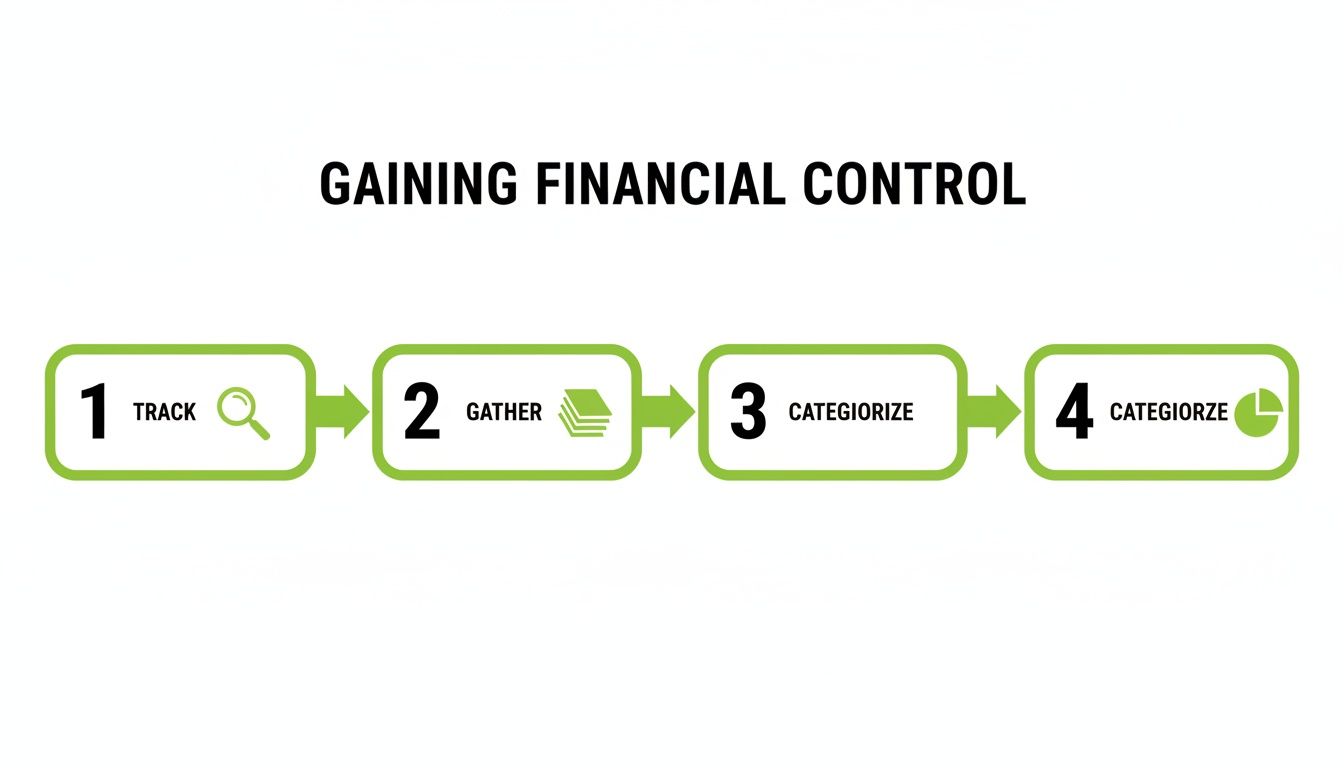
It’s all about creating awareness and getting organized first. That’s how you start to gain real control.
Key Insight: A budget for a low-income household has to be a living, breathing thing. It's not about a perfect plan you set once a month. It’s about making the smartest decision with the money you have in your hand, right now. Your budget’s job is to bend without breaking.
Ways to Cut Your Expenses and Find More Cash
Once your budget clearly shows where your money is going, the next step is to start plugging the leaks. This isn't about making yourself miserable by cutting out everything you enjoy. It’s about being strategic and finding those high-impact changes that free up cash without completely sacrificing your quality of life.
By trimming a bit of fat in a few key areas, you can create some much-needed breathing room. That extra cash can then go to work for you, whether that means chipping away at debt or finally starting a small emergency fund.
Challenge Your Essential Bills
So many of us treat our monthly bills—internet, phone, insurance—as if they're set in stone. The truth is, they're often more negotiable than you think. Service providers would almost always rather give you a small discount than lose you to a competitor.
Take an hour and make some calls. Be polite, but firm. Explain that things are tight and you need to lower your bill. Ask about promotions, loyalty discounts, or if there's a cheaper plan that still meets your needs. It helps to have competitor offers handy; this gives you real leverage. I’ve seen a simple 15-minute phone call shave $20 to $50 off a monthly bill.
Do a Subscription Audit
Those small, recurring payments are notorious budget killers. That $9.99 streaming service or that $15 app subscription feels like nothing on its own, but they quietly drain your account month after month.
It's time for a subscription audit. Pull up your bank statements and highlight every single recurring charge. For each one, ask yourself two honest questions:
- Do I really use this anymore?
- Is it genuinely worth the money?
Be ruthless here. If the answer is no, cancel it on the spot. Getting rid of just two or three of these can easily save you hundreds of dollars over a year.
Tame Your Utility and Energy Costs
Energy bills can be a huge chunk of anyone’s budget, but you have more control than you might realize. The biggest win often comes from simply switching to a cheaper energy tariff. Hop on a comparison website—it only takes a few minutes to see if you can get a better deal elsewhere.
Beyond that, small habits add up. Unplugging electronics, switching to energy-saving LED bulbs, and nudging your thermostat down a degree or two can make a surprising difference on your next bill.
Key Takeaway: The best way to manage a tight budget is to stop being a passive spender. Challenge everything. Don’t assume any cost is fixed. By negotiating, auditing, and making smart changes, you take control of your money instead of letting it control you.
For more ideas on where to find savings, our full guide on how to cut expenses goes into much more detail. You can also generate a quick bit of cash by clearing out things you don’t need; for instance, you can recycle old electronics for cash.
Let Technology Help You Find Savings
You don't have to do all this work manually. Modern budgeting apps can be a massive help, acting like a financial assistant in your pocket.
Here’s where they really shine:
- Automatic Tracking: Apps like Mint or PocketGuard link to your bank and categorize your spending for you. This saves you a ton of time and gives you an up-to-the-minute look at your finances.
- Spending Insights: Seeing a chart that shows you spent 30% of your discretionary funds on non-essentials can be a real eye-opener. These visuals make it easy to spot spending patterns.
- Helpful Nudges: You can set up alerts to warn you when you're getting close to your budget limit in a category. It's a great way to keep yourself accountable throughout the month.
Apps that use the zero-based budgeting method, like YNAB (You Need A Budget), are particularly great when money is tight. The whole point is to give every single dollar a job, which forces you to be intentional and ensures no money gets wasted.
Taking on Debt and Finding a Little Help
When you’re trying to budget on a tight income, debt can feel like an anchor holding you back. It’s often the biggest, most stubborn line item in your spending plan. But putting together a real strategy to chip away at it is one of the most powerful things you can do for your financial future.
Getting out of debt is about more than just sending in payments. It's about picking the right game plan—one that keeps you motivated and lets you see real progress. This means taking a hard look at what you owe, understanding your options, and knowing exactly where to turn when you need a hand.
Picking Your Debt Repayment Strategy
When you start looking into how to pay off debt, you'll see two popular methods come up again and again. They’re popular because they actually work. The trick is to choose the one that fits not just your wallet, but your personality. There’s no single "right" answer, just the one that’s right for you.
Debt Repayment Methods Compared
Let's break down the two main approaches. The Debt Snowball is all about quick wins to build momentum, while the Debt Avalanche is the most efficient path from a pure numbers perspective.
| Strategy | How It Works | Best For |
|---|---|---|
| Debt Snowball | You list debts from smallest to largest balance. You pay minimums on everything, but throw all extra cash at the smallest debt. Once it's gone, you roll that payment into the next-smallest debt. | People who need to see quick, motivating wins to stay on track. The psychological boost of clearing a debt, even a small one, is powerful. |
| Debt Avalanche | You list debts from highest to lowest interest rate. You pay minimums on everything, but throw all extra cash at the debt with the highest interest rate. | People who are disciplined and motivated by saving the most money possible over time. This approach minimizes the total interest you'll pay. |
No matter which path you choose, try plugging your numbers into a simple loan overpayment calculator. It can be a real eye-opener. Seeing how an extra $25 a month could knock years off your repayment timeline and save you hundreds in interest is a huge motivator.
Don’t Be Afraid to Ask for Financial Support
You absolutely do not have to handle financial pressure on your own. In fact, one of the smartest things you can do when money is tight is to actively look for the support systems built to help people in your exact situation. These programs are there to create some breathing room in your budget.
This is where the bigger picture really matters. Public support can completely change a family’s financial stability. Research shows that government assistance and public services are responsible for about 30% of global poverty reduction since 1980. Things like subsidized healthcare and education act like an extra source of income for families on a budget, freeing up their own money for other essentials. You can see the full research on how public services impact poverty from the World Inequality Lab.
Key Insight: Seeking financial assistance isn’t a sign of failure—it’s a smart financial move. These programs exist to bridge the gap and provide stability so you can focus on bigger goals, like becoming debt-free.
Where to Start Looking for Help
Figuring out where to even begin can feel overwhelming, but knowing who to ask makes all the difference. Help is often available at the local, state, and even national levels.
Here are a few great places to start your search:
- Government Assistance Programs: Check out programs like SNAP (Supplemental Nutrition Assistance Program) for help with groceries or LIHEAP (Low Income Home Energy Assistance Program) to lower your utility bills.
- Utility Support Programs: Your power or water company might have its own assistance program or offer flexible payment plans. It often just takes a quick phone call to their customer service line to find out what options they have for people facing financial hardship.
- Non-Profit Financial Counseling: Reputable organizations like the National Foundation for Credit Counseling (NFCC) provide free or low-cost sessions with certified counselors. They can help you build a realistic debt management plan, work with your creditors, and get your budget on solid ground.
How to Save and Invest on a Tight Budget

When you’re working with a tight budget, the idea of saving money—let alone investing it—can feel like a fantasy. But this is the exact moment to shift your thinking from just getting by to actively building a more secure future. Even tiny amounts, when saved consistently, build a powerful buffer against life’s inevitable curveballs.
Your first, non-negotiable goal should be an emergency fund. This isn’t vacation money; it’s a safety net. An unexpected car repair or a surprise medical bill can completely derail your finances, but having even a few hundred dollars set aside can turn a full-blown crisis into a manageable headache.
So, start small. Seriously. Even if it’s just $5 a week. The amount isn’t nearly as important as the habit you’re building.
The need for this personal safety net is only growing as outside support systems face their own pressures. For example, recent analysis shows that aid cuts to low-income countries are projected to dramatically worsen household finances between 2023 and 2026. In South Sudan, per capita aid is expected to fall from $110 to just $68 by 2026. This is a stark reminder that building your own financial resilience isn’t just a good idea—it’s a necessity when systemic supports can be unreliable. You can dig deeper into these global economic trends at the Center for Global Development.
Using Technology to Save Automatically
One of the sneakiest—and most effective—ways to save when cash is tight is to make it automatic. This is where technology becomes your secret weapon. Micro-saving apps do the work for you, turning your spare change into real savings without you ever feeling the pinch.
Here’s a look at how they work:
- Round-Ups: You connect your debit card, and the app rounds up every purchase to the nearest dollar. It then sweeps that difference into your savings. That $3.50 coffee becomes a $4.00 transaction in your app, and the extra $0.50 gets tucked away.
- Automated Transfers: Set up small, regular transfers you won’t even miss, like $1 every day or $10 every payday. These tiny amounts don’t disrupt your budget but add up surprisingly fast over the course of a year.
Apps like Acorns or Stash are great for this because they not only save your spare change but can also invest it for you. It’s a fantastic, low-stakes way to dip your toes into the world of investing.
Introduction to Beginner-Friendly Investing
Investing probably sounds like something reserved for people with fancy suits and corner offices, but it’s really just a way to make your money start working for you. The magic ingredient is compound interest—which is just a way of saying you start earning interest on your interest. It’s a slow burn at first, but over time, it can grow your small, steady contributions into a substantial amount.
You don’t need a pile of cash or a finance degree to get started. The key is to avoid the risky game of trying to pick individual winning stocks. Instead, you want to focus on low-cost, diversified options.
Key Takeaway: The goal of investing on a low income isn’t to get rich quick. It’s to build long-term wealth slowly and steadily, leveraging the power of time and consistency to create a more financially secure future for yourself.
A perfect starting point for beginners is Exchange-Traded Funds (ETFs). Think of an ETF as a big basket holding hundreds or even thousands of different stocks or bonds. When you buy a single share of an ETF, you’re instantly spreading your money across a huge slice of the market. This dramatically lowers your risk compared to betting it all on just one or two companies.
Many brokerage apps now offer “fractional shares,” which means you can invest with as little as $5. This feature has completely torn down the old barrier that kept everyday people out of the market. By starting small with a diversified ETF, you give your money a real chance to grow over the long haul.
Common Questions About Low-Income Budgeting
Trying to get a handle on your money, especially when every dollar counts, brings up a ton of questions. It’s completely normal to hit a roadblock and wonder if you’re doing it right. Let’s tackle some of the most common hurdles you might be facing and find some practical answers to keep you moving forward.
“My Income Is Too Low and Irregular to Budget. How Can I Even Start?”
This is probably the biggest and most understandable concern out there. When you don’t know what you’ll bring in from one week to the next, a standard monthly budget feels completely useless. The trick is to stop thinking in terms of a monthly calendar and start thinking in terms of priorities.
First, make a simple list of your absolute “survival” expenses—the things that have to get paid no matter what. We’re talking about your rent or mortgage, core utilities to keep the lights on, and gas to get to work.
Then, the moment any money comes in, your first move is to put that cash toward those critical bills. Once they’re covered, you can use what’s left for your next tier of priorities. Maybe that’s a minimum debt payment, then a few dollars into savings, and so on down the line. This way, you’re telling every dollar exactly where to go, even when you’re working with a small or unpredictable amount.
“What Should I Do When an Unexpected Expense Ruins My Budget?”
First off, an unexpected bill is a fact of life, not a personal failure. It doesn’t mean your budget is “ruined”—it just means it’s being tested. Your best line of defense is having a small emergency fund, even if it’s just $100 to $500. That little cushion can absorb a minor shock without blowing up your entire plan.
If you don’t have that fund built up yet, take a deep breath. You have options.
- Can it wait? Ask yourself if the expense can be pushed back a week or two until your next payday.
- Can you set up a payment plan? You’d be surprised how many medical offices, mechanics, or utility companies are willing to work with you if you just call and ask.
- Is there help available? A quick search for local non-profits or community charities might turn up programs that can help in a pinch.
After the dust settles, see this as a learning opportunity. Your budget didn’t break; it just showed you where it was vulnerable. Think about adding a new line item for “Unexpected Stuff” and start tucking away even a tiny amount each week. The goal isn’t to magically prevent emergencies, but to build a plan that’s resilient enough to handle them.
“I Feel Too Overwhelmed to Stick to a Budget. How Can I Stay Motivated?”
Budget fatigue is real. When money is incredibly tight, it can feel like you’re just stuck in a cycle of restriction with no room for error. To keep from burning out, you need to see your budget not as a cage, but as your roadmap to getting what you really want.
One of the best things you can do for your sanity is to build in small, guilt-free rewards. Seriously. A planned $5 weekly allowance for a coffee or a favorite snack can make a huge psychological difference. It gives you a little something to look forward to and keeps those feelings of deprivation at bay.
It also helps to find a way to watch your progress. Seeing your credit card balance actually go down or your tiny savings account tick up is powerful proof that your hard work is paying off. Try to connect your daily choices to a bigger, more meaningful goal—like being debt-free or having a safety net for your family—to remind yourself why you’re doing this in the first place.
“Are Budgeting Apps Actually Helpful for Low-Income Situations?”
They definitely can be, but you have to pick the right one for the job. A lot of free apps are great at showing you where your money already went, which is a good first step for awareness. But when your income is all over the place, you need something more proactive.
For managing a tight, irregular income, an app built on the zero-based budgeting method can be a game-changer. A tool like YNAB (You Need A Budget) forces you to give a job to every single dollar you have right now. While it has a subscription fee, that hands-on approach is perfect for navigating unpredictable cash flow.
My advice? Try out the free trials for a few different apps. See which one clicks with how your brain works. The right tool should make your life easier and reduce your stress, not add another chore to your list.
At Collapsed Wallet, our goal is to give you the clear, practical guidance you need to take control of your finances and build a more secure future. Explore our resources to find the strategies that work for you. Learn more about building a secure financial future on our website.
