

Table of Contents
This blog post may contain affiliate links. As an Amazon Associate I earn from qualifying purchases.
Feeling the sting at the grocery checkout? You’re not alone. But the secret to getting your food budget under control isn’t about spending hours clipping coupons. It’s about creating a smart, repeatable system. The most effective approach I’ve found boils down to three core pillars: planning ahead, shopping strategically, and cutting down on food waste. This is your ultimate guide to save funds on groceries.
The aim of our blog is to provide valuable insights and practical tips to help readers manage their money more effectively. However, the information shared here is for general guidance and educational purposes only. It should not be regarded as professional financial advice. Any actions taken based on our content are entirely the responsibility of the reader, and we accept no liability for the outcomes of those actions. If you require financial advice tailored to your personal circumstances, we strongly recommend seeking assistance from a qualified financial adviser.
Your Blueprint for Lower Grocery Spending
That sticker shock when the cashier announces your total can be a huge source of financial stress. It can feel like a major roadblock on your path to financial freedom. The good news? Taking back control of your grocery bill is more doable than you might think, and it doesn’t mean you have to give up all the foods you love.
It’s all about having a simple, consistent system. By focusing on what you do before you go to the store, how you shop once you’re there, and what you do with the food back at home, you build a powerful defense against overspending. This method turns a chaotic weekly shop into a focused, money-saving mission.
The Three Pillars of Grocery Savings
The most reliable way to shrink your food bill month after month is to build habits around a three-part framework. Each pillar supports the others, creating a solid strategy that hits overspending from every possible angle. It’s about being intentional with your money so it aligns with your bigger goals.
Here’s a great visual that breaks down this simple—but incredibly powerful—process.
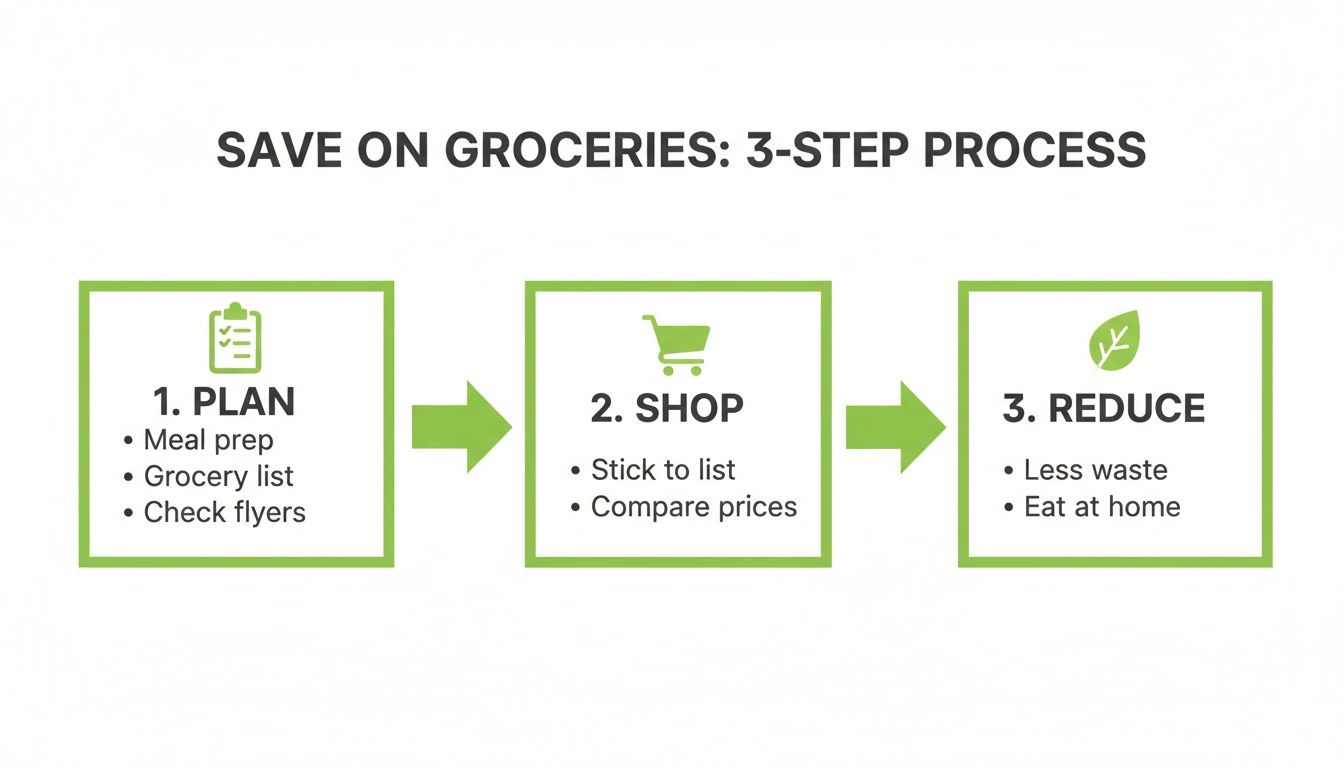
As you can see, the work starts long before you grab a cart and continues even after your fridge is full.
To make this crystal clear, here’s a quick summary of how these pillars work together.
The ‘Plan, Shop, Reduce’ Framework at a Glance
| Pillar | Key Action | Potential Savings |
|---|---|---|
| Plan | Creating a weekly meal plan and grocery list. | 15-20% by eliminating impulse buys and extra trips. |
| Shop | Comparing unit prices and using loyalty apps. | 10-25% by making smarter in-store decisions. |
| Reduce | Using leftovers and storing food properly. | 5-10% by preventing food (and money) from going in the bin. |
This table shows just how much impact each small, focused action can have when combined.
Integrating the Framework into Your Finances
Think of these pillars not as separate chores, but as interconnected habits that boost your overall financial health.
- Plan: This is your foundation. It’s where you set a realistic food budget and map out your spending for the week. This step is all about setting clear boundaries for your spending before you’re tempted in the store.
- Shop: This is the execution phase. In the aisles, you’ll put your plan into action by sticking to your list, comparing unit prices, and using store apps to snag deals.
- Reduce: The final piece is tackling food waste, which is like throwing money directly into the trash. Properly storing food ensures you get the most value out of every single dollar you spend.
By mastering these three interconnected pillars, you aren’t just cutting costs—you’re building a more resilient financial future. Every dollar saved on groceries is a dollar you can put toward paying down debt, investing, or achieving your financial freedom.
This kind of systematic approach is a cornerstone of smart personal finance. If you’re looking to get a better handle on your finances as a whole, our guide on how to manage money better is a great next step. Folding these grocery-saving tactics into a bigger financial plan can seriously speed up your journey toward escaping financial worries.
Mastering Your Meal Plan and Grocery Budget
A solid plan is your best defense against overspending at the supermarket. Without one, you’re basically walking into a retail battlefield unarmed—a space meticulously designed to make you spend more. A good plan gives every dollar a job before you even set foot in the store.
Think of this process as building the financial guardrails for your shopping trips. It’s how you shut down impulse buys and make sure your grocery spending actually lines up with your bigger financial goals, bringing you closer to financial freedom.
Setting a Realistic Grocery Budget
Before you can slash your spending, you have to know where your money is actually going. This is where a little tech can make a huge difference. Budgeting apps are fantastic for getting a clear picture of your finances.
- YNAB (You Need A Budget) is great for intentional spending because it makes you assign a “job” to every single dollar you have.
- Mint is more automated, pulling in your transactions and categorizing them for you so you can see your spending habits at a glance.
Hook up your bank accounts to one of these, and you’ll get a real-time, data-backed view of what you’re spending on groceries. This isn’t about pulling a random number out of thin air; it’s about setting a budget based on what you actually spend, which is the only way to make it stick and move toward your financial goals.
Reverse-Engineer Your Spending from Sales
Here’s a simple mindset shift that will save you a ton of money: let the sales flyers dictate your shopping list, not the other way around.
Before you even think about what to buy, grab the weekly ads from your local stores (or pull them up online). Look for the big discounts, especially on protein and fresh produce—these are usually the priciest parts of any shopping trip. From there, you can start building your week’s list around those core sale items using some proven budget-friendly meal planning techniques.
A shopping list built around what’s on sale doesn’t just cut your bill; it eliminates the financial stress of overspending. You’re no longer reacting to store promotions—you’re proactively managing your money.
This one habit turns grocery shopping from a chore into a strategic part of your journey to financial freedom.
Create Your Own Price Book
A price book sounds old-school, but it’s an incredibly powerful tool for making sure you’re always getting the best deal. It’s just a simple log—in a notebook or a spreadsheet—where you track the regular prices of things you buy all the time at different stores.
For example, you might track the price of a gallon of milk, a pound of ground beef, or a box of your favorite cereal. You’ll quickly learn that Store A consistently has the cheapest milk, while Store B almost always has a better deal on chicken.
Over a few months, this log becomes your secret weapon. You’ll know instantly whether a “sale” is a genuine bargain or just clever marketing. It’s not about being restrictive; it’s about being informed and in control of your financial future.
Smart Shopping Tactics That Actually Work
Alright, you’ve got your plan and budget locked in. Now comes the fun part: heading to the store. This is where all that prep work really pays off, letting you make sharp, on-the-fly decisions that will slash your total at the checkout. It’s time to stop being a passive shopper and start thinking strategically.
Think of it this way: you’re no longer just grabbing things off the shelf. You’re getting the absolute best value for every single dollar, which is a huge step toward hitting your financial goals and escaping financial worries. It’s about understanding the game and playing it well.
Become a Savvy Retailer Switcher
Being loyal to just one grocery store is a fast way to overspend. A seriously powerful tactic is to become what I call a ‘retailer switcher.’ This just means you shop at a few different stores, playing to each one’s strengths to get the best deals across the board.
As prices creep up, more people are catching on to this. Projections show that by 2026, a massive 33% of U.S. shoppers expect to spend ‘more’ or ‘much more’ on groceries. We already saw this trend pick up steam in 2025, when 48% of consumers were spending more than the year before. Smart shoppers are fighting back by rotating between places like Aldi, Walmart, and local ethnic markets, where you can often find staples for 10-20% cheaper. You can get a deeper look into these consumer spending trends and what they mean for your wallet.
This strategy is a key part of building financial resilience. You’re not tied to one store’s pricing, giving you more control over your budget.
Decode the Psychology of the Store Layout
Ever notice how grocery stores are laid out? It’s not random. They are masterfully designed to get you to spend more. The most expensive, tempting stuff is almost always right at eye level or on those end caps in high-traffic zones. You can beat them at their own game by shopping the perimeter of the store first.
This is where essential items usually live:
- Fresh produce
- Meat and dairy
- Bakery items
These are the whole, unprocessed foods that form the foundation of your shopping list, and they’re usually a better value. Those middle aisles? That’s the danger zone, filled with processed snacks and high-margin convenience foods designed to break your budget. I make it a rule to stick to the perimeter and only dart into the center aisles for specific things on my list.
Resisting the temptations of the center aisles is a direct act of financial self-discipline. Every cleverly marketed, high-priced item you walk past is a small victory for your budget and a step toward your long-term financial freedom.
Embrace the Power of Store Brands
Here’s one of the easiest, fastest ways to shrink your grocery bill: switch from name-brand products to store brands (sometimes called private labels). The secret is that in many cases, they’re made in the exact same factories as their pricier counterparts. You get virtually identical quality for a much lower price.
This isn’t just a niche trick; it’s a mainstream strategy. One report revealed that 51% of low-income families have traded down on meat and dairy, choosing private labels that can be up to half the price. Don’t feel like you have to switch everything at once. Just start by swapping one or two items per trip and watch the savings add up, freeing up more money to put toward your financial goals.
Using Technology to Save Funds on Groceries
Let’s be honest, your smartphone is probably already in your hand at the grocery store. It’s time to turn it into one of the most powerful money-saving tools you own. We’re talking about going beyond just the basic store loyalty app and using tech that puts actual cash or gift cards back in your pocket.
There are a handful of fantastic apps that have partnered with hundreds of brands to give you rebates on things you’re already buying. All you have to do is scan your receipt after a shopping trip. That’s it. You’ll earn points or cash back that you can redeem once you hit a certain amount. This simple habit can lead to significant savings over the course of a year, accelerating your journey to financial freedom.
Mastering the Art of Stacking Savings
This is where you can really start feeling like a pro. “Stacking” is simply combining multiple discounts on a single item. It’s a game-changer that can turn a pretty good deal into an incredible one.
The basic idea is to layer different savings on top of each other. It usually looks something like this:
- Store Sale: You start with an item that’s already marked down in the weekly flyer.
- Digital Coupon: Then, you clip a manufacturer’s coupon for that same item in your grocery store’s app.
- App Rebate: After you pay, you scan the receipt into a cashback app and get another rebate.
When you line up all three of these—the sale, the coupon, and the rebate—you can sometimes get items for just a fraction of the cost. It completely changes your mindset from just running an errand to actively building your financial future.
Real-World Savings with Cashback Apps
So, what does this look like in a real shopping cart? Let’s say a household staple is on sale for $3.00, normally $4.50. You check your store’s app and find a $0.50 digital coupon, which drops the price to $2.50 at checkout.
But you’re not done yet. After you get home, you snap a picture of your receipt with an app like Ibotta or Fetch Rewards and get another $0.75 back. Your final cost for that item is now just $1.75. That’s a total savings of over 61%!
Sure, saving a dollar or two on one item might not sound life-changing. But when you do this consistently across your shopping list, the savings compound fast. A family that gets into the habit of stacking and using cashback apps can easily save hundreds of dollars a year—money that can be put toward paying off debt, investing, or hitting other financial goals.
These apps fit perfectly with other smart money habits. For a deeper dive into how tech can help manage your finances, take a look at our guide on the best free budgeting apps out there. When you get all your tools working together, you create a powerful system for keeping your money on track and achieving financial freedom.
How to Shop Smarter When Food Prices Are Soaring
Let’s be honest: walking into a grocery store these days can feel like entering a financial battleground. With inflation driving prices up, knowing what to buy—and when—is less about filling your cart and more about protecting your wallet. To keep your financial goals from getting derailed, you have to think like a strategist.
This means getting proactive. It’s about spotting which food categories are getting expensive and which are staying put, then adjusting on the fly. Building this kind of flexibility into your shopping routine is key to absorbing those price shocks without blowing your budget.

Keep an Eye on Shifting Prices
Grocery prices are always in flux, bouncing around based on everything from the growing season to weird global supply chain hiccups. A huge part of learning how to save money on groceries is simply paying attention to these trends.
This is especially true for big-ticket items like meat and dairy. You don’t have to be an economist; just notice what’s happening. Recent data shows that tons of shoppers are “trading down”—they’re buying cheaper items or switching to store brands because the price hikes are just too much. It’s a real trend, and you can see the official numbers in the food price outlooks from the USDA if you’re curious.
Embrace the Store Brand
One of the quickest, easiest wins for your grocery budget is to start buying store brands, or private labels. That old idea that generic products are somehow “less than” is long gone. Smart shoppers know that in many cases, the stuff inside the package is identical to the big-name brands.
And this isn’t just a tip for people pinching pennies. High-earners are swapping their usual packaged goods for private labels to keep their spending in check. It’s a simple move that flat-out works. Since inflation really took off in 2022, private label sales have shot up, helping families cut their grocery costs by a whopping 15-40%.
Choosing a store brand over a name brand is a conscious financial decision. It’s an easy, repeatable action that directly frees up cash for your other financial priorities, like debt repayment or investing, without sacrificing quality.
Use Bulk Buying to Your Advantage
Buying in bulk isn’t about hoarding; it’s about being strategic. When you buy smart, you lock in today’s lower prices and protect your budget from whatever increases are coming next month. The trick is to focus on things that last.
Here’s where to focus your bulk-buying energy:
- Pantry Staples: Think rice, pasta, canned beans, and cooking oils. When these go on sale, buying a larger size almost always drops the unit price.
- Frozen Foods: See a great deal on frozen veggies, fruit, or even chicken? Stock that freezer. You’re essentially locking in that sale price for months to come.
- Household Goods: Paper towels, toilet paper, soap, and cleaning supplies have no expiration date. Grabbing them in bulk from a warehouse club or during a big sale is a no-brainer for long-term savings.
The idea is to build up a small, reliable stockpile. Having a well-stocked pantry and freezer acts like a financial cushion, reducing the number of things you’re forced to buy at full price each week. It gives you control, which is exactly what you need to navigate these economic times and secure your financial future.
Got Questions About Saving on Groceries? We’ve Got Answers
Even when you have a solid game plan, a few questions always seem to pop up as you’re getting the hang of cutting down your grocery spending. Let’s tackle some of the most common hurdles I see people face. Getting these sorted is key to making your new habits stick.
How Much Should I Actually Budget for Groceries?
Figuring out that magic number for your grocery budget can feel like a shot in the dark, but there’s a really solid place to start. The USDA actually publishes official food plan guidelines which give you a baseline for spending at different levels—from thrifty all the way to liberal. They’re a great reality check.
Of course, that’s just a starting point. To make that number work for you, you’ve got to tweak it for your own life.
- Household Size: Pretty straightforward—more mouths to feed means a bigger budget. The interesting part, though, is that your cost per person usually drops as your household grows because you can buy things more efficiently.
- Where You Live: The cost of living is no joke. A grocery run in a big city is going to look a lot different from one in a small rural town.
- Dietary Needs: If you’re dealing with specialized diets like gluten-free, or if you prioritize organic, those items just cost more. You have to build that reality into your budget from the get-go.
My advice? Look up the USDA’s “low-cost” plan to get a benchmark. From there, adjust it based on your family’s needs to land on a budget that feels both challenging and realistic.
Are Grocery Delivery Services a Total Waste of Money?
This is a big one. It’s so easy to see the delivery fees and think, “no way.” But the real answer is a bit more nuanced than just convenience versus cost.
The biggest, and often overlooked, benefit of delivery is how it kills impulse buys. You’re not wandering past the snack aisle, smelling tempting displays, or seeing that alluring display of high-margin items at the checkout. For a lot of people, the money they save by not grabbing those unplanned extras more than covers the delivery fee.
Think of a delivery service as a tool for self-control. If you know you’re someone who can’t resist temptation in the store, the fixed cost of delivery might actually save you money in the long run.
The only way to know for sure is to test it. Track your spending on a few traditional shopping trips and compare it to a few delivery orders. If you find you have more control and stick to your budget better with delivery, it might just be a smart financial move for you.
Is Buying In Bulk Always Cheaper?
Warehouse clubs feel like a savings paradise, but they can quickly turn into a food-waste nightmare. That low unit price is incredibly tempting, but it’s only a real bargain if you actually use every last bit of what you buy.
The trick is to be ruthless about what you put in that giant cart. You have to know what categories genuinely offer good value to make that membership fee pay for itself.
Smart Things to Buy in Bulk
- Pantry Staples: Think canned goods, pasta, rice, and cooking oils. These things last forever, so stocking up is a no-brainer.
- Paper Products: Toilet paper, paper towels, and napkins don’t go bad and are almost always a better deal in large quantities.
- Frozen Foods: Grabbing big bags of frozen fruit, veggies, and meat lets you lock in a lower price for items you’ll use over weeks or even months.
On the flip side, be extremely careful with fresh produce or dairy. That massive bag of salad greens is not a deal if half of it spoils in your crisper drawer. Unless you have a specific plan to use it all up fast, stick to smaller quantities from your regular grocery store.
At Collapsed Wallet, we’re all about giving you clear, practical financial advice to help you build a more secure future. To find more strategies for mastering your money, check us out at https://collapsedwallet.com.
