

Table of Contents
This blog post may contain affiliate links. As an Amazon Associate I earn from qualifying purchases.
Real financial freedom doesn't just happen. It isn't about a lucky break or a sudden windfall; it's the direct result of building a solid set of money management skills. Think of it less like trying to solve a complex math equation and more like assembling a practical, everyday toolkit—one that empowers you to make your money work for you and your goals, not against you.
The aim of our blog is to provide valuable insights and practical tips to help readers manage their money more effectively. However, the information shared here is for general guidance and educational purposes only. It should not be regarded as professional financial advice. Any actions taken based on our content are entirely the responsibility of the reader, and we accept no liability for the outcomes of those actions. If you require financial advice tailored to your personal circumstances, we strongly recommend seeking assistance from a qualified financial adviser.
The Foundation of Your Financial Wellness
If you want a reliable way to build security and seriously cut down on stress, developing strong money management skills is it. It’s simply the art of pointing your financial resources—whether you have a little or a lot—toward the life you actually want to live. This guide will walk you through the core pillars of financial health, breaking them down into simple, learnable habits anyone can pick up.
At its heart, smart money management boils down to a few key areas:
- Budgeting: Creating a simple plan for what comes in and what goes out.
- Saving: Putting money aside for future goals and those inevitable rainy days.
- Debt Management: Having a strategy to pay down and avoid high-interest debt.
- Investing: Making your money work to grow over time.
Why These Skills Matter More Than Ever
Let's be honest, the world has some massive financial gaps. The total amount of liquid money floating around the globe is about $123.3 trillion. If you split that evenly, it would come out to roughly $15,108 per person, but we all know that’s not how it works. Wealth is spread unevenly, which makes your personal ability to manage your own money absolutely critical for staying afloat. You can dig into the numbers on the global money supply at NCHSTATS.com.
How well you handle your resources directly impacts your ability to ride out financial storms and build a future you can count on.
"Understanding money management is one of the most essential skills you will ever learn to make your money count instead of pinching pennies. And you don’t need a finance degree to build strong financial habits."
It doesn’t matter if you're just getting your first paycheck or are years into planning for retirement. Getting a handle on these foundational skills gives you the confidence to make smart calls with your money. We'll give you actionable advice to help you get there, no matter where you're starting from.
Build Your Budget: A Blueprint for Financial Control
Let's get one thing straight: a budget isn't a financial straitjacket meant to suck all the fun out of your life. Think of it more like a blueprint for a house. It's a plan that gives you the power to tell your money exactly where to go, so you can build the future you actually want. Mastering this skill is the difference between hoping for financial success and intentionally creating it.
The first move is always to get brutally honest about where your money is going right now. You need a clear, unfiltered picture of what's coming in and what's flowing out. That means tracking every single dollar for at least a month to see your real spending habits, not just the ones you think you have.
This exercise can be a real eye-opener. You might be shocked to find how much those daily coffees or "small" impulse buys add up. This isn't about making you feel guilty; it’s about gathering cold, hard data so you can make smarter decisions moving forward.
Choosing Your Budgeting Method
Once you have a handle on your cash flow, it’s time to pick a budgeting system that actually fits your personality. There’s no single "best" method. The right one is simply the one you'll stick with consistently.
Here are a few popular approaches that work for different types of people:
- The 50/30/20 Rule: This is a perfect starting point if you want simplicity without a ton of tracking. The idea is to divide your after-tax income into three buckets: 50% for your needs (rent, utilities, groceries), 30% for your wants (dining out, hobbies), and 20% for savings and paying down debt. It's straightforward and gives you a lot of flexibility.
- Zero-Based Budgeting: If you're someone who likes precision and control, this is for you. With this method, every single dollar gets a job. You start with your income and assign it to different categories until you have zero dollars left over. It's more hands-on, but it ensures no money is ever wasted.
- The Envelope System: This old-school, cash-based system is incredibly effective if you're a visual or tactile person. You literally put cash into labeled envelopes for things like "Groceries," "Gas," or "Entertainment." When the cash in an envelope is gone, you're done spending in that category for the month. Simple, but powerful.
Choosing the right method is a big step. The infographic below offers a simple way to think about whether you're ready to tackle these financial tasks on your own or might be better off getting some professional advice to start.
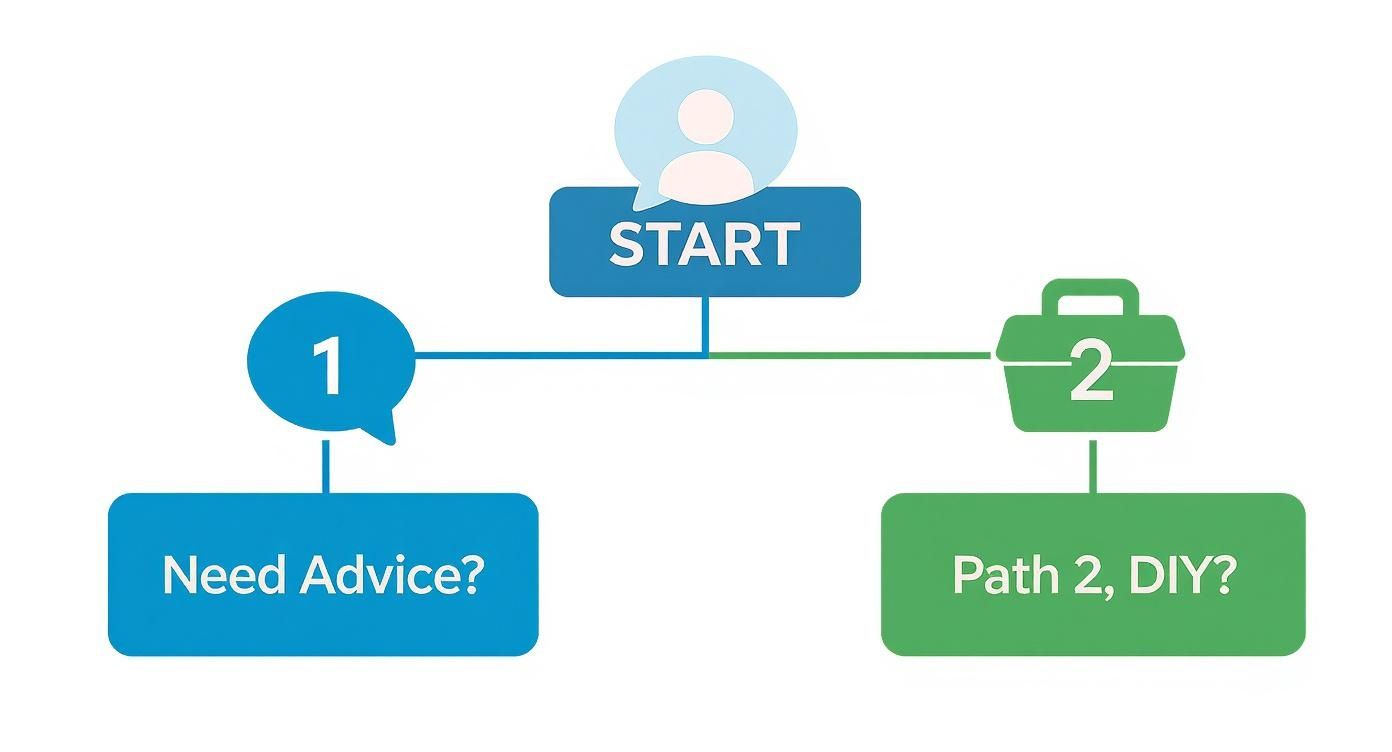
As you can see, the path to financial control really begins with a little self-assessment. Being honest about your confidence and needs will help you decide whether to go the DIY route or bring in an expert.
To make the choice even clearer, let's break down how these methods stack up against each other.
Comparison of Popular Budgeting Methods
This table compares the three common budgeting methods we just discussed. Use it to find the best fit for your lifestyle and what you want to achieve financially.
| Budgeting Method | Best For | Key Principle | Potential Drawback |
|---|---|---|---|
| 50/30/20 Rule | Beginners and those who want flexibility and simplicity. | Divides after-tax income into three broad categories: 50% Needs, 30% Wants, 20% Savings. | The broad categories might be too vague for detailed financial tracking or aggressive goals. |
| Zero-Based Budgeting | Detail-oriented people who want total control over their money. | Assigns every dollar a specific "job," so Income – Expenses = 0. | Can be time-consuming and requires meticulous tracking of every transaction. |
| The Envelope System | People who struggle with overspending on credit cards and prefer a tangible, visual approach. | Uses physical cash in labeled envelopes to enforce spending limits for each category. | Inconvenient for online purchases and bills; requires carrying cash. |
After looking at the options, pick one that feels manageable and aligns with your natural tendencies. Remember, you can always switch later if it's not working for you.
Putting Your Budget Into Action
Okay, choosing a method is one thing, but making it work is where the magic happens. A budget isn't a "set it and forget it" document; it's a living, breathing tool that needs your attention.
The key is to schedule a monthly budget review. Put it on your calendar. This is your non-negotiable time to check in, see how your actual spending compared to your plan, and make adjustments. Life happens—your car needs a repair, your income changes, a new goal pops up. Your budget needs to be flexible enough to roll with the punches.
A budget isn’t about saying "no" to everything you want. It's about saying "not right now" so you can say "yes" to the things that truly matter. It’s how you align your daily spending with your long-term dreams.
Don't be afraid to use technology to make this easier. Budgeting apps like YNAB or a simple Google Sheet can link directly to your bank accounts, automatically categorize your spending, and show you exactly where your money is going. This can save you a ton of time.
As you get better at this, you'll naturally start making smart consumer savings choices because you'll have a clear picture of what's important to you. A good budget ultimately gets rid of the financial guesswork. It puts you firmly in control, cuts down on money-related stress, and gives you a clear roadmap to build the secure future you deserve.
Master the Arts of Saving and Investing
Once your budget is dialed in, you can shift from just managing your money to actively growing it. This is where saving and investing come into play—two sides of the same coin, but each with a very different job when it comes to building long-term wealth.
Think of it like this: saving is like stashing seeds in a cool, dry place. They're safe, you know exactly where they are, and you can grab them whenever you need them. Investing is planting those seeds in a field where they can sprout, grow into strong plants, and eventually give you a harvest. You need both strategies, but for very different reasons.
The Non-Negotiable First Step: An Emergency Fund
Before you even think about investing a single dollar, you need a financial safety net. This is your emergency fund, a dedicated stash of cash for when life throws you a curveball—a sudden job loss, a surprise medical bill, or a car that decides to die on the highway.
Without this buffer, one unexpected event can send you straight into high-interest debt, wiping out all your progress.
Your first goal is simple: get to $1,000. Once you hit that milestone, your next target is saving three to six months' worth of essential living expenses. Keep this money in a high-yield savings account—it needs to be easy to access but separate from your everyday checking account. That separation is key to breaking the "see-money, spend-money" habit.
An emergency fund isn't an investment; it's insurance. It buys you peace of mind and protects your future from the chaos of the present.
The easiest way to build this fund is to automate it. Set up a recurring transfer from your checking to your savings account for every payday. Even a small amount adds up surprisingly fast. This "pay yourself first" approach makes saving a priority, not just an afterthought.
From Saving to Investing: Making Your Money Work for You
With a solid emergency fund in place, you can confidently start growing your wealth through investing. The word "investing" can sound complicated, but the core concept is straightforward: you're buying assets (like stocks or real estate) that have the potential to increase in value over time.
One of the most powerful forces you'll encounter is compound interest. Albert Einstein supposedly called it the "eighth wonder of the world," and for good reason. It's like a financial snowball effect. You start with a small ball of snow (your initial investment), and as you roll it downhill, it picks up more snow (your returns). Before long, the new snow is sticking to other snow, not just your original snowball, making it grow bigger, faster.
Beginner-Friendly Investment Options
You don't need a finance degree to get started. In fact, some of the simplest options are also the most effective for beginners.
- Index Funds: Instead of trying to pick individual winning stocks (which is incredibly difficult), an index fund lets you buy a tiny slice of an entire market, like the S&P 500. This gives you instant diversification, spreading your risk across hundreds of different companies.
- Exchange-Traded Funds (ETFs): Very similar to index funds, ETFs are baskets of investments that you can buy and sell like a single stock. They're known for their low fees and are a fantastic way to build a well-rounded portfolio without needing a ton of cash upfront.
These tools take the pressure off. You're not trying to beat the market; you're just growing your money right alongside it. All it takes is consistency and a long-term mindset.
Starting Your Investment Journey
A great place to begin is with a retirement account. If your employer offers a 401(k), especially one with a company match, jump on it. An employer match is literally free money—you won't find a better return on your investment anywhere. If you don't have a 401(k), look into opening a Roth IRA, which allows your investments to grow and be withdrawn in retirement completely tax-free.
Solid money management skills are the engine of wealth creation worldwide. The 2025 Global Wealth Report revealed that global financial wealth hit a staggering $305 trillion in 2024, thanks to strong market performance. But here's the interesting part: more than 80% of new assets managed over the last five years were brought in by new financial advisors, not established ones. This highlights a huge shift where sharp, modern money management skills are essential for success. You can explore the full BCG report on global wealth trends to see the data for yourself.
Finally, never forget that every dollar has potential. Finding small, consistent savings in your daily life can free up more cash to invest. For example, learning how to save money on groceries can easily put an extra $50 or $100 back into your budget each month—money that can then be put to work growing for your future.
Master the Art of Managing Debt
Debt can feel like you're trying to run a race with a heavy backpack on. But with the right strategy, you can turn that feeling of being weighed down into a focused plan for getting ahead. A core part of your money management skills is learning to handle debt intelligently, and that starts with a simple truth: not all debt is the same.
Some debt actually works for you, helping you build wealth over the long haul. This is often called "good debt," and it's used to buy things that grow in value or increase your income. A mortgage on a home is a classic example, as is a student loan that opens the door to a higher-paying career.
Then there's "bad debt." This is the stuff that buys things that lose value, usually financed with high interest rates that quietly eat away at your money. Think high-interest credit card balances from last year's vacation or a payday loan. Knowing the difference is your first move—it tells you which debts to tackle first and with everything you've got.
Picking Your Debt Payoff Strategy
Once you've sorted your debts, it's time to choose your battle plan. The best approach isn't always the one that looks best on paper; it's the one that keeps you motivated and in the fight. Two popular and proven methods are the Debt Snowball and the Debt Avalanche.
Each one taps into a different part of our psychology. Your job is to pick the one you're most likely to stick with when things get tough.
Let's see how they work:
-
The Debt Snowball: You list all your debts from the smallest balance to the largest. Forget the interest rates for a minute. You’ll make minimum payments on everything except the smallest debt. You throw every extra penny you have at that one until it's gone. Then, you take the money you were paying on it and roll it over to the next-smallest debt. Those quick wins create a powerful sense of momentum—a "snowball" effect that keeps you going.
-
The Debt Avalanche: This one is for the math-minded. You list your debts from the highest interest rate to the lowest. You make minimum payments on all of them, but you channel all your extra cash toward the one with the highest interest rate. Once that’s paid off, you move to the next-highest. This method will save you the most money in interest over the life of your loans.
Choosing a debt repayment plan is less about finding the "perfect" strategy and more about finding the one that you will actually stick with. Consistency is what ultimately leads to success.
From Plan to Action: How to Get Rid of Debt Faster
Picking a method is great, but it’s just the starting line. Now it’s time to put your plan into action and build habits that prevent you from falling back into the same hole. Real money management skills are forged in doing, not just planning.
Here are a few powerful moves you can make right now to speed up your journey to being debt-free:
-
Negotiate Your Interest Rates: You'd be surprised what a simple phone call can do. Ring up your credit card company and ask for a lower Annual Percentage Rate (APR). If you've been a good customer and made payments on time, mention that you're working hard to pay down your balance. Even a couple of percentage points can save you a ton of cash.
-
Explore Consolidation: If you're juggling several high-interest debts, a debt consolidation loan or a balance transfer card with a 0% introductory APR can be a game-changer. It simplifies your life with a single payment and can slash your interest costs. Just be sure to watch out for transfer fees and have a solid plan to pay off the balance before that sweet introductory rate expires.
-
Find the "Extra" Money: Revisit your budget with a critical eye. Where can you cut back, even just for a while? Every dollar you can squeeze out of your spending and redirect toward your debt is like a fast-forward button on your repayment plan.
By taking these steps, you're no longer a passive victim of your debt—you're the one in control. You're not just waiting for it to go away; you're actively dismantling it piece by piece, freeing up your money to build the future you actually want.
2. Use Technology to Make Money Management Effortless
Let's be honest, poring over spreadsheets and sifting through a shoebox full of receipts isn't anyone's idea of a good time. Thankfully, we don't have to manage our money that way anymore. Technology can serve as your personal financial assistant, automating good habits and giving you a crystal-clear picture of where every dollar goes.
Think of it this way: instead of manually logging every single coffee purchase, you can have an app do the heavy lifting for you by linking directly to your bank accounts. These tools don't just track—they help you build solid money management skills by providing real-time feedback and gentle nudges in the right direction.
The idea is to weave your financial habits into your digital life until smart money management becomes second nature.
Finding the Right Tech for Your Wallet
The world of financial technology, or "fintech," is packed with tools designed for just about every financial goal you can imagine. From simple spending trackers to sophisticated investment platforms, there’s an app out there ready to simplify your journey. The first step is figuring out what kind you actually need.
Most of these tools fall into a few key buckets:
- Budgeting and Expense Tracking Apps: These are your digital accountants. They sync with your bank and credit card accounts, automatically categorize your spending, and show you exactly where your money is going each month. Popular options include You Need A Budget (YNAB) and Rocket Money.
- Automated Savings Tools: These apps make saving feel like magic. You set a rule—like rounding up purchases to the nearest dollar and stashing the change—and they quietly build your savings in the background. Think of apps like Acorns or Digit.
- Beginner Investing Platforms: These platforms strip away the jargon and intimidation that often comes with investing. They offer user-friendly ways to start growing your wealth, often with features like fractional shares and ready-made portfolios.
This shift isn't just a convenience; it's a global phenomenon. The World Bank’s Global Findex Database highlights how digital financial services are exploding worldwide, giving millions of people access to financial tools for the first time. This technology is fundamental to building modern money management skills. You can dig deeper into this trend by exploring the World Bank's latest financial inclusion data.
Making Technology Your Ally, Not Just a Tool
Picking an app is easy. The real magic happens when you set it up to work for your specific goals. A tool is only as powerful as the system you build around it.
For instance, if you're using a budgeting app, don't just stick with the default categories. Customize them to match your actual lifestyle. If you're using an automated savings tool, give that savings pocket a name, like "Emergency Fund" or "Hawaii Vacation," to keep yourself motivated.
Technology doesn’t replace the need for good decisions, but it can make those decisions much easier. It automates the tedious work, freeing you up to focus on your bigger financial picture.
Here’s a simple routine to get started and stay on track:
- Do a Weekly Check-In: Set aside just 15 minutes each week to glance at your app's dashboard. Is your spending on track? Are there any surprise expenses? A quick review keeps you in the loop without feeling overwhelming.
- Conduct a Monthly Review: At the end of the month, take a slightly deeper dive. Use the app's reports to see where you can adjust for the next month. Spent too much on takeout? Maybe you can set a more realistic limit.
- Automate Everything: This is the most powerful step. Set up automatic transfers to your savings, investments, and any debt payments right after you get paid. When the money moves without you having to think about it, you’re far more likely to stick to the plan.
By putting these simple systems in place, you’re not just passively tracking your money—you’re actively building a financial machine that helps you reach your goals.
Your Lifelong Journey to Financial Mastery
We've covered a lot of ground in this guide, from budgeting and saving to investing and tackling debt. But here's the most important thing to remember: getting good with money isn't like crossing a finish line. It’s an ongoing journey—a lifelong process of learning, adjusting as life changes, and constantly sharpening your money management skills.
The secret to making it all stick is to start small. Don't try to change everything overnight. True, lasting success comes from building consistency and celebrating the small wins. Your journey can start with something as simple as tracking your expenses for a single week just to see where your money is actually going. Or maybe it’s setting up an automatic transfer of just $20 into your savings account every payday.
True financial mastery comes from the small, consistent actions you take every day, not from a single grand gesture. Each step forward builds momentum, creating a positive feedback loop that strengthens your financial habits.
Take Your First Step Today
You now have the knowledge you need to build a more secure and prosperous future. The real power, though, comes from turning that knowledge into action. Don't get overwhelmed by how big your long-term goals might seem. Every expert was once a beginner.
Your financial journey is no different. Pick just one simple, manageable task from this guide and commit to doing it today.
- Action Idea 1: Calculate your net worth for the first time.
- Action Idea 2: Set up one automated savings transfer, even a small one.
- Action Idea 3: Download a budgeting app and link your accounts.
- Action Idea 4: Identify your smallest debt and make a plan to pay it off.
Your path to better financial health starts right now, with one small decision. For more ongoing tips and practical strategies to keep you moving forward, feel free to explore the articles on the Collapsed Wallet blog.
Your Money Management Questions, Answered
Jumping into personal finance always stirs up a few questions. Let's clear the air and tackle some of the most common ones head-on. My goal is to give you clear, no-nonsense answers so you can feel confident moving forward.
How Long Does It Take to Get Good at Managing Money?
There’s no magic number here, because everyone's starting from a different place. Think of it less like a race and more like learning to play the guitar. It’s a skill you develop over time with consistent practice, not something you master in a weekend.
You'll probably start to feel a real difference—more control, less anxiety—within the first few months of actively tracking your spending and using a budget. But true financial fluency, where making smart money moves becomes second nature, is a lifelong journey. Your finances will change as your life does, and you'll adapt right along with it.
The secret isn't speed; it's consistency. Small, steady habits you practice every week will compound into massive progress over a year. The real win is making good habits stick, not chasing perfection overnight.
What Is the Single Most Important Skill for a Beginner?
If you can only nail down one thing to start, make it tracking your expenses. Seriously. This is the bedrock on which every other financial skill is built. You can't create a budget that actually works, set savings goals you can hit, or map out a debt-repayment plan if you don't know where your money is actually going.
Tracking your spending gives you clarity. It’s the move that takes you from guessing where your money went to knowing. That shift from guesswork to data is the most powerful first step you can possibly take.
How Can I Budget Effectively with an Irregular Income?
Budgeting with an income that goes up and down feels chaotic, but it’s completely doable once you change your approach. The trick is to stop thinking in terms of a fixed monthly budget and instead build a system that prioritizes your essentials first.
One of the most effective ways to do this is with a "baseline" budget. This budget covers only your absolute, non-negotiable expenses—think rent or mortgage, utilities, groceries, and minimum debt payments. When you get paid, that money's first job is to cover these core costs.
Here’s a simple system to get you started:
- Find Your Baseline: Add up all your essential monthly bills. This is your "bare-bones" survival number.
- Cover the Essentials First: When a paycheck comes in, immediately put aside enough cash to cover that baseline number for the coming month.
- Create a "Buffer" Account: Any money you earn above your baseline for the month gets moved into a separate savings account. This is your buffer.
- Pay Yourself a "Salary": On a set schedule (like the 1st of every month), transfer a consistent amount from that buffer account into your main checking account. This becomes your predictable "paycheck" for everything else—variable spending, savings goals, and fun stuff.
This method smooths out the financial highs and lows, giving you a sense of stability even when your income is anything but.
Are Investing Apps Safe for Beginners?
For the most part, yes. Investing apps from well-known, established companies are generally safe. They’re regulated financial institutions and use heavy-duty security like encryption and two-factor authentication to protect your account and your data.
But "safe" has two different meanings here. While the technology is secure, investing itself always involves market risk. The value of your investments can fall, and there’s never a guarantee you’ll make money.
To make sure you're using them safely:
- Stick to Reputable Apps: Go with the big names that are regulated by financial authorities like the SEC.
- Know the Risks: Never, ever invest money you can't afford to lose. This is especially true for your emergency fund—that money should stay out of the market.
- Start Small: Begin with small, regular investments. This lets you get a feel for how it works without putting a huge chunk of your money on the line.
These apps have made investing more accessible than ever, but they’re not magic. Do yourself a favor and learn the fundamentals of investing before you put your money to work.
At Collapsed Wallet, our mission is to give you clear, practical advice to help you build a stronger financial future. Explore our guides and tools to keep your journey going. Learn more at Collapsed Wallet.
Article created using Outrank

17 thoughts on “Essential Money Management Skills for Your Future”