
Table of Contents
- Unlocking Your Financial Future
- The 5 Building Blocks of Financial Health
- What Happens When We Don’t Know About Money?
- How to Assess Your Current Financial Skills
- Your Action Plan for Building Financial Confidence
- Essential Tools for Your Financial Literacy Journey
- A Few Common Questions We Hear All the Time
This blog post may contain affiliate links. As an Amazon Associate I earn from qualifying purchases.
Let’s get one thing straight: financial literacy isn’t about becoming a Wall Street guru or memorizing complex economic theories. It’s the practical, real-world skill of knowing how to manage your money effectively. It’s the quiet confidence you feel when you build a budget that actually works, make smart decisions about saving, and plan for your future without drowning in jargon.
The aim of our blog is to provide valuable insights and practical tips to help readers manage their money more effectively. However, the information shared here is for general guidance and educational purposes only. It should not be regarded as professional financial advice. Any actions taken based on our content are entirely the responsibility of the reader, and we accept no liability for the outcomes of those actions. If you require financial advice tailored to your personal circumstances, we strongly recommend seeking assistance from a qualified financial adviser.
Unlocking Your Financial Future
Think of your financial life like a road trip. Without a map, you’re just guessing. You might take wrong turns, run out of gas, or end up completely lost. Financial literacy is your roadmap—it gives you the knowledge and skills to navigate the journey, avoid costly detours, and reach your destination.
This is the skillset that puts you in the driver’s seat. It means knowing exactly where your paycheck is going each month, understanding the critical difference between good debt and bad debt, and learning how to make your money work for you.
Why Does This Matter So Much?
The ripple effects of poor financial know-how are huge, and they often start young. It’s a bit shocking, but a staggering 75% of American teens say they lack confidence in their personal finance knowledge. That uncertainty doesn’t just vanish when they turn 18; it often snowballs into major financial hurdles in adulthood.
This early gap in education is a big reason so many people struggle later. Consider this: among young adults aged 18-29, 23% have credit card debt that’s more than 90 days past due. That feeds into a national credit card debt total that has climbed past $1.03 trillion. For anyone trying to juggle student loans or stretch a first-job salary, these aren’t just abstract statistics—they represent real, everyday stress. You can dive deeper into these findings on the state of financial literacy on Annuity.org.
The hard truth is that without a solid handle on personal finance, most people feel like they’re just treading water. In fact, 37% of adults feel they are struggling financially, while a worrying 60% doubt their retirement savings are on track.
Your Path to Financial Freedom
Getting a grip on your financial literacy is the most direct way to leave these worries behind. It’s the toolkit you need to build a life where you control your money, not the other way around. It empowers you to spot and sidestep predatory loans, confidently plan for huge life goals like buying a house, and build a retirement you can actually look forward to.
By breaking down the essentials of managing money, you can turn that feeling of anxiety into a concrete plan of action. The journey really starts with understanding five core pillars.
The 5 Pillars of Financial Literacy at a Glance
Before we dive deep into each topic, let’s get a bird’s-eye view of the foundational concepts you’ll need to master. Think of these as the five essential building blocks for a strong financial future.
| Pillar | What It Means | Why It’s Crucial |
|---|---|---|
| Earning & Budgeting | Understanding your income, tracking expenses, and creating a realistic plan for your money. | It’s the foundation. Without a budget, you’re just guessing where your money goes. |
| Saving & Investing | Setting money aside for future goals and making it grow over time. | This is how you build wealth, prepare for emergencies, and fund your biggest dreams. |
| Managing Debt | Using credit wisely and having a clear strategy to pay off what you owe. | Bad debt can drain your income and halt your progress. Good debt can be a tool. |
| Understanding Credit | Knowing how credit scores work and how they impact your financial opportunities. | A good score opens doors to better interest rates on loans, mortgages, and more. |
| Managing Risk | Protecting yourself, your family, and your assets with the right insurance. | It’s your financial safety net for when life throws you a curveball. |
Getting comfortable with these five areas is what transforms your relationship with money from one of fear and uncertainty to one of control and empowerment. We’ll break down each one, step-by-step.
The 5 Building Blocks of Financial Health
So, what exactly is financial literacy? Instead of thinking of it as one big, scary concept, it’s much easier to break it down into five core skills. Think of them as the pillars holding up your entire financial house. When you strengthen each one, you build a stable and secure future.
It’s not just about crunching numbers, either. Getting a handle on these concepts directly improves your quality of life. You start making smarter decisions, which gives you more freedom and, most importantly, way less stress.
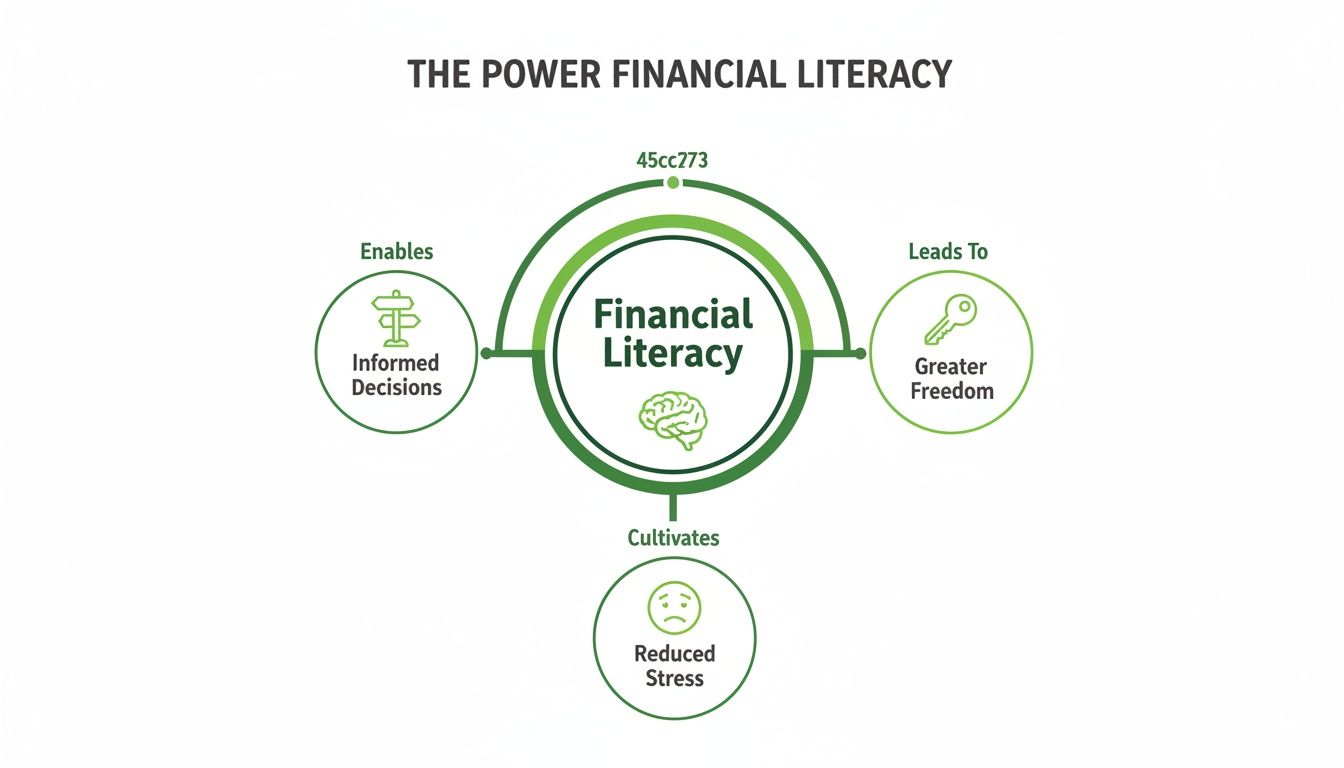
As you can see, knowledge isn’t just power—it’s peace of mind. Let’s dive into what each of these pillars really means.
1. Budgeting: Knowing Where Your Money Goes
This is the bedrock of everything else. Budgeting is simply about understanding your cash flow—what’s coming in and what’s going out. It’s the difference between guessing where your paycheck went and knowing exactly where you told it to go.
Trying to hit any financial goal without a budget is like trying to navigate a new city without a map. A simple plan gives you control, allowing you to point your money toward what actually matters to you.
2. Saving & Investing: Building for Tomorrow
Once you know where your money is going, you can start making it work for you. This is where saving and investing come in. They sound similar, but they have very different jobs.
Saving is for your short-term goals. Think of it as stockpiling cash for a specific purpose, like an emergency fund or a down payment on a car. The money needs to be safe and easy to grab, usually in a high-yield savings account.
Investing, on the other hand, is the long game. This is how you build real wealth for retirement or other far-off goals. You’re buying assets like stocks or ETFs that have the potential to grow significantly over time. While saving protects your money, investing is what truly grows it.
3. Debt: Using It Without It Using You
Most of us will deal with debt at some point, but it’s crucial to understand that not all debt is bad. This pillar is all about learning to manage what you owe. “Good debt” is typically money you borrow to buy something that will grow in value or improve your life, like a mortgage or a student loan.
“Bad debt” is the expensive kind, like high-interest credit cards used for stuff that loses value the second you buy it. Being financially literate means using debt as a tool when needed, but always having a plan to aggressively pay down the high-interest debt that can trap you.
4. Credit: Your Financial Reputation
Your credit score is one of the most important numbers in your adult life. It’s essentially your financial report card. Lenders look at this three-digit score to decide if you’re a safe bet, which directly affects whether you get approved for a loan and how much you’ll pay in interest.
A great score can save you thousands of dollars on a mortgage or car loan. A bad one can stop you in your tracks. Knowing how to build a strong credit history by paying bills on time and keeping balances low is one of the most valuable money management skills you can develop.
5. Insurance: Protecting Against the Unexpected
The final pillar is your financial safety net. You can have the perfect budget and a growing investment portfolio, but one bad accident or sudden illness could wipe it all out in an instant. This is what insurance is for.
From health and auto to renter’s and life insurance, the right coverage protects you from life’s curveballs. You pay a small, predictable amount now to avoid a catastrophic, unpredictable cost later. It’s the final piece of the puzzle that safeguards everything you’ve worked so hard to build.
What Happens When We Don’t Know About Money?
Knowing the definition of financial literacy is one thing, but seeing what happens without it is something else entirely. When large groups of people lack basic money skills, it’s not just a personal problem—it creates a ripple effect of economic instability, widens the gap between the rich and poor, and leaves entire communities on shaky ground.
The gulf between those with financial savvy and those without creates two completely different realities. It’s the difference between building a secure future and living one emergency away from disaster.
It’s a Global Problem, but a Deeply Personal One
Low financial literacy isn’t just an abstract economic issue; it has real, tangible consequences for individuals and families. It often translates directly into higher debt, a greater chance of financial hardship, and completely missed opportunities to build any kind of wealth. People who aren’t confident with financial concepts are far more likely to turn to high-cost borrowing like payday loans, simply because they don’t know better options exist.
And this isn’t a small-scale issue. A massive 2014 S&P Global FinLit Survey painted a pretty bleak picture: only about 1 in 3 adults globally (a mere 33%) actually understand fundamental concepts like inflation, risk diversification, and compound interest.
This landmark study, which included over 150,000 people in more than 140 countries, showed a huge divide. While places like Denmark and Norway led the way with 71% of adults considered financially literate, countries like Afghanistan and Albania were down at just 14-15%. This gap creates an uneven playing field, putting people in less knowledgeable regions at a serious disadvantage. You can dig deeper into the findings from this global financial literacy study on EZO.app.
This lack of knowledge very often leads to a crippling cycle of debt. Without understanding how to manage credit cards or loans, many people get trapped by sky-high interest payments that eat away at their income, making it impossible to save or get ahead.
The Staggering Cost of Being Kept in the Dark
The impact gets even more stark when you look at how people behave with their money. Those with very low financial understanding are often twice as likely to feel crushed by their debts and three times more likely to be financially fragile. This means a single, unexpected event—a surprise car repair or a medical bill—could spiral into a full-blown crisis.
A lack of financial literacy isn’t just about spreadsheets and budgets; it’s about stability. It determines whether a small emergency is a minor inconvenience or a catastrophe that takes years to recover from.
Think about these all-too-common situations:
- Vulnerability to Scams: People who don’t understand financial products are easy targets for predatory lenders and sophisticated scams, costing them everything.
- Poor Retirement Planning: Without grasping how compound interest works, many put off saving for retirement until it’s too late, drastically shrinking what they’ll have to live on later.
- Missed Wealth-Building Opportunities: A fear of investing—or just not knowing where to start—means many people leave their cash in savings accounts where it slowly loses value to inflation.
This table really highlights the different paths people take depending on their financial knowledge. It shows just how much these skills shape your day-to-day reality.
Financial Outcomes High vs Low Literacy
The following table compares the typical financial behaviors and outcomes for individuals with varying levels of financial literacy.
| Financial Area | High Financial Literacy | Low Financial Literacy |
|---|---|---|
| Emergency Savings | Likely has an established emergency fund covering 3-6 months of expenses. | Often has little to no savings, making them vulnerable to financial shocks. |
| Debt Management | Uses debt strategically (e.g., mortgage) and actively minimizes high-interest debt. | Frequently carries high-interest credit card balances and may use payday loans. |
| Retirement Planning | Starts investing for retirement early to take full advantage of compound growth. | Delays saving for retirement or is unsure how to begin, missing out on years of growth. |
| Credit Score | Maintains a good to excellent credit score, securing lower interest rates on loans. | Often has a poor credit score, leading to higher borrowing costs or loan denials. |
| Financial Decisions | Makes informed choices based on research and understanding of financial products. | More likely to make decisions based on emotion, advertising, or peer pressure. |
Ultimately, taking the time to improve your own financial skills is one of the most powerful things you can do. It’s not just about getting rich; it’s about giving yourself the tools to navigate a complicated world, protect yourself from harm, and build a more resilient future for you and your family.
How to Assess Your Current Financial Skills
Alright, you’ve got the lay of the land—you know what the core components of financial health are. Now it’s time to turn the spotlight on your own finances with a quick, honest check-in.
Think of this less like a test and more like finding the “You Are Here” sticker on a map. Before you can chart a course to where you want to go, you have to know your exact starting point. Pinpointing where you are right now is the most powerful first step you can take. It turns the vague idea of “getting better with money” into a concrete plan, showing you exactly where to focus your energy so it all feels less overwhelming.
A Quick Financial Self-Check
Grab a notebook or open a new note on your phone. Go through these questions and give yourself a straightforward ‘Yes,’ ‘Somewhat,’ or ‘No.’ Don’t overthink it—the goal here is honesty, not perfection.
Budgeting and Earning
- Do I know my exact monthly take-home pay?
- Do I have a written budget that I actually stick to most months?
- Could I confidently say where my money went last month?
Saving and Investing
- Do I have an emergency fund with at least one month’s worth of living expenses?
- Am I consistently saving a piece of every paycheck?
- Could I explain the basic idea of compound interest to a friend?
- Do I have any money invested for long-term goals like retirement?
Debt and Credit
- Do I know my current credit score?
- Do I pay all my bills on time, every single month?
- Is my total credit card debt less than 30% of my total credit limit?
- Do I have a clear plan to tackle any high-interest debt I’m carrying?
Risk and Insurance
- Do I have health insurance?
- If I have dependents, do I have life insurance coverage?
- Do I have a basic understanding of what my car or renter’s insurance policy actually covers?
Once you’ve gone through the list, take a look at your answers. See those ‘No’ and ‘Somewhat’ responses? They aren’t failures. They are your personalized to-do list, pointing you exactly where to begin.
What Your Answers Mean
If you’re looking at more ‘No’s than ‘Yes’s, you’re in good company. Getting a handle on money is a challenge for millions of people.
In fact, the national average for U.S. financial literacy has been stuck at just 49% since 2017. There’s also a clear generational gap, with Gen Z scoring the lowest at 38%, while Baby Boomers come in higher at 55%.
These figures, detailed in personal finance knowledge findings from the TIAA Institute, show that many young adults struggle to answer even basic financial questions, which often leads to more debt and less stability. Understanding risk is a major weak spot across the board, with an average score of just 36%.
But this self-check isn’t about comparing yourself to anyone else. It’s about establishing your own personal baseline. If budgeting is the area with the most ‘No’s, that’s where you start. If credit scores feel like a total mystery, you now know where to focus your attention. This kind of clarity is what sparks real, lasting progress.
Your Action Plan for Building Financial Confidence
Taking that personal financial check-up gives you a powerful advantage: clarity. Instead of feeling overwhelmed by a vague desire to “get better with money,” you now have a clear starting point. This section is your roadmap, breaking down the journey into small, manageable steps designed to build momentum and deliver real results.
This isn’t about a complete financial overhaul overnight. It’s about creating a series of small, positive habits that stack on top of each other, gradually building a strong foundation for your future. Let’s start with the most critical first step.
Step 1 Master Your Cash Flow with a Simple Budget
Before you can tackle debt or start investing, you absolutely must know where your money is going. This is non-negotiable. Think of a budget as nothing more than a plan that gives every pound or dollar a specific job to do.
Getting started is easier than you might think. Forget complicated spreadsheets—today’s tech has you covered. A user-friendly budgeting app can connect to your bank accounts and automatically categorize your spending, giving you a clear snapshot of your financial habits without hours of manual entry.
Your only goal for the first month is to observe. Don’t even try to change your spending; just watch. You might be surprised by what you find.
Step 2 Automate Your Savings with ‘Pay Yourself First’
Once you have a handle on your spending, the next move is to make saving a priority. The most effective way to do this is with the “pay yourself first” method. It’s a simple shift in mindset: treat your savings goal like any other important bill.
Before you pay for rent, groceries, or subscriptions, move a set amount of money from your current account into a separate savings account. The trick is to set up an automatic transfer for the day after you get paid. Even if you start with just £20 or £50 a month, you’re building a crucial habit.
This single action puts your future first and removes the temptation to spend that money elsewhere. It’s the core principle behind building wealth over time.
One of the first goals for your automated savings should be a starter emergency fund. Having even a small buffer of cash set aside can be the difference between a minor inconvenience and a major financial crisis.
For a detailed walkthrough, check out our complete guide on how to build an emergency fund and give yourself that essential safety net.
Step 3 Tackle One High-Interest Debt at a Time
High-interest debt, like credit card balances or personal loans, can feel like trying to run up a down escalator. The interest payments actively work against your progress, eating away at your income and making it incredibly difficult to get ahead. The key is to focus your energy.
A popular and effective strategy for this is the debt snowball method. Here’s how it works:
- List Your Debts: Write down all your debts from the smallest balance to the largest. For now, ignore the interest rates.
- Make Minimum Payments: Continue to make the minimum required payment on all your debts so you don’t fall behind.
- Attack the Smallest Debt: Throw every spare penny you can find at the debt with the smallest balance.
- Roll It Over: Once that smallest debt is paid off, you take the entire amount you were paying on it (the minimum plus all the extra) and add it to the minimum payment of the next smallest debt.
This method is so powerful because it gives you quick wins. Paying off that first debt provides a huge psychological boost, creating the momentum you need to keep going until you’re completely debt-free.
Step 4 Open a Beginner-Friendly Investment Account
Once your high-interest debt is under control and your emergency fund is growing, it’s time to start making your money work for you. Investing used to seem complex and exclusive, but today, it’s more accessible than ever.
You don’t need a lot of money to begin. Many modern platforms allow you to start investing with as little as £1. These platforms are designed for beginners, offering simple ways to invest in diversified, low-cost options like Exchange-Traded Funds (ETFs).
Think of an ETF as a basket containing hundreds or thousands of different company stocks, which automatically spreads your risk. By consistently investing small amounts over time, you can harness the power of compound growth, where your investment earnings start generating their own earnings. This is the quiet engine that builds long-term wealth.
Essential Tools for Your Financial Literacy Journey
Knowing the steps to improve your financial literacy is great, but having the right tools makes the entire process so much easier. You really don’t need expensive software or a personal accountant to get started.
In fact, some of the best resources out there are free or very low-cost, and they’re designed to turn complicated financial tasks into simple, everyday habits. This list is all about practical, accessible tools that will actually help you build that financial freedom you’re aiming for.
User-Friendly Budgeting Apps
The cornerstone of getting your money under control is knowing exactly where it’s going. Thankfully, modern tech has made the old manual spreadsheet a thing of the past.
- Automatic Tracking: Most apps can securely link to your bank accounts and automatically categorize every transaction. This gives you a clear, up-to-the-minute snapshot of your spending without any of the tedious data entry.
- Goal Setting: Want to build an emergency fund or save for a vacation? Many apps let you set these specific savings goals and show you visually how close you are to hitting them.
- Spending Alerts: You can get a heads-up when you’re about to overspend in a category, which is a massive help for staying on track throughout the month.
These digital tools are perfect for turning abstract goals into concrete actions. To find the right fit for you, check out our guide to the best free budgeting apps.
Essential Websites and Calculators
Beyond apps, the internet is filled with a ton of unbiased information that can deepen your understanding. Trusted educational websites can break down everything from credit scores to investment options in plain English.
Financial calculators are another game-changer. These simple online tools can take the mystery out of complex ideas and show you the tangible impact of your financial choices.
Ever played with a compound interest calculator? It’s amazing to see how even small, regular investments can snowball into a huge amount over time. A mortgage overpayment calculator is another powerful one—it can show you how much you could save in interest just by paying a little extra each month.
These resources empower you to make smarter decisions by turning abstract numbers into a clear vision for your future.
A Few Common Questions We Hear All the Time
As you start putting these ideas into practice, you’re bound to have some questions. It’s completely normal. This last section is all about tackling the common roadblocks that trip people up, giving you straight answers so you can keep moving forward with confidence.
How Long Does This Actually Take?
Let’s get one thing straight: there’s no graduation day for financial literacy. It’s more like a fitness journey than a final exam. The world of money is always shifting, so staying informed is a lifelong habit.
But here’s the good news: you can feel a real difference much sooner than you think. It’s all about consistency, not cramming. Just focus on one small habit, like tracking your spending for 30 days straight. That single action can lay a foundation that changes everything in just a few months. Your confidence builds with each little win.
Do I Need a Ton of Money to Start Investing?
This is probably the biggest myth out there, and it stops so many people from ever getting started. The old idea that investing is a rich person’s game is completely dead. Thanks to new tools and technology, it’s now open to everyone, no matter what your paycheque looks like.
Things like micro-investing apps and low-cost Exchange-Traded Funds (ETFs) have completely changed the landscape. You can literally start with just a few quid or a handful of dollars. What matters isn’t the amount you start with, but how early you start. That’s how you unleash the magic of compound interest, letting time do the heavy lifting to turn small, regular savings into a serious nest egg.
The most important thing is to simply begin. Your future self will thank you for starting small today rather than waiting until you feel “rich enough” tomorrow.
I’m Totally Overwhelmed. Where Do I Even Begin?
When it feels like everything is urgent, the natural reaction is to freeze up and do nothing. If you’re looking at your finances and just feel lost, focus on one thing and one thing only: make a simple budget.
Seriously, that’s it. This is the bedrock of financial control. You can’t make a plan if you don’t know where you’re starting from. Just figuring out where your money goes each month gives you the clarity to tackle everything else, from paying off debt to saving for the future. Don’t aim for perfection; just aim to start.
At Collapsed Wallet, our whole mission is to give you clear, no-nonsense guidance to help you master your money. For more real-world tips and deep dives, check out all our resources over at https://collapsedwallet.com.
