

Table of Contents
- 1. Track Every Dollar with the 50/30/20 Budget Rule
- 2. Use the Zero-Based Budget Method to Assign Every Dollar
- 3. Automate Your Savings to Remove Decision Fatigue
- 4. Conduct a Monthly Money Audit to Identify Spending Leaks
- 5. Build an Emergency Fund Before Aggressive Debt Payoff
- 6. Use Technology to Control Discretionary Spending
- 7. Negotiate Bills and Services to Reduce Fixed Expenses
- 8. Track Spending with the 30-Day Spending Pause Method
- Beginner Budgeting: 8 Strategies Compared
- Taking the Next Step on Your Financial Journey
This blog post may contain affiliate links. As an Amazon Associate I earn from qualifying purchases.

Welcome to your roadmap for financial control. For many, the word ‘budget’ brings to mind restriction and complexity, but it’s actually the most powerful tool for achieving financial freedom and escaping money-related stress. This guide breaks down the most effective budgeting tips for beginners into simple, actionable steps. Whether you’re a student, a young professional, or managing a family’s finances, these strategies will help you understand where your money goes, make intentional decisions, and build a secure future. Forget complicated spreadsheets and overwhelming jargon; we’re focusing on practical methods you can implement today to start your journey towards financial well-being and confidence.
The aim of our blog is to provide valuable insights and practical tips to help readers manage their money more effectively. However, the information shared here is for general guidance and educational purposes only. It should not be regarded as professional financial advice. Any actions taken based on our content are entirely the responsibility of the reader, and we accept no liability for the outcomes of those actions. If you require financial advice tailored to your personal circumstances, we strongly recommend seeking assistance from a qualified financial adviser.
1. Track Every Dollar with the 50/30/20 Budget Rule
When you’re first learning how to manage your finances, the sheer number of budgeting tips for beginners can feel overwhelming. The 50/30/20 rule, popularized by Senator Elizabeth Warren and her daughter Amelia Warren Tyagi, cuts through the noise with a simple, yet powerful framework. It provides a clear roadmap for your after-tax income, making it one of the most effective budgeting strategies for anyone new to tracking their money.
The aim of our blog is to provide valuable insights and practical tips to help readers manage their money more effectively. However, the information shared here is for general guidance and educational purposes only. It should not be regarded as professional financial advice. Any actions taken based on our content are entirely the responsibility of the reader, and we accept no liability for the outcomes of those actions. If you require financial advice tailored to your personal circumstances, we strongly recommend seeking assistance from a qualified financial adviser.
How the 50/30/20 Rule Works
This method divides your take-home pay into three distinct categories, giving every dollar a purpose without complex calculations.
- 50% for Needs: This is the largest portion, allocated to your absolute essentials. These are expenses you must pay to live, such as housing (rent or mortgage), utilities, groceries, transportation, and insurance.
- 30% for Wants: This category covers lifestyle choices and discretionary spending. It includes things like dining out, entertainment, hobbies, streaming subscriptions, and vacations.
- 20% for Savings and Debt Repayment: The final portion is dedicated to your financial goals. This includes building an emergency fund, contributing to retirement accounts, saving for a down payment, or paying off high-interest debt like credit cards and personal loans.
Putting the Rule into Practice
To get started, first calculate your monthly after-tax income. If you earn $3,000 per month after taxes, your budget would look like this:
- Needs (50%): $1,500
- Wants (30%): $900
- Savings & Debt (20%): $600
The key to success is understanding where your money currently goes. Before applying the rule, it is crucial to monitor your spending for a month. A detailed breakdown helps you identify where adjustments are needed and provides a baseline for your new budget. For a step-by-step guide on this, you can learn more about how to track your expenses on collapsedwallet.com. Remember, these percentages are guidelines, not rigid laws. If your housing costs are high, you might adjust to a 55/25/20 split. The goal is to create a sustainable plan that aligns with your financial reality and long-term goals.
2. Use the Zero-Based Budget Method to Assign Every Dollar
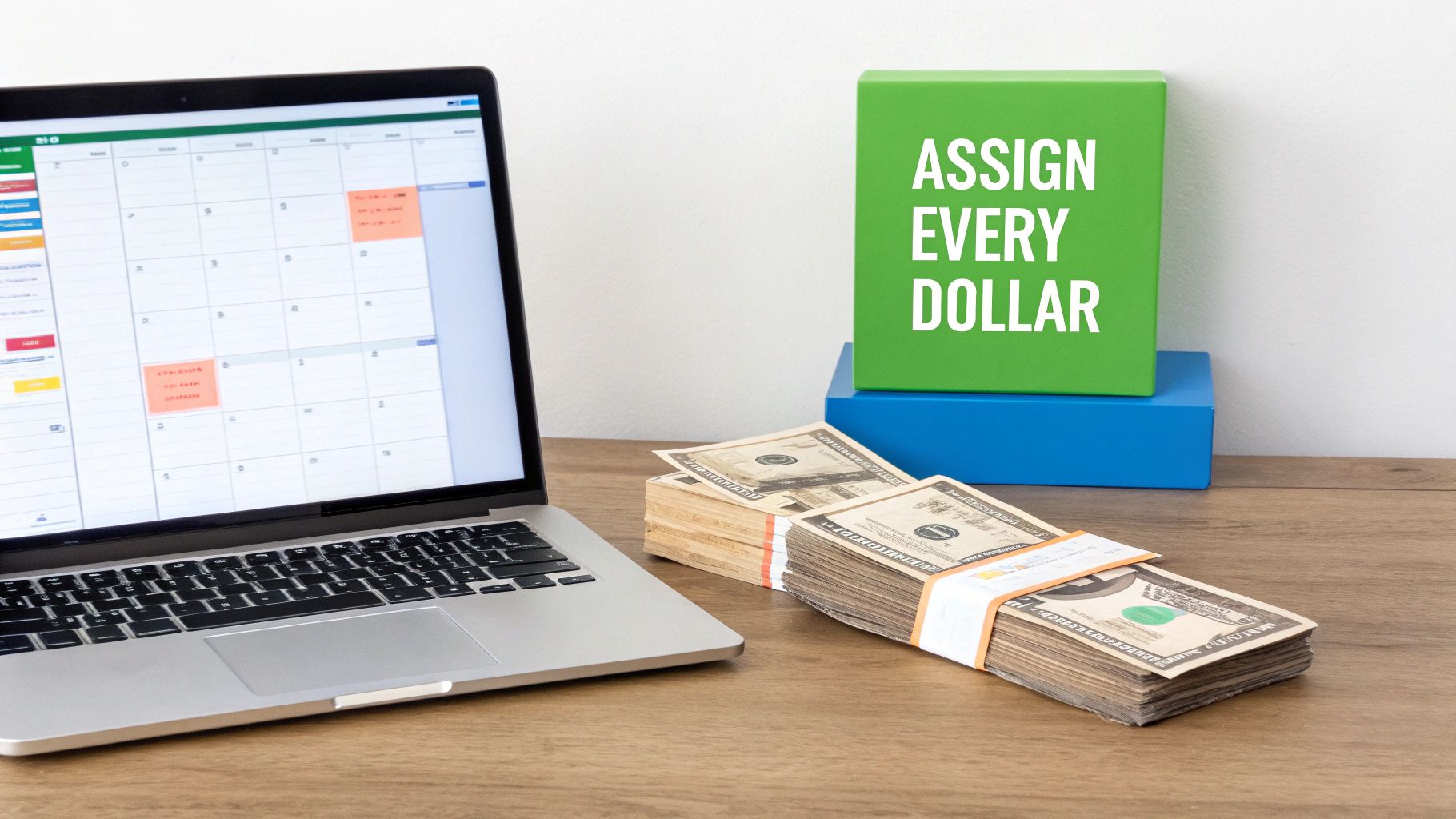
While some budgeting methods offer guidelines, zero-based budgeting demands a more hands-on approach. Popularized by financial experts like Dave Ramsey and platforms such as YNAB (You Need A Budget), this method forces you to be intentional with your money. Instead of just tracking past spending, you create a forward-looking plan that assigns a specific job to every single dollar you earn, making it one of the most powerful budgeting tips for beginners struggling with overspending.
The aim of our blog is to provide valuable insights and practical tips to help readers manage their money more effectively. However, the information shared here is for general guidance and educational purposes only. It should not be regarded as professional financial advice. Any actions taken based on our content are entirely the responsibility of the reader, and we accept no liability for the outcomes of those actions. If you require financial advice tailored to your personal circumstances, we strongly recommend seeking assistance from a qualified financial adviser.
How Zero-Based Budgeting Works
The core principle of this method is simple: your income minus your expenses must equal zero. Before the month begins, you allocate all your anticipated income to categories like bills, savings, debt repayment, and discretionary spending. This ensures no money is left unaccounted for, which helps eliminate impulse buys and mindless spending.
- Income: Start with your total monthly take-home pay.
- Expenses: List all planned outflows, including fixed bills, variable spending, savings contributions, and debt payments.
- The Goal: Adjust your expense categories until the total equals your income, bringing the final balance to zero.
Putting the Rule into Practice
To implement a zero-based budget, begin by listing all your income sources and every single expense, both fixed and variable. It is crucial to account for infrequent costs, like annual insurance premiums or car maintenance, by saving a small amount each month.
For example, a young professional earning $2,800 per month after taxes could create this budget:
- Rent & Utilities: $1,200
- Food & Groceries: $400
- Transportation: $200
- Student Loan Payment: $250
- Retirement Savings: $280
- Emergency Fund: $150
- Entertainment & Hobbies: $200
- Miscellaneous Buffer: $120
In this scenario, the $2,800 income is fully allocated, leaving no money unassigned. Tools like spreadsheets or specialized apps like You Need A Budget are invaluable for this process. The key is to plan before the month starts and review your progress weekly to stay on track and make adjustments as needed. This proactive approach gives you complete control over your financial destiny.
3. Automate Your Savings to Remove Decision Fatigue
One of the most powerful budgeting tips for beginners is to make saving effortless. Automating your savings treats it like any other essential bill, moving money from your checking to your savings account without you lifting a finger. This “pay yourself first” strategy removes willpower and decision fatigue from the equation, ensuring you consistently build wealth over time. Instead of saving what is left over, you prioritize your financial future first.
The aim of our blog is to provide valuable insights and practical tips to help readers manage their money more effectively. However, the information shared here is for general guidance and educational purposes only. It should not be regarded as professional financial advice. Any actions taken based on our content are entirely the responsibility of the reader, and we accept no liability for the outcomes of those actions. If you require financial advice tailored to your personal circumstances, we strongly recommend seeking assistance from a qualified financial adviser.
How Savings Automation Works
This method leverages behavioral psychology to work with your natural tendencies, not against them. By setting up recurring, automatic transfers immediately after you get paid, you make saving a default action. You quickly adapt to living on the remaining amount, effectively tricking your brain into saving without feeling the pinch.
- Set It and Forget It: You schedule a transfer once through your bank’s online portal or a third-party app. This transfer repeats automatically, usually on payday.
- Remove Temptation: The money moves out of your primary spending account before you have a chance to use it for discretionary purchases.
- Build Momentum: Watching your savings grow consistently, even with small amounts, provides positive reinforcement and motivation to continue your financial journey.
Putting the Rule into Practice
Getting started is simple and can be done in minutes. Log into your online banking and look for an option like “automatic transfers” or “recurring payments.” From there, you can schedule the transfers.
- Young Professional: Set up a recurring transfer of $250 to move from your checking to a high-yield savings account the day after each monthly payday. This simple action accumulates $3,000 annually without any ongoing effort.
- Family with Variable Income: Automate a transfer for 15% of every direct deposit. Many banks allow percentage-based transfers, which helps you save consistently even when your income fluctuates.
- Student with Part-Time Job: Automate a $50 transfer every Friday after getting paid. Over a four-month semester, this builds an $800 emergency fund.
To make automation even more effective, start with a small, manageable amount you will not miss. You can gradually increase it as your income grows or your expenses decrease. Consider opening a separate savings account, ideally at a different bank, to create a psychological barrier against impulse withdrawals. Labeling these accounts with specific goals like “Emergency Fund” or “Investment Portfolio” adds another layer of motivation.
4. Conduct a Monthly Money Audit to Identify Spending Leaks
Setting up a budget is an excellent first step, but the real power comes from understanding where your money is actually going. A monthly money audit is a deep dive into your transactions from the previous month to uncover wasteful spending patterns, identify forgotten subscriptions, and close the gap between your planned budget and your actual financial behavior. This detective work is one of the most vital budgeting tips for beginners, as most people discover $50-$200 in monthly waste during their first audit.
The aim of our blog is to provide valuable insights and practical tips to help readers manage their money more effectively. However, the information shared here is for general guidance and educational purposes only. It should not be regarded as professional financial advice. Any actions taken based on our content are entirely the responsibility of the reader, and we accept no liability for the outcomes of those actions. If you require financial advice tailored to your personal circumstances, we strongly recommend seeking assistance from a qualified financial adviser.
How a Money Audit Works
Think of a money audit as a financial check-up. You gather all your financial data from the past 30 days and analyze it to diagnose “spending leaks”. These are small, often unnoticed expenses that drain your resources over time.
- Discover “Invisible” Spending: An audit brings hidden costs to light. A family might realize their “occasional” coffee runs actually total $120 per month, while a professional could find that food delivery fees and tips add over $200 to their monthly costs.
- Uncover Forgotten Subscriptions: Many beginners find they are still paying for services they no longer use. For example, you might discover an $18/month streaming subscription you forgot about, which adds up to $216 annually.
- Align Spending with Goals: The process reveals whether your spending habits match your financial priorities. If you want to save aggressively but see a large portion of your income going to impulse buys, the audit provides the data you need to make a change.
Putting the Audit into Practice
To conduct your first audit, schedule an hour at the beginning of each month. Consistency is key to building this powerful financial habit.
- Gather Your Statements: Download transaction histories from all your accounts, including checking, credit cards, PayPal, and Venmo, for a complete picture.
- Categorize Every Transaction: Use a simple spreadsheet or a budgeting app to assign each expense to a category (e.g., groceries, transport, entertainment). This helps you see where the bulk of your money is going.
- Flag and Verify: Pay special attention to recurring charges. Ask yourself if you still use and value each subscription. If not, cancel it immediately.
- Identify Your Top Categories: Find your top 3-5 spending categories and brainstorm ways to reduce them without drastically impacting your quality of life.
By regularly auditing your finances, you move from passively watching your money disappear to actively directing it toward your goals for financial freedom.
5. Build an Emergency Fund Before Aggressive Debt Payoff
When you’re eager to get out of debt, it’s tempting to throw every spare dollar at your loans. However, one of the most crucial budgeting tips for beginners is to prioritize building a financial safety net first. An emergency fund, a concept popularized by experts like Dave Ramsey and Suze Orman, is a dedicated savings account that acts as a buffer against life’s unexpected expenses, preventing a minor crisis from becoming a major financial setback.
The aim of our blog is to provide valuable insights and practical tips to help readers manage their money more effectively. However, the information shared here is for general guidance and educational purposes only. It should not be regarded as professional financial advice. Any actions taken based on our content are entirely the responsibility of the reader, and we accept no liability for the outcomes of those actions. If you require financial advice tailored to your personal circumstances, we strongly recommend seeking assistance from a qualified financial adviser.
How an Emergency Fund Works
This fund is designed to cover 3 to 6 months of your essential living expenses, such as rent, utilities, and groceries. Its purpose is to protect you from taking on new debt when faced with an emergency like a sudden job loss, unexpected medical bill, or urgent car repair.
- Creates Financial Stability: By having cash reserves, you can handle emergencies without derailing your budget or pausing your debt repayment goals long-term.
- Reduces Financial Stress: Knowing you have a cushion provides peace of mind and allows you to make clear, intentional financial decisions rather than panicked ones.
- Breaks the Debt Cycle: Without an emergency fund, unexpected costs often go on a credit card, deepening the debt you’re trying to escape. This fund breaks that cycle.
Putting the Rule into Practice
Start by calculating your essential monthly expenses. If your non-negotiable costs are $2,000 per month, your ultimate goal is an emergency fund of $6,000 to $12,000.
- Start Small: Begin with a more achievable “starter” emergency fund of $1,000. For a family, this initial amount provides an immediate buffer while you continue making minimum payments on your debts.
- Grow Steadily: Once you hit your starter goal, shift your focus to building the fund to cover 3-6 months of expenses. During this phase, continue making only the minimum payments on non-mortgage debts.
- Automate and Separate: Keep your emergency fund in a separate, high-yield savings account to earn interest and reduce the temptation to spend it. Set up automatic transfers to grow it consistently.
The key is to define what constitutes a true emergency. This fund is not for planned purchases or wants. Once it’s fully funded, you can then redirect that money to aggressively pay down debt. For a complete walkthrough, you can find a guide detailing how to build an emergency fund on collapsedwallet.com. Remember to replenish the fund immediately any time you use it for a genuine emergency, ensuring your financial safety net remains intact.
6. Use Technology to Control Discretionary Spending
For beginners struggling with overspending in specific areas, modern technology offers a highly effective solution. Budgeting apps, digital envelopes, and automated tracking tools provide a clear, real-time limit on your discretionary spending. By leveraging technology, you create a powerful digital barrier that forces mindful consumption, making this one of the best budgeting tips for beginners wanting hands-on control in the digital age.
The aim of our blog is to provide valuable insights and practical tips to help readers manage their money more effectively. However, the information shared here is for general guidance and educational purposes only. It should not be regarded as professional financial advice. Any actions taken based on our content are entirely the responsibility of the reader, and we accept no liability for the outcomes of those actions. If you require financial advice tailored to your personal circumstances, we strongly recommend seeking assistance from a qualified financial adviser.
How Digital Budgeting Works
The concept is simple: you use technology to allocate a specific amount of money for each variable spending category. These digital “envelopes” or categories track your spending automatically by linking to your bank accounts. Once a category’s budget is empty, the app alerts you, preventing overspending.
- Real-Time Tracking: Apps like YNAB, Mint, or Goodbudget automatically categorize transactions from your linked accounts, giving you an up-to-the-minute view of your budget.
- Digital Envelopes: Many apps digitize the classic envelope method. You create virtual “envelopes” for categories like “Groceries” or “Entertainment.” When you spend, you assign the transaction to an envelope, which depletes its balance.
- The Golden Rule: The rule is the same as its physical counterpart. When the money in a digital category is gone, it’s gone. This simple limitation eliminates the temptation to dip into funds meant for other goals or essential bills.
Putting the Rule into Practice
Start by identifying 2-3 problem areas in your budget where you consistently overspend. Download a reputable budgeting app and create specific budget categories for these areas. For example, after your fixed bills are accounted for, you might allocate your discretionary income in the app like this:
- Groceries Budget: $400
- Dining Out Budget: $150
- Entertainment Budget: $100
When you use your card at a restaurant, the app will log the expense and show you how much is left in your “Dining Out” budget. This method provides immediate, digital feedback on your spending habits and forces you to make conscious trade-offs, which is crucial for building a sustainable budget and achieving long-term financial freedom.
7. Negotiate Bills and Services to Reduce Fixed Expenses
Many beginners assume their fixed monthly bills are set in stone, but this is rarely the case. Proactively negotiating with service providers like internet, phone, and insurance companies is one of the most powerful budgeting tips for beginners. This simple action can free up significant cash in your budget without forcing you to change your lifestyle or sacrifice things you enjoy. A 15-minute phone call can often yield an annualized return of hundreds of dollars, making it an incredibly high-impact financial habit.
The aim of our blog is to provide valuable insights and practical tips to help readers manage their money more effectively. However, the information shared here is for general guidance and educational purposes only. It should not be regarded as professional financial advice. Any actions taken based on our content are entirely the responsibility of the reader, and we accept no liability for the outcomes of those actions. If you require financial advice tailored to your personal circumstances, we strongly recommend seeking assistance from a qualified financial adviser.
How Bill Negotiation Works
The core principle is simple: companies want to keep you as a customer. The cost of acquiring a new customer is far higher than the cost of giving a loyal one a discount. By calling and expressing your desire for a better rate, often armed with competitor offers, you leverage this fact to your advantage. Most providers have retention departments specifically authorized to offer discounts and special promotions to prevent customers from leaving.
- Internet & Cable: Call your provider, mention a competitor’s introductory offer, and ask if they can match it to keep your business. This simple script can easily save you $20-40 per month.
- Mobile Phone: Review your data usage. If you are consistently under your limit, ask to switch to a cheaper plan. You can also ask for loyalty discounts if you have been with the carrier for a long time.
- Insurance: Car and home insurance rates change frequently. Shopping around annually and asking your current provider to match lower quotes is a proven way to reduce your premiums.
Putting Negotiation into Practice
Success in negotiation comes from preparation and a polite, firm approach. Before you pick up the phone, take a few minutes to gather your information.
- Do Your Homework: Research competitor pricing online for a similar service. Having a specific offer to reference, like “$20 less per month from XYZ company,” is more effective than just asking for a discount.
- Be Polite but Persistent: The customer service representative is a person, not an obstacle. Be friendly and clearly state your goal. If they cannot help, politely ask to be transferred to the “customer retention” or “loyalty” department.
- Know Your Value: Remind them how long you have been a loyal customer and that you always pay your bills on time. These are valuable traits they do not want to lose.
- Set Annual Reminders: Make it a habit. Set a calendar reminder to review and renegotiate your major bills every 10-12 months, especially before a contract is set to auto-renew.
For a more comprehensive guide with specific scripts, you can learn more about how to save money on your monthly bills on collapsedwallet.com. By systematically lowering your fixed costs, you create immediate breathing room in your budget, allowing you to redirect that money toward your savings goals or debt repayment.
8. Track Spending with the 30-Day Spending Pause Method
Impulse spending is one of the biggest obstacles for anyone learning to budget, often derailing even the most well-intentioned financial plans. The 30-Day Spending Pause is a powerful behavioral tool that directly tackles this challenge. It introduces a mandatory waiting period for non-essential purchases, giving you the time and space to separate emotional wants from genuine needs. This method is one of the most effective budgeting tips for beginners because it builds mindful spending habits without complex tracking.
The aim of our blog is to provide valuable insights and practical tips to help readers manage their money more effectively. However, the information shared here is for general guidance and educational purposes only. It should not be regarded as professional financial advice. Any actions taken based on our content are entirely the responsibility of the reader, and we accept no liability for the outcomes of those actions. If you require financial advice tailored to your personal circumstances, we strongly recommend seeking assistance from a qualified financial adviser.
How the 30-Day Spending Pause Works
This strategy is less about numbers and more about changing your relationship with spending. It forces a deliberate delay between the desire to buy something and the actual purchase, allowing the initial emotional high to fade.
- Identify a Non-Essential Want: This could be a new video game, a piece of clothing, or a gadget you see online. Anything that isn’t a true necessity like groceries or rent qualifies.
- Log the Item and Date: Instead of buying it, write down what you want, its price, and the date on a dedicated “pause list.”
- Wait for 30 Days: Set a calendar reminder and completely remove the item from your online shopping cart. The goal is to avoid thinking about it for the full 30-day period.
- Re-evaluate After the Pause: When the reminder goes off, ask yourself if you still genuinely want or need the item. You’ll often find the desire has completely vanished, proving it was just an impulse.
Putting the Rule into Practice
Implementing this method reveals surprising insights into your spending triggers. For example, a student might want a new $60 video game, but after the 30-day pause, they realize the excitement was temporary and they’d rather put that $60 toward their savings goal.
To make this strategy work for you, consider these practical steps:
- Create a “Pause List”: Use a notes app on your phone, a spreadsheet, or a physical notebook to track all your desired non-essential purchases.
- Remove Temptation: Immediately close browser tabs and clear online shopping carts after logging an item. The less you see it, the less you’ll want it.
- Track Your Success: After a few months, review your list to see how many items you decided against. Seeing that you saved hundreds of dollars by simply waiting is a powerful motivator.
This method works because it builds a crucial skill: intentional decision-making. By delaying gratification, you gain control over your financial choices and ensure your money is spent only on things that add real, lasting value to your life.
Beginner Budgeting: 8 Strategies Compared
| Method | 🔄 Implementation complexity | ⚡ Resource requirements | 📊 Expected outcomes | 💡 Ideal use cases | ⭐ Key advantages |
|---|---|---|---|---|---|
| Track Every Dollar with the 50/30/20 Budget Rule | 🔄 Low — simple percentage splits | ⚡ Minimal — basic calculator or app | 📊 Balanced spending/savings; clearer priorities | 💡 Beginners wanting an easy starting framework | ⭐ Easy to implement, flexible, promotes saving |
| Use the Zero-Based Budget Method to Assign Every Dollar | 🔄 High — detailed monthly planning | ⚡ Moderate — spreadsheets or YNAB, time monthly | 📊 Precise control of cash flow; reduced impulse spending | 💡 Those with variable income or tight goals (debt payoff) | ⭐ Complete allocation, forces prioritization |
| Automate Your Savings to Remove Decision Fatigue | 🔄 Low — one-time setup | ⚡ Low — bank/app transfers | 📊 Steady, compounding savings with minimal effort | 💡 People with weak willpower or inconsistent discipline | ⭐ Passive, reliable, reduces decision load |
| Conduct a Monthly Money Audit to Identify Spending Leaks | 🔄 Medium — monthly review process | ⚡ Low–Moderate — bank statements, apps, 30–60 min/month | 📊 Identifies waste and quick cuttable expenses | 💡 Anyone who suspects hidden or recurring leaks | ⭐ Data-driven insights; often immediate savings |
| Build an Emergency Fund Before Aggressive Debt Payoff | 🔄 Low–Medium — staged saving plan | ⚡ Moderate — dedicated account and discipline | 📊 Financial resilience; fewer emergency-driven debts | 💡 Risk-averse beginners or those with no buffer | ⭐ Reduces stress; prevents setbacks from surprises |
| Use Technology to Control Discretionary Spending | 🔄 Medium — routine allocation and monitoring | ⚡ Low — budgeting apps, bank account linking | 📊 Strong reduction in category overspending | 💡 Impulse spenders, tech-savvy users | ⭐ Real-time accountability; automates tracking |
| Negotiate Bills and Services to Reduce Fixed Expenses | 🔄 Low — targeted calls/emails | ⚡ Low — time, current bills, competitor quotes | 📊 Immediate and recurring bill reductions (high ROI) | 💡 Anyone with subscriptions or service contracts | ⭐ Quick savings with minimal lifestyle change |
| Track Spending with the 30-Day Spending Pause Method | 🔄 Low–Medium — behavioral commitment | ⚡ Minimal — wishlist or simple tracker | 📊 Fewer impulse purchases; clearer priorities | 💡 Online shoppers and impulse buyers | ⭐ No-cost, habit-changing, reveals true desires |
Taking the Next Step on Your Financial Journey
You’ve just navigated a comprehensive guide filled with actionable budgeting tips for beginners. From assigning every dollar a job with the zero-based budget to automating your savings and building a crucial emergency fund, you now possess a powerful set of tools to reshape your financial landscape. The journey to financial control isn’t about implementing every single strategy at once; it’s about finding the methods that align with your lifestyle and goals.
The aim of our blog is to provide valuable insights and practical tips to help readers manage their money more effectively. However, the information shared here is for general guidance and educational purposes only. It should not be regarded as professional financial advice. Any actions taken based on our content are entirely the responsibility of the reader, and we accept no liability for the outcomes of those actions. If you require financial advice tailored to your personal circumstances, we strongly recommend seeking assistance from a qualified financial adviser.
From Knowledge to Action: Your Immediate Next Steps
The most significant barrier to financial progress is often inertia. To overcome it, focus on taking one small, manageable step today. Don’t feel pressured to build the perfect budget overnight. Instead, choose the path of least resistance to build momentum.
- If you’re unsure where your money goes: Start with the Monthly Money Audit. Spend just one hour reviewing your last month’s bank and credit card statements. This single action will provide immediate clarity and highlight your biggest spending “leaks,” giving you a clear target for improvement.
- If you struggle to save consistently: Automate Your Savings right now. Log into your online banking and set up a recurring transfer of just $20 or $50 from your checking to your savings account. The amount is less important than the habit you are building.
- If you feel overwhelmed by debt: Your priority is to Build an Emergency Fund. Focus all your initial efforts on saving at least $1,000. This buffer will prevent future emergencies from derailing your debt payoff plan and adding to your financial stress.
The True Value of a Well-Managed Budget
Mastering these budgeting tips for beginners is about more than just numbers on a spreadsheet; it’s about reclaiming your power. A budget is a plan that aligns your spending with what you truly value, whether that’s achieving debt freedom, saving for a down payment, or simply reducing financial anxiety. It transforms money from a source of stress into a tool for building the life you desire.
Key Takeaway: Consistency will always be more powerful than perfection. A simple budget that you stick with is infinitely more effective than a complex one you abandon after a week.
Every dollar you consciously direct, every bill you negotiate, and every impulsive purchase you avoid is a victory. These small wins compound over time, leading to significant financial strength and resilience. This isn’t a one-time fix but a lifelong skill that will serve you through every stage of life, helping you navigate economic uncertainty and seize opportunities with confidence. You are now equipped with the knowledge to stop letting your money manage you, and start managing your money. The path to financial freedom begins with the first step you take today.
Ready to take control of your finances with powerful, easy-to-use tools? Collapsed Wallet offers a suite of resources designed to simplify the principles we’ve discussed, helping you track spending, automate savings, and visualize your progress effortlessly. Visit Collapsed Wallet to see how our platform can accelerate your journey from a budgeting beginner to a financial expert.

2 thoughts on “8 Essential Budgeting Tips for Beginners to Achieve Financial Freedom in 2025”