

Table of Contents
This blog post may contain affiliate links. As an Amazon Associate I earn from qualifying purchases.
Thinking about how much you need to save for retirement can be pretty intimidating. If you’re worried you’re behind, you’re not alone—it’s a feeling a lot of us share. But here’s the good news: building a secure future is far more doable than you might think. This guide is all about cutting through the noise and giving you a straightforward, consistent plan to follow. We’re going to ditch the complicated jargon and turn that anxiety into an actionable roadmap for your financial freedom.
The aim of our blog is to provide valuable insights and practical tips to help readers manage their money more effectively. However, the information shared here is for general guidance and educational purposes only. It should not be regarded as professional financial advice. Any actions taken based on our content are entirely the responsibility of the reader, and we accept no liability for the outcomes of those actions. If you require financial advice tailored to your personal circumstances, we strongly recommend seeking assistance from a qualified financial adviser.
Facing the Retirement Reality
The thought of retirement usually brings up two very different emotions: excitement and a healthy dose of fear. The idea of no more alarm clocks is fantastic, but the financial side of it? That can feel pretty heavy.
The numbers don’t lie. The average American is looking at a $442,000 gap between what they’ve saved for retirement and what they’ll likely need. The 2025 Natixis Global Retirement Index found that while people think they’ll need around $1.49 million, their savings are currently closer to $1.048 million. And with inflation chipping away at our purchasing power, it’s easy to see why so many people feel like they’re losing ground. You can see more about how the U.S. compares globally from 401k Specialist in their full report.
Build Your Foundation Before You Build Your Fortune
Before you even start thinking about 401(k)s and IRAs, you need to get your current financial house in order. The absolute first step is building a solid emergency fund. This isn’t just a suggestion; it’s non-negotiable.
This cash cushion is what stands between you and financial disaster when life happens. Without it, an unexpected car repair or a surprise medical bill could force you to raid your long-term savings, completely derailing your progress. We’ve got a complete walkthrough that shows you how to build an emergency fund right from square one.
Your emergency fund is the firewall between a minor inconvenience and a major financial setback. It protects your retirement savings by giving you a readily available source of cash for life’s surprises.
Getting this foundation right isn’t just a defensive move—it builds the discipline and mindset you need for the long haul.
- Financial Stability: Having that safety net gives you the peace of mind to focus on growing your investments.
- Debt Management: It keeps you from swiping a high-interest credit card when an emergency pops up.
- Consistent Investing: You’re far less likely to pause your contributions or, worse, make a withdrawal when you have cash on hand for the unexpected.
Nail these basics first. Once you have a stable launchpad, you’ll be ready for your retirement journey to really take off.
Defining Your Retirement Vision
Knowing you should save for retirement is easy. But knowing what you’re actually saving for? That’s the real game-changer. Saving without a clear target is like heading out on a road trip with no destination in mind—you’ll burn a lot of gas and probably won’t end up where you truly want to be.
The very first step is to get specific. Move past the fuzzy idea of “retiring someday” and start painting a detailed picture of that life. Do you see yourself exploring new countries, mastering a hobby you never had time for, or just enjoying quiet mornings with family? Each of those lifestyles comes with a different price tag. Be honest with yourself about what truly brings you joy and what that might cost.
From a Dream to a Real Number
Once you have a solid vision, you can start putting some numbers to it. How much annual income will you actually need to fund that lifestyle?
A great rule of thumb is to aim for 80% of your pre-retirement income. So, if you’re earning $60,000 a year right now, you’d want a retirement income of about $48,000 to maintain a similar standard of living.
Of course, this isn’t an exact science—it’s a starting point. Some of your expenses will likely drop (goodbye, daily commute!), but others, like healthcare, could climb higher than you expect. It’s crucial to be realistic about these shifts.
A retirement plan without a specific number is just a wish. Calculating your target nest egg makes your goal real and gives you something concrete to work toward every single month.
So, how do you get that big final number? A simple and trusted method is the 4% Rule. The idea is that you can safely withdraw 4% of your total savings in your first year of retirement (and adjust for inflation after that) without a high risk of running out of money for at least 30 years.
To figure out your target, just multiply your desired annual retirement income by 25.
- For example: If you’ve decided you need $50,000 per year, your total retirement savings goal would be $1.25 million ($50,000 x 25).
This visual really captures the emotional journey—moving from the anxiety that comes with uncertainty to the freedom that a solid plan provides.
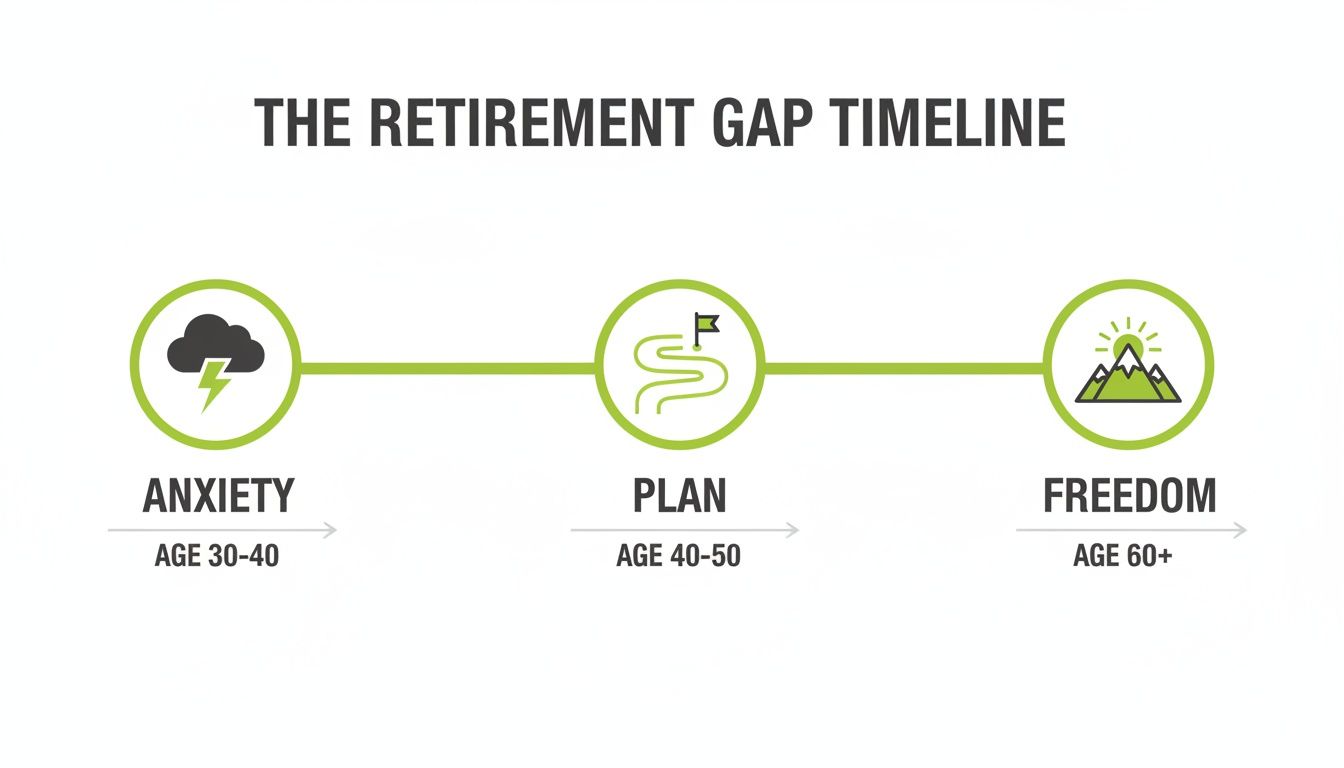
That’s what this is all about. A clear plan is the bridge that takes you from financial stress to genuine freedom.
Charting Your Course with Milestones
Seeing a number like $1.25 million can feel overwhelming, but remember, you don’t have to get there all at once. The key is to break that huge goal down into smaller, age-based milestones. Think of them as checkpoints on your long-term journey, making the whole process feel much more achievable.
You can even take it a step further by creating dedicated savings buckets for specific future expenses, like a big trip you want to take at 70 or a new car you’ll need. To get the hang of this strategy, check out our guide on what is a sinking fund and see how it can help you prepare for big purchases.
To give you a clearer picture, here are some widely accepted benchmarks to aim for at different stages of your career.
Retirement Savings Milestones by Age
This table provides general savings goals as a multiple of your annual salary at different life stages, helping you gauge if you are on track for retirement.
| Age | Savings Goal (Multiple of Annual Salary) |
|---|---|
| 30 | 1x your annual salary |
| 40 | 3x your annual salary |
| 50 | 6x your annual salary |
| 60 | 8x your annual salary |
| 67 | 10x your annual salary |
If you look at this chart and feel like you’re behind, don’t panic. Seriously. The absolute most important thing you can do is start right now. Every single dollar you invest today is a powerful step toward the future you’ve just envisioned.
Choosing Your Retirement Savings Tools

Once you’ve got a target number in mind for retirement, it’s time to pick the right tools to get you there. Think of retirement accounts as special containers designed to help your money grow, supercharged by some pretty amazing tax advantages. Honestly, learning to use them correctly is one of the most powerful moves you can make on your journey to financial freedom.
The world of retirement savings can feel a little intimidating, with acronyms like 401(k) and IRA tossed around. But I promise, the basics are much simpler than they seem. These accounts are the workhorses of your savings plan, and choosing the right ones will dramatically speed up your progress.
The Power of the 401(k) and Employer Match
If your job offers a 401(k) plan, this is almost always the best place to start. A 401(k) is a retirement plan sponsored by your employer that lets you save and invest a piece of your paycheck before taxes are taken out. This lowers your taxable income for the year, which is an immediate win.
But the real magic of a 401(k) is the employer match. This is, quite literally, free money. A very common matching formula is 50% of the first 6% you contribute from your salary. In plain English, if you save 6% of your pay, your employer will chip in an extra 3% on top of it.
Neglecting your employer’s 401(k) match is like turning down a guaranteed 50% or 100% return on your investment from day one. It’s the single best financial deal most people will ever be offered.
Your first, non-negotiable goal should be to contribute at least enough to get every penny of that match. Anything less is leaving part of your salary on the table.
Understanding Individual Retirement Accounts (IRAs)
Beyond what you can do at work, you can also open an Individual Retirement Account, or IRA. These accounts aren’t tied to an employer, which gives you a lot more freedom in how you invest your money. The two main flavors you need to know are the Traditional IRA and the Roth IRA.
- Traditional IRA: Your contributions might be tax-deductible, which means you pay taxes later when you withdraw the money in retirement. This is a great choice if you think you’ll be in a lower tax bracket when you retire than you are today.
- Roth IRA: You contribute with after-tax dollars, so you don’t get an upfront tax break. The massive advantage here is that your qualified withdrawals in retirement are completely tax-free. A Roth is perfect if you expect to be in a higher tax bracket later in life.
Deciding between a Traditional and a Roth often comes down to a calculated guess about your future income and tax rates. Many savvy savers actually have both to create some tax diversification for their retirement years. To see how these accounts fit into the big picture, it’s worth understanding the difference between saving and investing and the unique role each one plays.
Comparing Your Main Retirement Account Options
With a few solid options on the table, seeing them side-by-side can make your decision much clearer. Each account has its own rules for how much you can contribute, how your money is taxed, and when you can take it out.
The table below breaks down the key features of the most popular retirement accounts to help you decide where to put your hard-earned money.
Comparing Key Retirement Accounts
| Feature | 401(k) | Traditional IRA | Roth IRA |
|---|---|---|---|
| How it’s funded | Payroll deductions from your employer | Contributions you make directly | Contributions you make directly |
| Contribution Limit (2025) | $23,000 (plus $7,500 catch-up if 50+) | $7,000 (plus $1,000 catch-up if 50+) | $7,000 (plus $1,000 catch-up if 50+) |
| Tax Treatment (Contributions) | Pre-tax (lowers your current taxable income) | May be tax-deductible | After-tax (no upfront tax break) |
| Tax Treatment (Withdrawals) | Taxed as ordinary income in retirement | Taxed as ordinary income in retirement | Tax-free in retirement (qualified) |
| Employer Match | Often available (a major benefit) | Not available | Not available |
| Investment Options | Limited to the plan’s specific fund lineup | Nearly unlimited (stocks, bonds, ETFs, etc.) | Nearly unlimited (stocks, bonds, ETFs, etc.) |
So, what’s your next move? Start with your 401(k) to grab that free match. After that, consider opening an IRA to save even more. The right combination depends on your income, goals, and what you think your financial future looks like.
Just remember that consistent saving in these accounts makes a huge difference. While the average 401(k) balance in 2025 is $134,128, that number jumps to $239,900 for savers in their 60s, showing what years of steady contributions can do.
Make Your Money Work for You Through Investing

Let’s be clear: stashing cash in a savings account won’t get you to a comfortable retirement. Thanks to inflation, the money you save today will have less buying power tomorrow. To build real wealth, your savings need to do more than just sit there—they need to grow. That’s what investing is all about.
If the word “investing” makes you think of complex charts and high-stakes stock picking, take a deep breath. A powerful and effective retirement strategy is built on consistency, not complexity.
The single best thing you can do is put the whole process on autopilot. By setting up automatic contributions from your paycheck straight into your retirement account, you build a system that works without you even thinking about it. This “set it and forget it” approach is the secret weapon for long-term success because it removes emotion and second-guessing from the equation.
Keep Your Investments Simple and Powerful
You don’t need a finance degree to be a smart investor. For most of us, the best path is to use low-cost, diversified funds—the kind you’ll find in nearly any 401(k) or IRA.
The two main players you’ll run into are index funds and exchange-traded funds (ETFs). Think of them like baskets holding tiny pieces of hundreds, or even thousands, of different companies. Instead of gambling on a single company’s success, you’re spreading your money across a massive slice of the economy.
This strategy, called diversification, is your number one defense against risk. If one company hits a rough patch, its impact on your overall portfolio is minimal because so many others are likely doing just fine.
- Index Funds: These funds simply aim to match the performance of a market index, like the S&P 500 (which tracks 500 of the biggest U.S. companies). They are an incredibly simple and effective way to own a piece of the entire market.
- ETFs: Very similar to index funds, ETFs also track an index and provide instant diversification. The main difference is they trade on an exchange like a stock, so their price can change throughout the day.
The goal here isn’t to outsmart the market. It’s to participate in the long-term growth of the economy using these simple, proven tools.
The Real Magic? Compound Interest
Automation gets the money into your account, but compound interest is what makes it explode over time. It’s the process of earning returns not just on your original investment, but on the returns you’ve already made. It’s a snowball effect that turns small, regular contributions into a serious nest egg.
Let’s look at an example. Say you start saving $300 a month when you’re 25. Assuming an average annual return of 8%, that simple habit would grow to over $1 million by the time you turn 65.
“Compound interest is the eighth wonder of the world. He who understands it, earns it; he who doesn’t, pays it.” – Quote often attributed to Albert Einstein
This incredible growth isn’t about making one huge investment. It’s about time and consistency. The earlier you start, the more decades your money has to work for you, creating a growth curve that gets steeper and steeper as you get older.
This is exactly why that “set it and forget it” approach is so powerful. When your contributions are automated, you ensure the snowball keeps rolling downhill, gathering more mass year after year without any extra effort.
Your Automation Action Plan
Getting your automated investing strategy up and running is surprisingly simple. It’s a one-time setup that will pay you back for the rest of your career.
- Log into your 401(k) or IRA account. Head to the section for “contributions” or “automatic investments.”
- Decide how much to contribute. Start with whatever it takes to get your full employer match. From there, work your way toward that 10-15% goal.
- Choose your investments. For most people, a target-date fund or a low-cost S&P 500 index fund is a fantastic, no-fuss starting point.
- Schedule the transfers. Set up the contributions to happen automatically every payday. This is the definition of “paying yourself first.”
Once it’s set, your job is to get out of the way and let the system do its thing. Resist the urge to constantly check your balance or freak out when the market has a bad week. Building wealth for retirement is a marathon, not a sprint, and automation is the key to maintaining a steady pace.
Your Retirement Plan Isn’t Set in Stone
Think of your retirement plan less like a carved-in-stone tablet and more like a living roadmap. You don’t just create it once and stuff it in a drawer. Life is unpredictable, and your plan needs to be flexible enough to handle the twists and turns.
The savers who truly succeed aren’t the ones who stick rigidly to a plan from 20 years ago. They’re the ones who know how to adapt. An annual check-in is a fantastic habit, but certain life events should trigger an immediate review to make sure your strategy still makes sense for your new reality.
Navigating a Job Change
Switching jobs is one of the most common reasons to pull out your retirement roadmap. When you leave a company, you also have to decide what to do with the 401(k) you’ve been contributing to. This is a critical move.
You could just leave the money in your old plan, but that’s rarely the best option. You might be stuck with high fees or a mediocre selection of investments. The two smartest moves you can make are:
- Roll it into your new employer’s 401(k). This keeps things simple by consolidating your retirement money in one place. It’s a clean and easy way to manage your accounts, as long as your new plan has solid, low-cost investment options.
- Roll it over into an Individual Retirement Account (IRA). This is my preferred route for most people. An IRA gives you total control and a nearly endless universe of investment choices, from individual stocks to low-cost index funds. A “direct rollover” is the easiest way to do this without accidentally triggering taxes.
Your old 401(k) is a huge piece of your financial future. Don’t let it become an afterthought. Taking active control during a job change ensures that money keeps working hard for you instead of getting left behind.
When Your Family Grows or Changes
Major life milestones like getting married or having kids will completely reshape your financial world. These are exciting times, but they also bring new responsibilities that require you to adjust your savings plan.
When you get married, you’re not just combining households; you’re merging two financial lives. This is the perfect time to sit down together and map out a shared vision for retirement. You’ll need to update beneficiaries on all your accounts and figure out a joint strategy that takes full advantage of things like who has the better employer match.
Bringing a child into the family introduces a whole new set of priorities, like saving for college. It can be incredibly tempting to hit pause on retirement savings to focus on immediate needs, but try your best to find a balance. Even small, consistent contributions during these busy years have decades to grow. Set up automatic transfers, even if it’s a smaller amount for a while.
Your Income Gets a Boost
Scoring a raise or a big bonus is a fantastic feeling. It’s also a golden opportunity to put your retirement savings on the fast track. The biggest financial trap here is something called “lifestyle creep”—the all-too-common tendency for our spending to rise right along with our income.
The trick is to make a plan for that new money before it even lands in your bank account. Here’s a simple rule of thumb that works wonders: commit to saving 50% of every raise.
For example, if you get a $400 per month raise, immediately bump up your 401(k) or IRA contribution by $200. You still get to enjoy half of your raise now, but you’re also giving your future self a massive leg up without ever feeling the pinch.
Common Questions That Come Up When Saving for Retirement
Even with the best plan laid out, you’re going to have questions. That’s perfectly normal. The path to retirement isn’t always a straight line, and getting clear answers to the questions that pop up can give you the confidence to stay the course.
Let’s dive into some of the most common questions people ask when they start getting serious about their retirement plan. Think of this as your go-to FAQ for overcoming those little roadblocks.
How Much Do I Actually Need to Save?
You’ll often hear financial experts throw out the 10-15% rule—save that much of your pre-tax income. But the truth is, there’s no single magic number. The right amount for you is completely tied to the life you want to live.
A few things really move the needle here:
- Your vision for retirement: Are you picturing quiet years at home, or are you planning to travel the world? A globetrotting lifestyle costs a lot more.
- Your target retirement age: Hanging it up at 60 requires a much bigger nest egg than working until you’re 70.
- Where you’re starting from: If you already have a decent amount saved, you won’t have to save as aggressively as someone starting from scratch.
A great way to get a personalized number is to play around with a retirement calculator. But if that 15% target feels totally impossible right now, don’t sweat it. Just start by contributing enough to your 401(k) to get your full employer match. From there, try to bump up your savings rate by 1% every year. The most important thing is simply to get started and let compounding do its thing.
Should I Pay Off Debt or Save for Retirement First?
This is the classic money dilemma, isn’t it? The best strategy is almost always a hybrid approach, not an all-or-nothing decision. It all comes down to where your money will work hardest for you.
Here’s a simple order of operations I’ve seen work for countless people:
- Get the 401(k) Match: Before you do anything else, contribute enough to get your full employer match. This is free money—an instant 50% or 100% return. You won’t beat that anywhere else.
- Wipe Out High-Interest Debt: Once the match is secured, turn your attention to high-interest debt like credit cards. With interest rates often pushing past 20%, the interest you’re paying is a guaranteed loss that will almost certainly outpace any investment gains.
- Do Both at the Same Time: For lower-interest debt, like a mortgage or federal student loans, you can usually afford to tackle both at once. The potential long-term growth of your investments often has a good chance of outpacing the interest you’re paying on that debt.
And remember, all of this is built on the foundation of an emergency fund. Having that cash buffer keeps you from having to whip out a credit card when your car breaks down, which protects both your debt-payoff plan and your retirement savings.
Is It Too Late for Me to Start in My 40s or 50s?
Not a chance. While starting earlier is always ideal, it is never, ever too late to build a more secure future. The trick is to be deliberate and act now.
If you’re getting a later start, you’ll just need a more aggressive game plan. But you have advantages, too. Your income is likely at its peak, and the IRS actually gives you a leg up.
A lot of people think the game is over if they haven’t started saving by 40. The reality is, the single most powerful time to start is right now. Decisive action today can still pave the way for a comfortable retirement.
Anyone aged 50 and over can make what are called “catch-up contributions.” This lets you sock away more money in your retirement accounts than younger folks. For 2025, that means an extra $7,500 in your 401(k) and another $1,000 in your IRA. You absolutely want to take full advantage of this.
You’ll probably need to aim for a higher savings rate—maybe 20% or even more. That might mean making some lifestyle cuts or finding ways to boost your income. You might also consider working a few years longer than you’d originally planned. It’s all about creating a focused plan and getting the ball rolling immediately.
At Collapsed Wallet, our mission is to provide you with the clear, actionable guidance you need to build a stronger financial future. To continue your journey, explore our other resources and take control of your money today. Find more practical tips and in-depth guides at https://collapsedwallet.com.
