

Table of Contents
This blog post may contain affiliate links. As an Amazon Associate I earn from qualifying purchases.
Ever found yourself scrambling for cash when a big, predictable expense pops up? That annual car insurance bill, the holidays, or a planned vacation? A sinking fund is your secret weapon to handle these without breaking a sweat. It’s a powerful strategy for achieving financial freedom and escaping the worry that comes with unexpected bills.
The aim of our blog is to provide valuable insights and practical tips to help readers manage their money more effectively. However, the information shared here is for general guidance and educational purposes only. It should not be regarded as professional financial advice. Any actions taken based on our content are entirely the responsibility of the reader, and we accept no liability for the outcomes of those actions. If you require financial advice tailored to your personal circumstances, we strongly recommend seeking assistance from a qualified financial adviser.
Think of it as a dedicated savings pot you build for a specific, known future expense. Instead of letting these costs catch you off guard and force you into debt, you strategically set aside money each month. It's simple, powerful, and guarantees the cash is ready and waiting when you need it.
What Exactly Is A Sinking Fund?
A sinking fund is one of the most effective ways to take control of your money. It’s a method for turning a big, intimidating future expense into small, manageable monthly contributions. This removes the stress and guesswork from your budget and is a cornerstone of solid money management skills.
Here's a quick thought experiment: You know your car insurance is due every March. You also know Christmas happens every December. Instead of treating these like financial emergencies, a sinking fund lets you prepare for them months in advance. It’s a deliberate plan that stops you from raiding your actual emergency fund or swiping a credit card for costs you knew were coming all along.
A Strategy With a Long History
Interestingly, this isn't some new-fangled financial hack. The concept actually dates back to 18th-century Britain, where it was first used as a public finance tool to systematically pay down the national debt. In 1716, the government created a fund to use surplus tax revenue for debt reduction, bringing stability by allocating dedicated sums each year.
Sinking Fund Key Characteristics
To really grasp how a sinking fund works, it helps to break down its core features. This table summarizes what makes this savings method so effective for hitting your financial goals.
| Characteristic | Description | Example |
|---|---|---|
| Goal-Specific | Each fund has one clear purpose. | A fund for a down payment, a new laptop, or a vacation. |
| Time-Bound | It has a definite end date. | Saving for a wedding in 18 months. |
| Predictable | It's for expenses you know are coming. | Annual property taxes or holiday gifts. |
These defining features are what separate a sinking fund from other types of savings, like an emergency fund, and make it such a practical tool for personal finance.
Sinking Fund vs. Emergency Fund: Know the Difference
It's one of the most common mix-ups in personal finance: the sinking fund versus the emergency fund. They both involve saving money, sure, but they play completely different roles in your financial playbook. Getting this distinction right is the key to building a plan that can weather both expected bumps and genuine storms.
An emergency fund is your financial firefighter. It's the cash you have on standby for true, out-of-the-blue crises—a sudden job loss, a trip to the ER, or a tree falling on your roof.
A sinking fund, on the other hand, is for expenses you can see coming from a mile away. It's a savings strategy for a specific, predictable goal.
The Real Difference Is Predictability
At its core, the difference is all about purpose. Your emergency fund is purely reactive, a buffer for the financial shocks you can't possibly plan for. It's your safety net. If you're just starting, check out this guide on how to build an emergency fund to get that crucial foundation in place.
Sinking funds are the exact opposite—they're proactive. You use them for costs that are definite but don't fit into your regular monthly spending.
Here’s a simple way to think about it:
- Emergency Fund: For life’s “Oh no!” moments.
- Sinking Fund: For life’s “It’s time for…” moments.
A sinking fund transforms a future budget-buster into a simple, planned expense. By saving a little at a time, you sidestep the stress and avoid raiding your actual emergency savings for something that wasn't an emergency to begin with.
Key Differences at a Glance
Let's break down the fundamentals side-by-side to make it crystal clear.
Sinking Fund vs Emergency Fund: A Clear Comparison
This table highlights the fundamental differences between sinking funds and emergency funds to guide proper financial planning.
| Feature | Sinking Fund | Emergency Fund |
|---|---|---|
| Purpose | To save for a specific, predictable future expense (e.g., new car, vacation). | To cover unexpected, urgent life events (e.g., job loss, medical crisis). |
| Timeline | Has a fixed, known deadline. You know when you'll need the money. | Has an unknown timeline. You have no idea when you'll need it. |
| Target Amount | A specific, calculated amount based on the cost of the goal. | A general amount, typically 3-6 months of living expenses. |
| Withdrawal Frequency | Money is withdrawn once the savings goal is met and the expense occurs. | Funds are withdrawn rarely, only for true emergencies. |
In short, each fund has a unique job. One is for planning ahead, and the other is for protecting yourself from the unknown.
This infographic does a great job of showing how a sinking fund puts you in the driver's seat for those big, planned purchases.
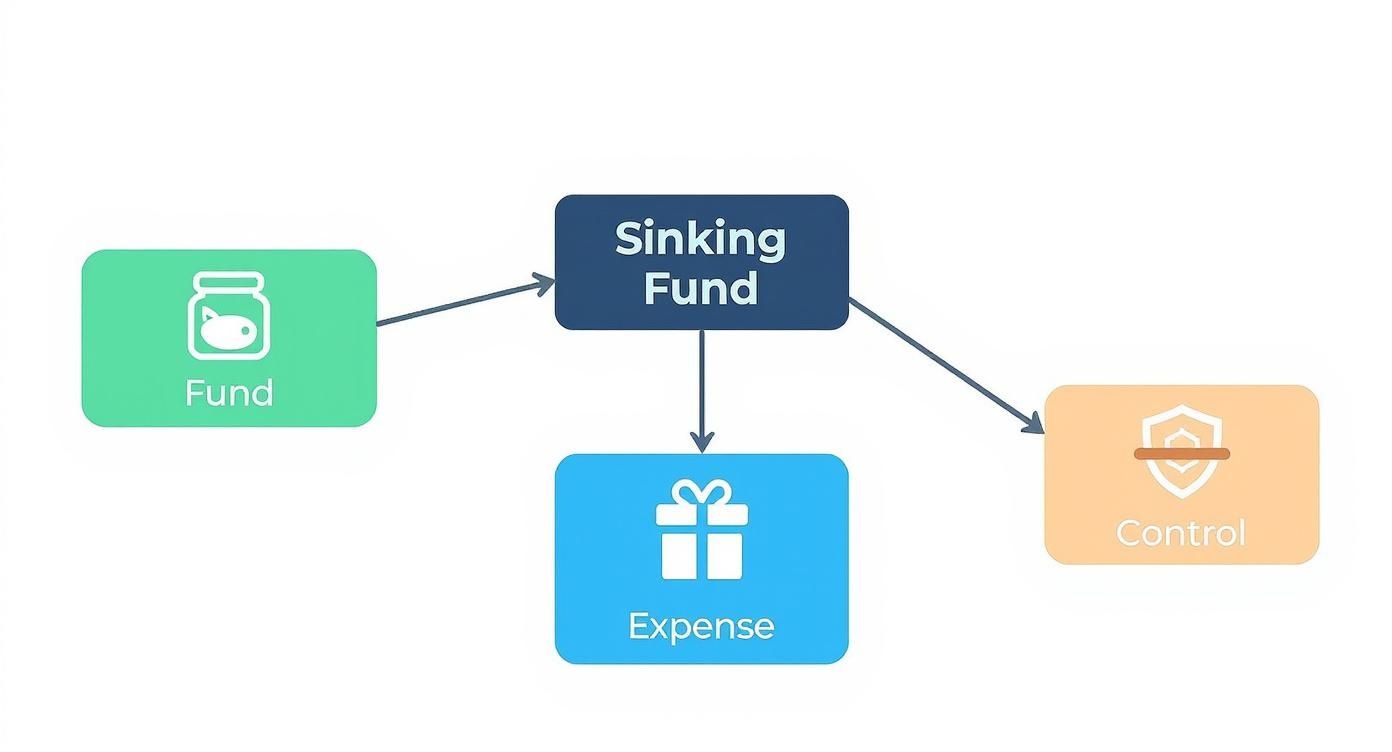
Ultimately, mastering both funds is what creates true financial resilience. Your sinking funds handle the planned stuff without creating debt or drama, while your emergency fund stands guard, untouched and ready for a real crisis.
Real-World Sinking Fund Goals You Can Start Today
This is where the idea of a sinking fund really comes to life. You stop just reacting to big expenses and start planning for them, which completely changes the game. It’s all about taking those scary, intimidating costs and breaking them down into small, easy-to-handle savings goals.
It's a simple concept, but it's powerful. In fact, it’s not just a personal finance trick; it has a long history in national economics. Way back in 1790, the very first U.S. Congress created a Sinking Fund Commission to tackle the nation's Revolutionary War debt. It was a clear, structured plan to pay off a massive expense over time—the same principle you can apply to your own goals. If you're curious, you can explore the historical context of these early federal financial mechanisms to see just how deep these roots go.

Common Sinking Fund Categories
So, how do you put this into practice? Start by thinking about the predictable, non-monthly expenses that pop up in your life. Most people have great success by picking a few key areas where a sinking fund can make an immediate difference.
Here are some of the most popular and practical goals to get you started:
- Vehicle Costs: We all know the car will need new tires eventually. Or that the annual service is coming up. Instead of letting it be a surprise, you can build a fund for these costs, or even for a down payment on your next car.
- Homeownership Expenses: For homeowners, this is a lifesaver. You can prepare for things like annual property taxes, HVAC servicing, or save up for bigger projects like replacing the roof in five years.
- Personal Goals and Celebrations: This is the fun stuff! Think of a dream vacation, a wedding, or just getting through the holiday season without a credit card hangover.
- Life Events and Education: Are you planning for a new baby, saving for university tuition, or thinking about taking a course to advance your career? A sinking fund is the perfect tool.
- Annual Subscriptions: Don't get caught off guard by that yearly software renewal or gym membership fee. Just take the total cost, divide it by 12, and tuck that small amount away each month.
When you create a dedicated sinking fund for each of these goals, you transform a future financial shock into a manageable, planned-for event. It's a huge step toward taking control of your money and leaving financial stress behind.
How to Calculate and Set Up Your First Sinking Fund
Alright, let's turn this idea into a reality. Setting up your first sinking fund is refreshingly simple and gives you a powerful sense of control over your money. It all comes down to a clear, three-part process.
First, you need a specific goal with a target amount. Next, you decide on a realistic deadline for when you'll need the cash. And finally, you figure out how much to put aside each month. That's it—no complicated formulas, just a clear path from A to B.
A Simple Calculation for Your Goal
Let's use a real-world example. Say you're dreaming of a big family holiday next year and you know it’s going to cost around £2,400.
The maths is incredibly straightforward:
Total Goal Amount ÷ Number of Months to Save = Your Monthly Contribution
So, for the holiday fund, it would look like this:
£2,400 ÷ 12 months = £200 per month
And just like that, you’ve broken down a massive, stressful expense into a completely manageable monthly habit. This same simple logic works for anything, whether you’re saving for a new laptop in six months or getting ahead of your annual car insurance payment.
The real magic of a sinking fund is its simplicity. It transforms a big, future financial hit into a series of small, consistent steps, which makes hitting your goals feel almost effortless.
Where Should You Keep Your Sinking Fund?
Once you have your monthly number, the next question is where to put the money. The key here is to keep it separate from your everyday current account. If it’s mixed in with your spending money, it's far too easy to dip into it by accident.
Here are a couple of great options:
- A High-Yield Savings Account (HYSA): This is usually the best bet. Your money is kept safe and is easy to get to, plus it earns a little bit of interest while it’s sitting there.
- Dedicated Savings Pots: Many digital banks now let you create separate "pots" or "spaces" within your main account. This is a brilliant way to keep track of multiple sinking funds at once without the hassle of opening several different accounts.
Giving your savings a dedicated home creates a psychological barrier that protects the money and keeps you focused on the finish line.
Putting Your Savings on Autopilot with Financial Tech

Here’s a secret: the most successful savers don’t rely on willpower. Willpower is fleeting, but a good system runs on its own. The real key to building your sinking funds consistently is to make the process completely effortless, and modern tech is your best friend here.
The single most effective thing you can do is set up an automatic, recurring transfer from your checking account to your savings account. Seriously, do it right now.
Schedule that transfer for the day after your paycheck hits. This is the classic "pay yourself first" method, and it works because it treats your savings like any other bill. The money is whisked away before you even have a chance to miss it, turning saving from a monthly maybe into an automatic win.
Make the Most of Banking and Budgeting Apps
We're way past the days of stuffing cash into physical envelopes. Today's digital banks and budgeting apps are built for this exact strategy.
Tools like Monzo, Starling Bank, or even the powerful YNAB (You Need A Budget) let you create virtual "Pots" or "Goals." Think of them as digital envelopes. You can create one for "Christmas 2024," another for "Car Maintenance," and a third for "Summer Vacation." It’s an incredibly visual and motivating way to see each specific goal grow.
This isn’t just a clever trick for personal budgeting, by the way. The same logic applies in the high-stakes world of corporate finance, where sinking funds are used to responsibly pay down large debts over time. Companies set money aside methodically to ensure they can meet their obligations, which makes them less risky and more appealing to investors. If you're curious, you can learn more about how sinking funds work in corporate finance on Britannica.
Setting up these systems—automating your transfers and using apps to track your goals—removes the friction from saving. It keeps you organized, motivated, and on a clear path to hitting every single one of your financial targets.
Frequently Asked Questions About Sinking Funds
When you’re getting started with sinking funds, a few questions tend to pop up. Let’s walk through the most common ones so you can feel confident—and stay on track—without overthinking it.
How Many Sinking Funds Should I Have?
There’s no one-size-fits-all answer. A smart place to begin is with 1-3 funds for your biggest upcoming expenses, like:
- Routine car maintenance
- A holiday getaway
- Holiday gifts in December
Starting small keeps things simple. Once you’ve nailed those, you can open additional pots for other goals. Many online banks offer “savings pots” or “spaces” that let you juggle multiple funds in a single account—no need to open separate accounts for every goal.
What Happens If I Miss a Monthly Contribution?
Don’t beat yourself up—sinking funds are about steady progress, not perfection. If you miss a payment, try these steps:
- Review your budget to see where you can chip in a bit extra next month.
- Adjust your timeline: extend your target date and lower your regular contribution.
- Revisit your goal amount if your priorities have shifted.
A sinking fund is not a rigid contract; it’s a flexible plan. The key is to adapt it to fit your life, not to abandon it when things don’t go perfectly.
Where Is The Best Place To Keep My Sinking Fund Money?
Ideally, stash these savings in a separate, high-yield savings account (HYSA). This setup does two things:
- Creates a mental barrier between this money and your everyday spending.
- Lets your cash earn a little interest while you’re building up to your goal.
Resist the urge to invest sinking fund dollars—market volatility can derail your plans if you need the money on a fixed schedule.
Can I Use A Sinking Fund For Something Vague?
Absolutely. While a specific target like “new laptop” is easy to plan, broader categories work just as well. For example:
- Home Maintenance—a pot for your annual boiler service or a leaky roof repair
- Car Repairs—covering brake pads, tires, or that surprise check-engine light
These general funds prevent predictable-but-unpleasant costs from eating into your emergency stash.
At Collapsed Wallet, we believe simple, well-explained tools like sinking funds can transform your financial confidence. Our blog is packed with jargon-free guides that walk you through every step. Explore more practical tips and take control of your finances today at Collapsed Wallet.

4 thoughts on “What Is a Sinking Fund and How Does It Work?”